


Page 37 - Cardiac Nursing
P. 37
92806_c01.qxd  11/21/11  10:30 AM  Page 13


                                                                          CHAPTER 1 / Cardiac Anatomy and Physiology   13

                                                                         Parasympathetic preganglionic cardiac nerves arise from the right
                                                                         and left vagus nerves and synapse with postganglionic nerves close
                                                                         to their target cardiac cells.
                                                                           Both vagal and sympathetic cardiac nerves converge in the car-
                                                                         diac plexus. The cardiac plexus is situated superior to the bifurca-
                                                                         tion of the pulmonary artery, behind the aortic arch, and anterior
                                                                         to the trachea at the level of tracheal bifurcation. From the cardiac
                                                                         plexus, the cardiac nerves course in two coronary plexuses along
                                                                         with the right and left coronary blood vessels.
                                                                           Sympathetic fibers are richly distributed throughout the heart.
                                                                         Right sympathetic ganglia fibers most commonly innervate the si-
                                                                         nus node, the right atrium, the anterior ventricular walls, and to
                                                                         some extent the AV node. Most commonly, left sympathetic gan-
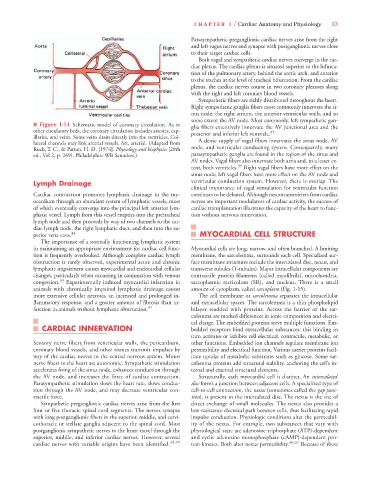
                     ■ Figure 1-14 Schematic model of coronary circulation. As in  glia fibers extensively innervate the AV junctional area and the
                     other circulatory beds, the coronary circulation includes arteries, cap-  posterior and inferior left ventricle. 35
                     illaries, and veins. Some veins drain directly into the ventricles. Col-
                     lateral channels may link arterial vessels. Art, arterial. (Adapted from  A dense supply of vagal fibers innervates the sinus node, AV
                     Ruch, T. C., & Patton, H. D. [1974]. Physiology and biophysics [20th  node, and ventricular conducting system. Consequently, many
                     ed., Vol 2, p. 249]. Philadelphia: WB Saunders.)    parasympathetic ganglia are found in the region of the sinus and
                                                                         AV nodes. Vagal fibers also innervate both atria and, to a lesser ex-
                                                                         tent, both ventricles. 35  Right vagal fibers have more effect on the
                                                                         sinus node; left vagal fibers have more effect on the AV node and
                     Lymph Drainage                                      ventricular conduction system. However, there is overlap. The
                                                                         clinical importance of vagal stimulation for ventricular function
                     Cardiac contraction promotes lymphatic drainage in the my-  continues to be debated. Although neurotransmitters from cardiac
                     ocardium through an abundant system of lymphatic vessels, most  nerves are important modulators of cardiac activity, the success of
                     of which eventually converge into the principal left anterior lym-  cardiac transplantation illustrates the capacity of the heart to func-
                     phatic vessel. Lymph from this vessel empties into the pretracheal  tion without nervous innervation.
                     lymph node and then proceeds by way of two channels to the car-
                     diac lymph node, the right lymphatic duct, and then into the su-
                     perior vena cava. 34                                  MYOCARDIAL CELL STRUCTURE
                       The importance of a normally functioning lymphatic system
                     in maintaining an appropriate environment for cardiac cell func-  Myocardial cells are long, narrow, and often branched. A limiting
                     tion is frequently overlooked. Although complete cardiac lymph  membrane, the sarcolemma, surrounds each cell. Specialized sur-
                     obstruction is rarely observed, experimental acute and chronic  face membrane structures include the intercalated disc, nexus, and
                     lymphatic impairment causes myocardial and endocardial cellular  transverse tubules (T-tubules). Major intracellular components are
                     changes, particularly when occurring in conjunction with venous  contractile protein filaments (called myofibrils), mitochondria,
                     congestion. 34  Experimentally induced myocardial infarction in  sarcoplasmic recticulum (SR), and nucleus. There is a small
                     animals with chronically impaired lymphatic drainage causes  amount of cytoplasm, called sarcoplasm (Fig. 1-15).
                     more extensive cellular necrosis, an increased and prolonged in-  The cell membrane or sarcolemma separates the intracellular
                     flammatory response, and a greater amount of fibrosis than in-  and extracellular spaces. The sarcolemma is a thin phospholipid
                     farction in animals without lymphatic obstruction. 34  bilayer studded with proteins. Across the barrier of the sar-
                                                                         colemma are marked differences in ionic composition and electri-
                                                                         cal charge. The embedded proteins serve multiple functions. Em-
                        CARDIAC INNERVATION                              bedded receptors bind extracellular substances; this binding in
                                                                         turn activates or inhibits cell electrical, contractile, metabolic, or
                     Sensory nerve fibers from ventricular walls, the pericardium,  other functions. Embedded ion channels regulate membrane ion
                     coronary blood vessels, and other tissues transmit impulses by  permeability and electrical function. Various carrier proteins facil-
                     way of the cardiac nerves to the central nervous system. Motor  itate uptake of metabolic substrates such as glucose. Some sar-
                     nerve fibers to the heart are autonomic. Sympathetic stimulation  colemma proteins add structural stability, anchoring the cell’s in-
                     accelerates firing of the sinus node, enhances conduction through  ternal and external structural elements.
                     the AV node, and increases the force of cardiac contraction.  Structurally, each myocardial cell is distinct. An intercalated
                     Parasympathetic stimulation slows the heart rate, slows conduc-  disc forms a junction between adjacent cells. A specialized type of
                     tion through the AV node, and may decrease ventricular con-  cell-to-cell connection, the nexus (sometimes called the gap junc-
                     tractile force.                                     tion), is present in the intercalated disc. The nexus is the site of
                        Sympathetic preganglionic cardiac nerves arise from the first  direct exchange of small molecules. The nexus also provides a
                     four or five thoracic spinal cord segments. The nerves synapse  low-resistance electrical path between cells, thus facilitating rapid
                     with long postganglionic fibers in the superior, middle, and cervi-  impulse conduction. Physiologic conditions alter the permeabil-
                     cothoracic or stellate ganglia adjacent to the spinal cord. Most  ity of the nexus. For example, two substances that vary with
                     postganglionic sympathetic nerves to the heart travel through the  physiological state are adenosine triphosphate (ATP)-dependent
                     superior, middle, and inferior cardiac nerves. However, several  and cyclic adenosine monophosphate (cAMP)-dependent pro-
                     cardiac nerves with variable origins have been identified. 33,35  tein kinases. Both alter nexus permeability. 36,37  Because of these

