


Page 35 - Cardiac Nursing
P. 35
92806_c01.qxd  11/21/11  10:30 AM  Page 11


                                                                          CHAPTER 1 / Cardiac Anatomy and Physiology   11


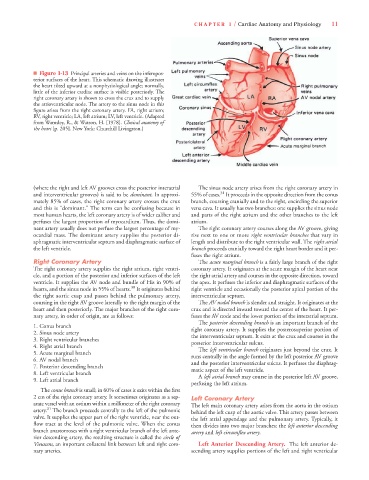
                     ■ Figure 1-13 Principal arteries and veins on the inferopos-
                     terior surfaces of the heart. This schematic drawing illustrates
                     the heart tilted upward at a nonphysiological angle; normally,
                     little of the inferior cardiac surface is visible posteriorly. The
                     right coronary artery is shown to cross the crux and to supply
                     the atrioventricular node. The artery to the sinus node in this
                     figure arises from the right coronary artery. FA, right atrium;
                     RV, right ventricle; LA, left atrium; LV, left ventricle. (Adapted
                     from Wamsley, R., & Watson, H. [1978]. Clinical anatomy of
                     the heart [p. 205]. New York: Churchill Livingston.)


                     (where the right and left AV grooves cross the posterior interatrial  The sinus node artery arises from the right coronary artery in
                                                                                  31
                     and interventricular grooves) is said to be dominant. In approxi-  55% of cases. It proceeds in the opposite direction from the conus
                     mately 85% of cases, the right coronary artery crosses the crux  branch, coursing cranially and to the right, encircling the superior
                     and this is “dominant.” The term can be confusing because in  vena cava. It usually has two branches: one supplies the sinus node
                     most human hearts, the left coronary artery is of wider caliber and  and parts of the right atrium and the other branches to the left
                     perfuses the largest proportion of myocardium. Thus, the domi-  atrium.
                     nant artery usually does not perfuse the largest percentage of my-  The right coronary artery courses along the AV groove, giving
                     ocardial mass. The dominant artery supplies the posterior di-  rise next to one or more right ventricular branches that vary in
                     aphragmatic interventricular septum and diaphragmatic surface of  length and distribute to the right ventricular wall. The right atrial
                     the left ventricle.                                 branch proceeds cranially toward the right heart border and it per-
                                                                         fuses the right atrium.
                     Right Coronary Artery                                 The acute marginal branch is a fairly large branch of the right
                     The right coronary artery supplies the right atrium, right ventri-  coronary artery. It originates at the acute margin of the heart near
                     cle, and a portion of the posterior and inferior surfaces of the left  the right atrial artery and courses in the opposite direction, toward
                     ventricle. It supplies the AV node and bundle of His in 90% of  the apex. It perfuses the inferior and diaphragmatic surfaces of the
                                                     30
                     hearts, and the sinus node in 55% of hearts. It originates behind  right ventricle and occasionally the posterior apical portion of the
                     the right aortic cusp and passes behind the pulmonary artery,  interventricular septum.
                     coursing in the right AV groove laterally to the right margin of the  The AV nodal branch is slender and straight. It originates at the
                     heart and then posteriorly. The major branches of the right coro-  crux and is directed inward toward the center of the heart. It per-
                     nary artery, in order of origin, are as follows:    fuses the AV node and the lower portion of the interatrial septum.
                                                                           The posterior descending branch is an important branch of the
                     1. Conus branch                                     right coronary artery. It supplies the posterosuperior portion of
                     2. Sinus node artery                                the interventricular septum. It exits at the crux and courses in the
                     3. Right ventricular branches                       posterior interventricular sulcus.
                     4. Right atrial branch                                The left ventricular branch originates just beyond the crux. It
                     5. Acute marginal branch                            runs centrally in the angle formed by the left posterior AV groove
                     6. AV nodal branch                                  and the posterior interventricular sulcus. It perfuses the diaphrag-
                     7. Posterior descending branch                      matic aspect of the left ventricle.
                     8. Left ventricular branch                            A left atrial branch may course in the posterior left AV groove,
                     9. Left atrial branch
                                                                         perfusing the left atrium.
                        The conus branch is small; in 60% of cases it exits within the first
                     2 cm of the right coronary artery. It sometimes originates as a sep-  Left Coronary Artery
                     arate vessel with an ostium within a millimeter of the right coronary  The left main coronary artery arises from the aorta in the ostium
                          31
                     artery. The branch proceeds centrally to the left of the pulmonic  behind the left cusp of the aortic valve. This artery passes between
                     valve. It supplies the upper part of the right ventricle, near the out-  the left atrial appendage and the pulmonary artery. Typically, it
                     flow tract at the level of the pulmonic valve. When the conus  then divides into two major branches: the left anterior descending
                     branch anastomoses with a right ventricular branch of the left ante-  artery and left circumflex artery.
                     rior descending artery, the resulting structure is called the circle of
                     Vieussens, an important collateral link between left and right coro-  Left Anterior Descending Artery. The left anterior de-
                     nary arteries.                                      scending artery supplies portions of the left and right ventricular

