


Page 453 - Cardiac Nursing
P. 453
9/0
                               0
                                  9/2
                                        8:2
                                    009
                       0-4
                    p42
                         38.
                           qxd
                         38.
                                                    29
                                                  e 4
                                                    29
                                                         ara
                                                       Apt
                                             M
                                           7 A
                                               P
                                                 g
                                               P
         LWBK340-c19_19_p420-438.qxd  09/09/2009  08:27 AM  Page 429 Aptara
         L L LWB
         LWB K34 0-c 19_ p42 0-4 38. qxd  0 9/0 9/2 009  0 0 8:2 7 A M  P a a g e 4 29  Apt ara
            K34
            K34
               0-c
                 19_
                                                                                   C HAPTER 1 9 / Exercise Testing  429
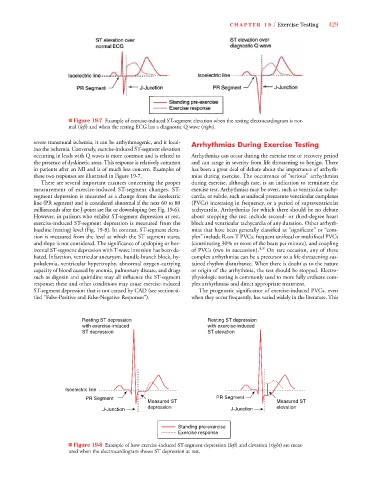
                              ■ Figure 19-7 Example of exercise-induced ST-segment elevation when the resting electrocardiogram is nor-
                              mal (left) and when the resting ECG has a diagnostic Q wave (right).
                                                                             t
                                    t
                                    t
                                                                             t
                   severe transmural ischemia, it can be arrhythmogenic, and it local-  Arrhythmias During Exercise Testing
                   izes the ischemia. Conversely, exercise-induced ST-segment elevation
                   occurring in leads with Q waves is more common and is related to  Arrhythmias can occur during the exercise test or recovery period
                   the presence of dyskinetic areas. This response is relatively common  and can range in severity from life threatening to benign. There
                   in patients after an MI and is of much less concern. Examples of  has been a great deal of debate about the importance of arrhyth-
                   these two responses are illustrated in Figure 19-7.  mias during exercise. The occurrence of “serious” arrhythmias
                     There are several important nuances concerning the proper  during exercise, although rare, is an indication to terminate the
                   measurement of exercise-induced ST-segment changes. ST-  exercise test. Arrhythmias may be overt, such as ventricular tachy-
                   segment depression is measured as a change from the isoelectric  cardia, or subtle, such as unifocal premature ventricular complexes
                   line (PR segment) and is considered abnormal if the next 60 to 80  (PVCs) increasing in frequency, or a period of supraventricular
                   milliseconds after the J-point are flat or downsloping (see Fig. 19-6).  tachycardia. Arrhythmias for which there should be no debate
                   However, in patients who exhibit ST-segment depression at rest,  about stopping the test include second- or third-degree heart
                   exercise-induced ST-segment depression is measured from the  block and ventricular tachycardia of any duration. Other arrhyth-
                   baseline (resting) level (Fig. 19-8). In contrast, ST-segment eleva-  mias that have been generally classified as “significant” or “com-
                   tion is measured from the level at which the ST segment starts,  plex” include R-on-T PVCs, frequent unifocal or multifocal PVCs
                   and slope is not considered. The significance of upsloping or hor-  (constituting 30% or more of the beats per minute), and coupling
                   izontal ST-segment depression with T-wave inversion has been de-  of PVCs (two in succession). 4,8  On rare occasion, any of these
                   bated. Infarction, ventricular aneurysm, bundle-branch block, hy-  complex arrhythmias can be a precursor to a life-threatening sus-
                   pokalemia, ventricular hypertrophy, abnormal oxygen-carrying  tained rhythm disturbance. When there is doubt as to the nature
                   capacity of blood caused by anemia, pulmonary disease, and drugs  or origin of the arrhythmia, the test should be stopped. Electro-
                   such as digoxin and quinidine may all influence the ST-segment  physiologic testing is commonly used to more fully evaluate com-
                   response; these and other conditions may cause exercise-induced  plex arrhythmias and direct appropriate treatment.
                   ST-segment depression that is not caused by CAD (see section ti-  The prognostic significance of exercise-induced PVCs, even
                   tled “False-Positive and False-Negative Responses”).  when they occur frequently, has varied widely in the literature. This


                                   Resting ST depression                    Resting ST depression
                                   with exercise-induced                    with exercise-induced
                                   ST depression                            ST elevation


                             Isoelectric line
                                    PR Segment                                 PR Segment
                                                        Measured ST                               Measured ST
                                                        depression                                elevation
                                          J-Junction                               J-Junction

                                                                  Standing pre-exercise
                                                                  Exercise response

                                                                                                   t
                                                                                                   t
                              ■ Figure 19-8 Example of how exercise-induced ST-segment depression (left) and elevation (t t  right) are meas-
                              ured when the electrocardiogram shows ST depression at rest.

