


Page 50 - Cardiac Nursing
P. 50
92806_c01.qxd  11/21/11  10:30 AM  Page 26


                     26   PA R T  I / Anatomy and Physiology

                     delayed, and conduction is decreased. Arrhythmias may occur  node normally initiates the electrical impulse that is then con-
                     during cooling, which is clinically relevant for the cardiac surgical  ducted to other areas of the myocardium, depolarizing other cells
                     patient who has been subjected to hypothermia and for the pa-  of the conducting system before those cells have time to sponta-
                     tient experiencing hypothermia caused by exposure.  neously depolarize to threshold. The electrical impulse appears to
                       Stretching cardiac fibers increases the rate of diastolic depolar-  spread outward in relatively concentric circles from the sinus node
                     ization and makes the maximal diastolic potential less negative in  through the atria, moving in approximately 0.1 second from the
                     automatic fibers. Myocardial fiber stretch may cause arrhythmias  upper right atrium to the posterior left atrium. Conduction ve-
                     during heart failure.                              locity (speed with which the impulse spreads) through the atria is
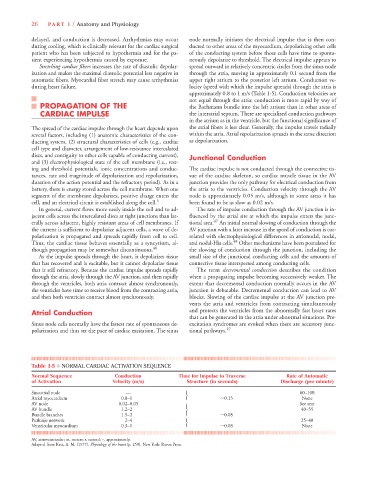
                                                                        approximately 0.8 to 1 m/s (Table 1-5). Conduction velocities are
                                                                        not equal through the atria; conduction is more rapid by way of
                       PROPAGATION OF THE                               the Bachmann bundle into the left atrium than in other areas of
                       CARDIAC IMPULSE                                  the interatrial septum. There are specialized conduction pathways
                                                                        in the atrium as in the ventricle, but the functional significance of
                     The spread of the cardiac impulse through the heart depends upon  the atrial fibers is less clear. Generally, the impulse travels radially
                     several factors, including (1) anatomic characteristics of the con-  within the atria. Atrial repolarization spreads in the same direction
                     ducting system, (2) structural characteristics of cells (e.g., cardiac  as depolarization.
                     cell type and diameter, arrangement of low-resistance intercalated
                     discs, and contiguity to other cells capable of conducting current),  Junctional Conduction
                     and (3) electrophysiological state of the cell membrane (i.e., rest-
                     ing and threshold potentials, ionic concentrations and conduc-  The cardiac impulse is not conducted through the connective tis-
                     tances, rate and magnitude of depolarization and repolarization,  sue of the cardiac skeleton, so cardiac muscle tissue in the AV
                     duration of the action potential and the refractory period). As in a  junction provides the only pathway for electrical conduction from
                     battery, there is energy stored across the cell membrane. When one  the atria to the ventricles. Conduction velocity through the AV
                     segment of the membrane depolarizes, positive charge enters the  node is approximately 0.05 m/s, although in some areas it has
                     cell, and an electrical circuit is established along the cell. 5  been found to be as slow as 0.02 m/s.
                       In general, current flows more easily inside the cell and to ad-  The rate of impulse conduction through the AV junction is in-
                    jacent cells across the intercalated discs at tight junctions than lat-  fluenced by the atrial site at which the impulse enters the junc-
                                                                                47
                    erally across adjacent, highly resistant areas of cell membranes. If  tional area. An initial normal slowing of conduction through the
                    the current is sufficient to depolarize adjacent cells, a wave of de-  AV junction with a later increase in the speed of conduction is cor-
                    polarization is propagated and spreads rapidly from cell to cell.  related with electrophysiological differences in atrionodal, nodal,
                                                                                      48
                    Thus, the cardiac tissue behaves essentially as a syncytium, al-  and nodal-His cells. Other mechanisms have been postulated for
                    though propagation may be somewhat discontinuous. 46  the slowing of conduction through the junction, including the
                       As the impulse spreads through the heart, it depolarizes tissue  small size of the junctional conducting cells and the amounts of
                    that has recovered and is excitable, but it cannot depolarize tissue  connective tissue interspersed among conducting cells.
                    that is still refractory. Because the cardiac impulse spreads rapidly  The term  decremental conduction describes the condition
                    through the atria, slowly through the AV junction, and then rapidly  when a propagating impulse becoming successively weaker. The
                    through the ventricles, both atria contract almost synchronously,  extent that decremental conduction normally occurs in the AV
                    the ventricles have time to receive blood from the contracting atria,  junction is debatable. Decremental conduction can lead to AV
                    and then both ventricles contract almost synchronously.  blocks. Slowing of the cardiac impulse at the AV junction pre-
                                                                        vents the atria and ventricles from contracting simultaneously
                     Atrial Conduction                                  and protects the ventricles from the abnormally fast heart rates
                                                                        that can be generated in the atria under abnormal situations. Pre-
                     Sinus node cells normally have the fastest rate of spontaneous de-  excitation syndromes are evoked when there are accessory junc-
                     polarization and thus set the pace of cardiac excitation. The sinus  tional pathways. 27


                     Table 1-5 ■ NORMAL CARDIAC ACTIVATION SEQUENCE
                     Normal Sequence            Conduction           Time for Impulse to Traverse       Rate of Automatic
                     of Activation             Velocity (m/s)          Structure (in seconds)         Discharge (per minute)
                     Sinoatrial node               —                                                        60–100
                     Atrial myocardium            0.8–1                r           0.15                      None
                    AV node                      0.02–0.05                                                  See text
                    AV bundle                     1.2–2                s                                     40–55
                    Bundle branches               1.5–2                            0.08
                    Purkinje network               2–4                                                       25–40
                                                                       r
                    Ventricular myocardium        0.3–1                            0.08                      None
                     AV, atrioventricular; m, meters; s, second; ~, approximately.
                     Adapted from Katz, A. M. (1977). Physiology of the heart (p. 259). New York: Raven Press.

