


Page 49 - Cardiac Nursing
P. 49
92806_c01.qxd  11/21/11  10:30 AM  Page 25


                                                                          CHAPTER 1 / Cardiac Anatomy and Physiology   25


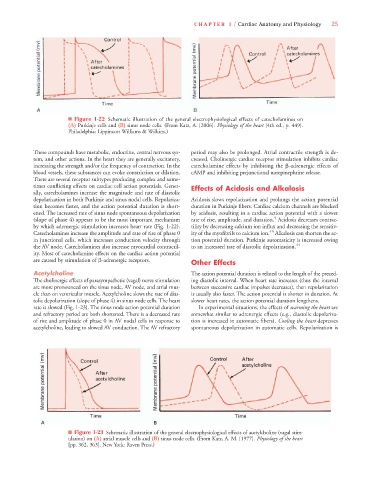
                                 ■ Figure 1-22 Schematic illustration of the general electrophysiological effects of catecholamines on
                                (A) Purkinje cells and (B) sinus node cells. (From Katz, A. [2006]. Physiology of the heart [4th ed., p. 449].
                                Philadelphia: Lippincott Williams & Wilkins.)


                     These compounds have metabolic, endocrine, central nervous sys-  period may also be prolonged. Atrial contractile strength is de-
                     tem, and other actions. In the heart they are generally excitatory,  creased. Cholinergic cardiac receptor stimulation inhibits cardiac
                     increasing the strength and/or the frequency of contraction. In the  catecholamine effects by inhibiting the  -adrenergic effects of
                     blood vessels, these substances can evoke constriction or dilation.  cAMP and inhibiting prejunctional norepinephrine release.
                     There are several receptor subtypes producing complex and some-
                     times conflicting effects on cardiac cell action potentials. Gener-  Effects of Acidosis and Alkalosis
                     ally, catecholamines increase the magnitude and rate of diastolic
                     depolarization in both Purkinje and sinus nodal cells. Repolariza-  Acidosis slows repolarization and prolongs the action potential
                     tion becomes faster, and the action potential duration is short-  duration in Purkinje fibers. Cardiac calcium channels are blocked
                     ened. The increased rate of sinus node spontaneous depolarization  by acidosis, resulting in a cardiac action potential with a slower
                                                                                                    5
                     (slope of phase 4) appears to be the most important mechanism  rate of rise, amplitude, and duration. Acidosis decreases contrac-
                     by which adrenergic stimulation increases heart rate (Fig. 1-22).  tility by decreasing calcium ion influx and decreasing the sensitiv-
                                                                                                  45
                     Catecholamines increase the amplitude and rate of rise of phase 0  ity of the myofibrils to calcium ion. Alkalosis can shorten the ac-
                     in junctional cells, which increases conduction velocity through  tion potential duration. Purkinje automaticity is increased owing
                     the AV node. Catecholamines also increase myocardial contractil-  to an increased rate of diastolic depolarization. 44
                     ity. Most of catecholamine effects on the cardiac action potential
                     are caused by stimulation of  -adrenergic receptors.  Other Effects

                     Acetylcholine                                       The action potential duration is related to the length of the preced-
                     The cholinergic effects of parasympathetic (vagal) nerve stimulation  ing diastolic interval. When heart rate increases (thus the interval
                     are more pronounced on the sinus node, AV node, and atrial mus-  between successive cardiac impulses decreases), then repolarization
                     cle than on ventricular muscle. Acetylcholine slows the rate of dias-  is usually also faster. The action potential is shorter in duration. At
                     tolic depolarization (slope of phase 4) in sinus node cells. The heart  slower heart rates, the action potential duration lengthens.
                     rate is slowed (Fig. 1-23). The sinus node action potential duration  In experimental situations, the effects of warming the heart are
                     and refractory period are both shortened. There is a decreased rate  somewhat similar to adrenergic effects (e.g., diastolic depolariza-
                     of rise and amplitude of phase 0 in AV nodal cells in response to  tion is increased in automatic fibers). Cooling the heart depresses
                     acetylcholine, leading to slowed AV conduction. The AV refractory  spontaneous depolarization in automatic cells. Repolarization is


                                 ■ Figure 1-23 Schematic illustration of the general electrophysiological effects of acetylcholine (vagal stim-
                                 ulation) on (A) atrial muscle cells and (B) sinus node cells. (From Katz, A. M. [1977]. Physiology of the heart
                                [pp. 362, 363]. New York: Raven Press.)

