


Page 471 - Cardiac Nursing
P. 471
9 P
                                     9 P
                                   1:2
                                   1
                                   1:2
                                        M
                                          Pa
                                           g
                                          Pa
                                        M
                                          Pa
                                   1
                             6
                             6
                           xd
                          q
                           xd
                              /29
                                /09
                                    1
                                /09
                              /29
                                /09
                                                   a
                                                   a
                                                  ara
                                                  t
                                                  ara
                                                   a
                                                      c.
                                                      c.
                                                    In
                                                   a
                                                    In
                                                  t
                                            e 4
                                              47
                                            e 4
                                           g
                                           g
                                              47
                                                 p
                                                 p
                                                 p
                                                A
                                                A
                          q
         LWB K34 0-c 20_ p p pp439-459.qxd  6/29/09  11:29 PM  Page 447 Aptara Inc.
         LWB
                    43
                    43
         LWBK340-c20_
                 20_
                 20_
            K34
               0-c
                        59.
                      9-4
                      9-4
                          q
                        59.
                        59.
                                                                             C HAPTER 2 0 / Cardiac Catheterization  447
                           A                                               B B
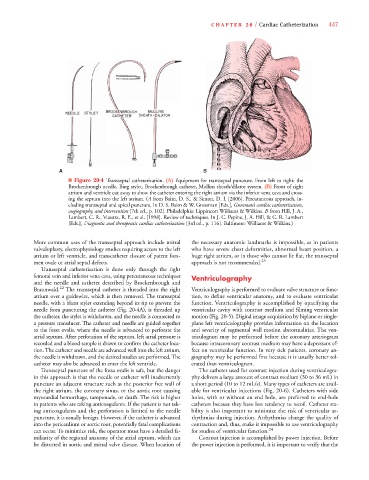
                              ■ Figure 20-4 Transseptal catheterization. (A) Equipment for transseptal puncture. From left to right: the
                              Brockenbrough needle, Bing stylet, Brockenbrough catheter, Mullins sheath/dilator system. (B) Front of right
                              atrium and ventricle cut away to show the catheter entering the right atrium via the inferior vena cava and cross-
                              ing the septum into the left atrium. (A from Baim, D. S., & Simon, D. I. [2006]. Percutaneous approach, in-
                                                        (
                                                        (
                              cluding transseptal and apical puncture. In D. S. Baim & W. Grossman [Eds.], Grossman’s cardiac catheterization,
                              angiography, and intervention [7th ed., p. 102]. Philadelphia: Lippincott Williams & Wilkins. B from Hill, J. A.,
                              Lambert, C. R., Vuestra, R. E., et al. [1998]. Review of techniques. In J. C. Pepine, J. A. Hill, & C. R. Lambert
                              [Eds.], Diagnostic and therapeutic cardiac catheterization [3rd ed., p. 116]. Baltimore: Williams & Wilkins.)
                   More common uses of the transseptal approach include mitral  the necessary anatomic landmarks is impossible, as in patients
                   valvuloplasty, electrophysiology studies requiring access to the left  who have severe chest deformities, abnormal heart position, a
                   atrium or left ventricle, and transcatheter closure of patent fora-  huge right atrium, or in those who cannot lie flat, the transseptal
                   men ovale or atrial septal defects.                 approach is not recommended. 23
                     Transseptal catheterization is done only through the right
                   femoral vein and inferior vena cava, using percutaneous techniques  Ventriculography
                   and the needle and catheter described by Brockenbrough and
                   Braunwald. 22  The transseptal catheter is threaded into the right  Ventriculography is performed to evaluate valve structure or func-
                   atrium over a guidewire, which is then removed. The transseptal  tion, to define ventricular anatomy, and to evaluate ventricular
                   needle, with a blunt stylet extending beyond its tip to prevent the  function. Ventriculography is accomplished by opacifying the
                   needle from puncturing the catheter (Fig. 20-4A), is threaded up  ventricular cavity with contrast medium and filming ventricular
                   the catheter, the stylet is withdrawn, and the needle is connected to  motion (Fig. 20-5). Digital image acquisition by biplane or single-
                   a pressure transducer. The catheter and needle are guided together  plane left ventriculography provides information on the location
                   to the fossa ovalis, where the needle is advanced to perforate the  and severity of segmental wall motion abnormalities. The ven-
                   atrial septum. After perforation of the septum, left atrial pressure is  triculogram may be performed before the coronary arteriogram
                   recorded and a blood sample is drawn to confirm the catheter loca-  because intracoronary contrast medium may have a depressant ef-
                   tion. The catheter and needle are advanced well into the left atrium,  fect on ventricular function. In very sick patients, coronary an-
                   the needle is withdrawn, and the desired studies are performed. The  giography may be performed first because it is usually better tol-
                   catheter may also be advanced to enter the left ventricle.  erated than ventriculogram.
                     Transseptal puncture of the fossa ovalis is safe, but the danger  The catheter used for contrast injection during ventriculogra-
                   in this approach is that the needle or catheter will inadvertently  phy delivers a large amount of contrast medium (30 to 36 mL) in
                   puncture an adjacent structure such as the posterior free wall of  a short period (10 to 12 mL/s). Many types of catheters are avail-
                   the right atrium, the coronary sinus, or the aortic root causing  able for ventricular injections (Fig. 20-6). Catheters with side
                   myocardial hemorrhage, tamponade, or death. The risk is higher  holes, with or without an end hole, are preferred to end-hole
                   in patients who are taking anticoagulants. If the patient is not tak-  catheters because they have less tendency to recoil. Catheter sta-
                   ing anticoagulants and the perforation is limited to the needle  bility is also important to minimize the risk of ventricular ar-
                   puncture, it is usually benign. However, if the catheter is advanced  rhythmias during injection. Arrhythmias change the quality of
                   into the pericardium or aortic root, potentially fatal complications  contraction and, thus, make it impossible to use ventriculography
                   can occur. To minimize risk, the operator must have a detailed fa-  for studies of ventricular function. 24
                   miliarity of the regional anatomy of the atrial septum, which can  Contrast injection is accomplished by power injection. Before
                   be distorted in aortic and mitral valve disease. When location of  the power injection is performed, it is important to verify that the

