


Page 505 - Cardiac Nursing
P. 505
LWBK340-c21_p460-510.qxd  09/09/2009  08:28 AM  Page 481 Aptara


                                                                           C HAP TE R 2 1 / Hemodynamic Monitoring  481


                   Table 21-6 ■ RIGHT HEART FUNCTION VARIABLES         Table 21-7 ■ DIFFERENCES IN CVP AND PAOP BETWEEN
                                                                       FLUID RESPONDERS (R) AND NONRESPONDERS (N)
                   Variable                   Normal
                                                                       Patients           R (mm Hg)  N (mm Hg)      p
                   SV                         60–100 mL/beat
                   Stroke volume index        33–46 mL/beat/m 2        CVP
                   RVEF                       40%–60%                  Critically ill/cardiac 232  5   1  5   2    NS
                   RV end-systolic index      30–60 mL/m 2             Sepsis/septic shock 233  9   3  9   4       NS
                   RVEDVI                     60–100 mL/m 2            Sepsis 175           8   4      9   4       NS
                                                                       PAOP
                                                                       Critically ill/cardiac 232  8   1  7   2    NS
                                                                       Trauma 221           16   6     15   5      NS
                                                                       Septic shock 234     10   4     12   3      NS
                   who performed these steps 33% and 70% of the time, respec-  Postcardiac surgeryy 235  12   2  16   3   .01
                   tively. These studies support that nurses who are educated in the  Sepsis/septic shock 233  10   3  11   2  NS
                   correct procedure for PA catheter removal can do so safely.  Sepsis 175  10   4     11   4      NS

                   Volumetric Measures
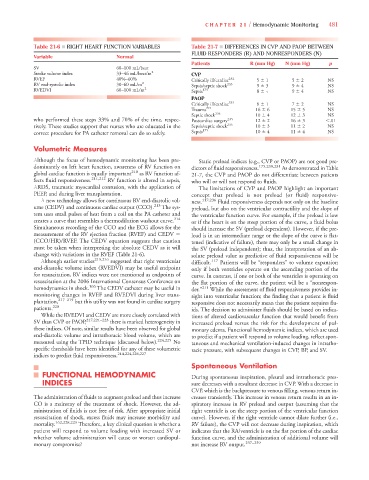
                   Although the focus of hemodynamic monitoring has been pre-  Static preload indices (e.g., CVP or PAOP) are not good pre-
                   dominantly on left heart function, awareness of RV function on  dictors of fluid responsiveness. 175,230,231  As demonstrated in Table
                   global cardiac function is equally important 210  as RV function af-  21-7, the CVP and PAOP do not differentiate between patients
                   fects fluid responsiveness. 211,212  RV function is altered in sepsis,  who will or will not respond to fluids.
                   ARDS, traumatic myocardial contusion, with the application of  The limitations of CVP and PAOP highlight an important
                   PEEP, and during liver transplantation.             concept that preload is not preload (or fluid) responsive-
                     A new technology allows for continuous RV end-diastolic vol-  ness. 117,236  Fluid responsiveness depends not only on the baseline
                   ume (CEDV) and continuous cardiac output (CCO). 213  The sys-  preload, but also on the ventricular contractility and the slope of
                   tem uses small pulses of heat from a coil on the PA catheter and  the ventricular function curve. For example, if the preload is low
                   creates a curve that resembles a thermodilution washout curve. 214  or if the heart is on the steep portion of the curve, a fluid bolus
                   Simultaneous recording of the CCO and the ECG allows for the  should increase the SV (preload dependent). However, if the pre-
                   measurement of the RV ejection fraction (RVEF) and CEDV    load is in an intermediate range or the slope of the curve is flat-
                   (CCO/HR)/RVEF. The CEDV equation suggests that caution  tened (indicative of failure), there may only be a small change in
                   must be taken when interpreting the absolute CEDV as it will  the SV (preload independent); thus, the interpretation of an ab-
                   change with variations in the RVEF (Table 21-6).    solute preload value as predictive of fluid responsiveness will be
                     Although earlier studies 215,216  suggested that right ventricular  difficult. 117  Patients will be “responders” to volume expansion
                   end-diastolic volume index (RVEDVI) may be useful endpoint  only if both ventricles operate on the ascending portion of the
                   for resuscitation, RV indices were not mentioned as endpoints of  curve. In contrast, if one or both of the ventricles is operating on
                   resuscitation at the 2006 International Consensus Conference on  the flat portion of the curve, the patient will be a “nonrespon-
                   hemodynamics in shock. 166  The CEDV catheter may be useful in  der.” 211  While the assessment of fluid responsiveness provides in-
                   monitoring changes in RVEF and RVEDVI during liver trans-  sight into ventricular function; the finding that a patient is fluid
                   plantation, 217–219  but this utility was not found in cardiac surgery  responsive does not necessarily mean that the patient requires flu-
                   patients. 220                                       ids. The decision to administer fluids should be based on indica-
                     While the RVEDVI and CEDV are more closely correlated with  tions of altered cardiovascular function that would benefit from
                   SV than CVP or PAOP , 217,221–223  there is marked heterogeneity in  increased preload versus the risk for the development of pul-
                   these indices. Of note, similar results have been observed for global  monary edema. Functional hemodynamic indices, which are used
                   end-diastolic volume and intrathoracic blood volume, which are  to predict if a patient will respond to volume loading, reflect spon-
                   measured using the TPID technique (discussed below). 224,225  No  taneous and mechanical ventilation-induced changes in intratho-
                   specific thresholds have been identified for any of these volumetric  racic pressure, with subsequent changes in CVP, BP, and SV.
                   indices to predict fluid responsiveness. 214,224,226,227
                                                                       Spontaneous Ventilation
                      FUNCTIONAL HEMODYNAMIC                           During spontaneous inspiration, pleural and intrathoracic pres-
                      INDICES                                          sure decreases with a resultant decrease in CVP. With a decrease in
                                                                       CVP, which is the backpressure to venous filling, venous return in-
                   The administration of fluids to augment preload and thus increase  creases transiently. This increase in venous return results in an in-
                   CO is a mainstay of the treatment of shock. However, the ad-  spiratory increase in RV preload and output (assuming that the
                   ministration of fluids is not free of risk. After appropriate initial  right ventricle is on the steep portion of the ventricular function
                   resuscitation of shock, excess fluids may increase morbidity and  curve). However, if the right ventricle cannot dilate further (i.e.,
                   mortality. 162,228,229  Therefore, a key clinical question is whether a  RV failure), the CVP will not decrease during inspiration, which
                   patient will respond to volume loading with increased SV or  indicates that the RA/ventricle is on the flat portion of the cardiac
                   whether volume administration will cause or worsen cardiopul-  function curve, and the administration of additional volume will
                   monary compromise?                                  not increase RV output. 237–239

