


Page 593 - Cardiac Nursing
P. 593
0/0
                                6/2
                              0/0
                             3
                             3
                                6/2
                                     0
                                      1:4
                                     0
                                  009
                                  009
                        94.
                        94.
                      5-5
                    55
                      5-5
                          q
                           xd
                              3
                           xd
                          q
                          q
                                      1:4
                                                  A
                                                   p
                                                  A
                                                69
                                                69
                                                   p
                                                     ara
                                                     ara
                                                    t
                                                   p
                                                    t
                                          M
                                            Pa
                                          M
                                        3 P
                                        3 P
                                            Pa
                                              e 5
                                              e 5
                                              g
                                              g
                                              g
         LWB K34 0-c 24_ p p pp555-594.qxd  30/06/2009  01:43 PM  Page 569 Aptara
         LWB
            K34
                 24_
               0-c
         LWBK340-c24_
                    55
                                                                   C HAPTER 24 / Heart Failure and Cardiogenic Shock  569
                                Mean BNP levels for normal LV function  20%. 58  Historically, mortality has been linked to NYHA func-
                                      versus LV dysfunction            tional class (i.e., patient’s symptoms); newer algorithms include
                      1500
                                                                       laboratory measures and quantitative data regarding LV status.
                                                                       Clinical factors associated with a lower survival rates include older
                      1200                                             age; hyponatremia, decreased hematocrit; widened QRS; and
                                                                       worsening LVEF, NYHA functional class, peak exercise oxygen
                    BNP pcg/dL  900                                    demonstrated an association between elevated circulating neuro-
                                                                                                      43
                                                                                                        While studies have
                                                                       uptake (V O2 max), and renal function.
                                                                       hormones (BNP, ET, and NE) and outcome, neurohormonal lev-
                       600
                                                                       els are not used commonly in the clinical area to predict survival.
                                                                       Sudden cardiac death (SCD; Chapter 27) remains an ever-present
                                                                       risk. It is estimated that approximately 50% of patients with sys-
                       300
                                                                       tolic dysfunction will die of a sudden tachycardic or bradycardiac
                                                                       rhythm. Predicting SCD in this population has proven difficult;
                         0                                             thus, primary prevention measures, such as implantation of im-
                               Normal   Systolic  Diastolic  Systolic &
                                                 N
                                        N = 53
                              N = 105   N        N = 42  Diastolic     plantable cardioverter defibrillators (ICDs) is indicated in patients
                              N
                                                          N
                                                          N = 14       with LVEF less than 0.35. 59
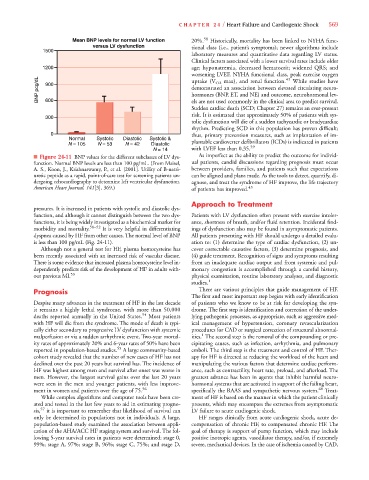
                   ■ Figure 24-11 BNP values for the different subclasses of LV dys-  As imperfect as the ability to predict the outcome for individ-
                   function. Normal BNP levels are less than 100 pg/mL. (From Maisel,  ual patients, candid discussions regarding prognosis must occur
                   A. S., Koon, J., Krishnaswamy, P., et al. [2001]. Utility of B-natri-  between providers, families, and patients such that expectations
                   uretic peptide as a rapid, point-of-care test for screening patients un-  can be aligned and plans made. As the tools to detect, quantify, di-
                   dergoing echocardiography to determine left ventricular dysfunction.  agnose, and treat the syndrome of HF improve, the life trajectory
                   American Heart Journal, 141[3], 369.)               of patients has improved. 43
                                                                       Approach to Treatment
                   pressures. It is increased in patients with systolic and diastolic dys-
                   function, and although it cannot distinguish between the two dys-  Patients with LV dysfunction often present with exercise intoler-
                   functions, it is being widely investigated as a biochemical marker for  ance, shortness of breath, and/or fluid retention. Incidental find-
                   morbidity and mortality. 50–52  It is very helpful in differentiating  ings of dysfunction also may be found in asymptomatic patients.
                   dyspnea caused by HF from other causes. The normal level of BNP  All patients presenting with HF should undergo a detailed evalu-
                   is less than 100 pg/mL (Fig. 24-11).                ation to: (1) determine the type of cardiac dysfunction, (2) un-
                     Although not a general test for HF, plasma homocysteine has  cover correctable causative factors, (3) determine prognosis, and
                   been recently associated with an increased risk of vascular disease.  (4) guide treatment. Recognition of signs and symptoms resulting
                   There is some evidence that increased plasma homocysteine level in-  from an inadequate cardiac output and from systemic and pul-
                   dependently predicts risk of the development of HF in adults with-  monary congestion is accomplished through a careful history,
                   out previous MI. 53                                 physical examination, routine laboratory analyses, and diagnostic
                                                                       studies. 1
                   Prognosis                                             There are various principles that guide management of HF.
                                                                       The first and most important step begins with early identification
                   Despite many advances in the treatment of HF in the last decade  of patients who we know to be at risk for developing the syn-
                   it remains a highly lethal syndrome, with more than 50,000  drome. The first step is identification and correction of the under-
                   deaths reported annually in the United States. 54  Most patients  lying pathogenic processes, as appropriate, such as aggressive med-
                   with HF will die from the syndrome. The mode of death is typi-  ical management of hypertension, coronary revascularization
                   cally either secondary to progressive LV dysfunction with systemic  procedures for CAD or surgical correction of structural abnormal-
                                                                          1
                   malperfusion or via a sudden arrhythmic event. Two-year mortal-  ities. The second step is the removal of the compounding or pre-
                   ity rates of approximately 20% and 6-year rates of 50% have been  cipitating causes, such as infection, arrhythmia, and pulmonary
                   reported in population-based studies. 55  A large community-based  emboli. The third step is the treatment and control of HF. Ther-
                   cohort study revealed that the number of new cases of HF has not  apy for HF is directed at reducing the workload of the heart and
                   declined over the past 20 years but survival has. The incidence of  manipulating the various factors that determine cardiac perform-
                   HF was highest among men and survival after onset was worse in  ance, such as contractility, heart rate, preload, and afterload. The
                   men. However, the largest survival gains over the last 20 years  greatest advance has been in agents that inhibit harmful neuro-
                   were seen in the men and younger patients, with less improve-  hormonal systems that are activated in support of the failing heart,
                   ment in women and patients over the age of 75. 56   specifically the RAAS and sympathetic nervous system. 60  Treat-
                     While complex algorithms and computer tools have been cre-  ment of HF is based on the manner in which the patient clinically
                   ated and tested in the last few years to aid in estimating progno-  presents, which may encompass the extremes from asymptomatic
                   sis, 57  it is important to remember that likelihood of survival can  LV failure to acute cardiogenic shock.
                   only be determined in populations not in individuals. A large,  HF ranges clinically from acute cardiogenic shock, acute de-
                   population-based study examined the association between appli-  compensation of chronic HF, to compensated chronic HF. The
                   cation of the AHA/ACC HF staging system and survival. The fol-  goal of therapy is support of pump function, which may include
                   lowing 5-year survival rates in patients were determined: stage 0,  positive inotropic agents, vasodilator therapy, and/or, if extremely
                   99%; stage A, 97%; stage B, 96%; stage C, 75%; and stage D,  severe, mechanical devices. In the case of ischemia caused by CAD,

