


Page 592 - Cardiac Nursing
P. 592
LWBK340-c24_p555-594.qxd  30/06/2009  01:43 PM  Page 568 Aptara


                  568    PA R T  IV / Pathophysiology and Management of Heart Disease

                                                                      is of particular benefit for specifically assessing ventricular mass,
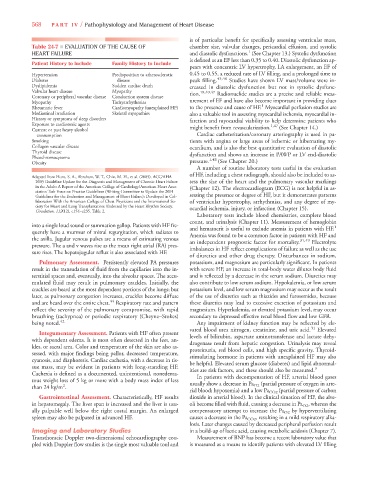
                  Table 24-7 ■ EVALUATION OF THE CAUSE OF             chamber size, valvular changes, pericardial effusion, and systolic
                                                                                         1
                  HEART FAILURE                                       and diastolic dysfunctions. (See Chapter 13.) Systolic dysfunction
                                                                      is defined as an EF less than 0.35 to 0.40. Diastolic dysfunction ap-
                  Patient History to Include  Family History to Include
                                                                      pears with concentric LV hypertrophy, LA enlargement, an EF of
                  Hypertension               Predisposition to atherosclerotic   0.45 to 0.55, a reduced rate of LV filling, and a prolonged time to
                  Diabetes                    disease                 peak filling. 45,46  Studies have shown LV mass/volume were in-
                  Dyslipidemia               Sudden cardiac death     creased in diastolic dysfunction but not in systolic dysfunc-
                  Valvular heart disease     Myopathy                    18,40,47
                  Coronary or peripheral vascular disease  Conduction system disease  tion.  Radionuclide studies are a precise and reliable meas-
                  Myopathy                   Tachyarrhythmias         urement of EF and have also become important in providing clues
                                                                                             1
                  Rheumatic fever            Cardiomyopathy (unexplained HF)  to the presence and cause of HF. Myocardial perfusion studies are
                  Mediastinal irradiation    Skeletal myopathies      also a valuable tool in assessing myocardial ischemia, myocardial in-
                  History or symptoms of sleep disorders              farction and myocardial viability to help determine patients who
                  Exposure to cardiotoxic agents                                                1,47
                  Current or past heavy alcohol                       might benefit from revascularization.  (See Chapter 14.)
                    consumption                                         Cardiac catheterization/coronary arteriography is used in pa-
                  Smoking                                             tients with angina or large areas of ischemic or hibernating my-
                  Collagen vascular disease                           ocardium, and is also the best quantitative evaluation of diastolic
                  Thyroid disease
                  Pheochromocytoma                                    dysfunction and shows an increase in PAWP or LV end-diastolic
                                                                            1,48
                  Obesity                                             pressure.  (See Chapter 20.)
                                                                        A number of routine laboratory tests useful in the evaluation
                                                                      of HF, including a chest radiograph, should also be included to as-
                  Adapted from Hunt, S. A., Abraham, W. T., Chin, M. H., et al. (2005). ACC/AHA
                    2005 Guideline Update for the Diagnosis and Management of Chronic Heart Failure  sess the size of the heart and the pulmonary vascular markings
                    in the Adult: A Report of the American College of Cardiology/American Heart Asso-  (Chapter 12). The electrocardiogram (ECG) is not helpful in as-
                    ciation Task Force on Practice Guidelines (Writing Committee to Update the 2001
                    Guidelines for the Evaluation and Management of Heart Failure): Developed in Col-  sessing the presence or degree of HF, but it demonstrates patterns
                    laboration With the American College of Chest Physicians and the International So-  of ventricular hypertrophy, arrhythmias, and any degree of my-
                    ciety for Heart and Lung Transplantation: Endorsed by the Heart Rhythm Society.  ocardial ischemia, injury, or infarction (Chapter 15).
                    Circulation, 112(12), e154–e235. Table 2.
                                                                        Laboratory tests include blood chemistries, complete blood
                                                                      count, and urinalysis (Chapter 11). Measurement of hemoglobin
                  into a single loud sound or summation gallop. Patients with HF fre-                                1
                                                                      and hematocrit is useful to exclude anemia in patients with HF.
                  quently have a murmur of mitral regurgitation, which radiates to
                                                                      Anemia was found to be a common factor in patients with HF and
                  the axilla. Jugular venous pulses are a means of estimating venous                      31,49
                                                                      an independent prognostic factor for mortality.  Electrolyte
                  pressure. The a and v waves rise as the mean right atrial (RA) pres-
                                                                      imbalances in HF reflect complications of failure as well as the use
                  sure rises. The hepatojugular reflux is also associated with HF.
                                                                      of diuretics and other drug therapy. Disturbances in sodium,
                     Pulmonary Assessment. Persistently elevated PA pressures  potassium, and magnesium are particularly significant. In patients
                  result in the transudation of fluid from the capillaries into the in-  with severe HF, an increase in total-body water dilutes body fluid
                  terstitial spaces and, eventually, into the alveolar spaces. The accu-  and is reflected by a decrease in the serum sodium. Diuretics may
                  mulated fluid may result in pulmonary crackles. Initially, the  also contribute to low serum sodium. Hypokalemia, or low serum
                  crackles are heard at the most dependent portions of the lungs; but  potassium level, and low serum magnesium may occur as the result
                  later, as pulmonary congestion increases, crackles become diffuse  of the use of diuretics such as thiazides and furosemides, because
                                            44
                  and are heard over the entire chest. Respiratory rate and pattern  these diuretics may lead to excessive excretion of potassium and
                  reflect the severity of the pulmonary compromise, with rapid  magnesium. Hyperkalemia, or elevated potassium level, may occur
                  breathing (tachypnea) or periodic respiratory (Cheyne–Stokes)  secondary to depressed effective renal blood flow and low GFR.
                  being noted. 42                                       Any impairment of kidney function may be reflected by ele-
                                                                      vated blood urea nitrogen, creatinine, and uric acid. 31  Elevated
                     Integumentary Assessment. Patients with HF often present
                                                                      levels of bilirubin, aspartate aminotransferase and lactate dehy-
                  with dependent edema. It is most often detected in the feet, an-
                                                                      drogenase result from hepatic congestion. Urinalysis may reveal
                  kles, or sacral area. Color and temperature of the skin are also as-
                                                                      proteinuria, red blood cells, and high specific gravity. Thyroid-
                  sessed, with major findings being pallor, decreased temperature,
                                                                      stimulating hormone in patients with unexplained HF may also
                  cyanosis, and diaphoresis. Cardiac cachexia, with a decrease in tis-
                                                                      be helpful. Elevated serum glucose (diabetes) and lipid abnormal-
                  sue mass, may be evident in patients with long-standing HF.                                  9
                                                                      ities are risk factors, and these should also be measured.
                  Cachexia is defined as a documented, unintentional, nonedema-
                                                                        In patients with decompensation of HF, arterial blood gases
                  tous weight loss of 5 kg or more with a body mass index of less
                             2
                  than 24 kg/m .                                      usually show a decrease in Pa O2 (partial pressure of oxygen in arte-
                                                                      rial blood; hypoxemia) and a low Pa CO2 (partial pressure of carbon
                     Gastrointestinal Assessment. Characteristically, HF results  dioxide in arterial blood). In the clinical situation of HF, the alve-
                  in hepatomegaly. The liver span is increased and the liver is usu-  oli become filled with fluid, causing a decrease in Pa O2 , whereas the
                  ally palpable well below the right costal margin. An enlarged  compensatory attempt to increase the Pa O2 by hyperventilating
                  spleen may also be palpated in advanced HF.         causes a decrease in the Pa CO2 , resulting in a mild respiratory alka-
                                                                      losis. Later changes caused by decreased peripheral perfusion result
                  Imaging and Laboratory Studies                      in a build-up of lactic acid, causing metabolic acidosis (Chapter 7).
                  Transthoracic Doppler two-dimensional echocardiography cou-  Measurement of BNP has become a recent laboratory value that
                  pled with Doppler flow studies is the single most valuable tool and  is measured as a means to identify patients with elevated LV filling

