


Page 595 - Cardiac Nursing
P. 595
LWBK340-c24_p555-594.qxd  30/06/2009  01:43 PM  Page 571 Aptara


                                                                   C HAP TE R 24 / Heart Failure and Cardiogenic Shock  571

                                                                       prove some exercise parameters. Calcium-channel blockers have
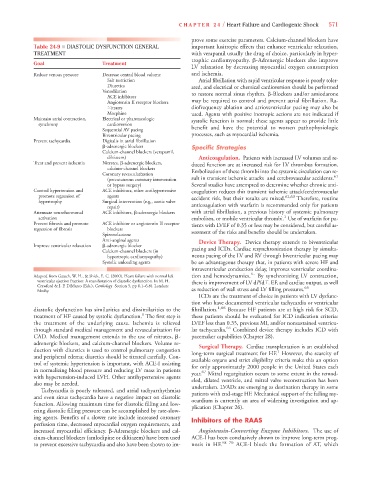
                   Table 24-9 ■ DIASTOLIC DYSFUNCTION GENERAL          important lusitropic effects that enhance ventricular relaxation,
                   TREATMENT                                           with verapamil usually the drug of choice, particularly in hyper-
                                                                       trophic cardiomyopathy.  -Adrenergic blockers also improve
                   Goal                  Treatment
                                                                       LV relaxation by decreasing myocardial oxygen consumption
                   Reduce venous pressure  Decrease central blood volume  and ischemia.
                                           Salt restriction              Atrial fibrillation with rapid ventricular response is poorly toler-
                                           Diuretics                   ated, and electrical or chemical cardioversion should be performed
                                         Venodilation
                                           ACE inhibitors              to restore normal sinus rhythm.  -Blockers and/or amiodarone
                                           Angiotensin II receptor blockers  may be required to control and prevent atrial fibrillation. Ra-
                                           Nitrates                    diofrequency ablation and atrioventricular pacing may also be
                                           Morphine                    used. Agents with positive inotropic actions are not indicated if
                   Maintain atrial contraction,   Electrical or pharmacologic   systolic function is normal; these agents appear to provide little
                     synchrony             cardioversion
                                         Sequential AV pacing          benefit and have the potential to worsen pathophysiologic
                                         Biventricular pacing          processes, such as myocardial ischemia.
                   Prevent tachycardia   Digitalis in atrial fibrillation
                                          -adrenergic blockers         Specific Strategies
                                         Calcium-channel blockers (verapamil,
                                           diltiazem)                    Anticoagulation. Patients with increased LV volumes and re-
                   Treat and prevent ischemia  Nitrates,  -adrenergic blockers,  duced function are at increased risk for LV thrombus formation.
                                           calcium-channel blockers
                                         Coronary revascularization    Embolization of these thrombi into the systemic circulation can re-
                                                                                                                     61
                                           (percutaneous coronary intervention  sult in transient ischemic attacks  and cerebrovascular accidents.
                                           or bypass surgery)          Several studies have attempted to determine whether chronic anti-
                   Control hypertension and   ACE inhibitors, other antihypertensive  coagulation reduces this transient ischemic attack/cerebrovascular
                     promote regression of   agents                    accident risk, but their results are mixed. 62,63  Therefore, routine
                     hypertrophy         Surgical intervention (e.g., aortic valve
                                           repair)                     anticoagulation with warfarin is recommended only for patients
                   Attenuate neurohormonal  ACE inhibitors,  -adrenergic blockers  with atrial fibrillation, a previous history of systemic pulmonary
                                                                                                     1
                     activation                                        embolism, or mobile ventricular thrombi. Use of warfarin for pa-
                   Prevent fibrosis and promote   ACE inhibitor or angiotensin II receptor  tients with LVEF of 0.35 or less may be considered, but careful as-
                   regression of fibrosis   blockers
                                         Spironolactone                sessment of the risks and benefits should be undertaken.
                                         Anti-anginal agents             Device Therapy. Device therapy extends to biventricular
                   Improve ventricular relaxation   -adrenergic blocker
                                         Calcium-channel blockers (in   pacing and ICDs. Cardiac resynchronization therapy by simulta-
                                           hypertropic cardiomyopathy)  neous pacing of the LV and RV through biventricular pacing may
                                         Systolic unloading agents     be an advantageous therapy that, in patients with severe HF and
                                                                       intraventricular conduction delay, improves ventricular coordina-
                   Adapted from Gaasch, W. H., & Shick, E. C. (2000). Heart failure with normal left  tion and hemodynamics. 64  By synchronizing LV contraction,
                    ventricular ejection fraction: A manifestation of diastolic dysfunction. In M. H.  there is improvement of LV dP/dP T, EF, and cardiac output, as wellT
                                                                                               T
                                                                                            P
                    Crawford & J. P. DiMarco (Eds.), Cardiology (Section 5, pp 6.1–6.8). London:            65
                    Mosby.                                             as reduction of wall stress and LV filling pressures.
                                                                         ICDs are the treatment of choice in patients with LV dysfunc-
                                                                       tion who have documented ventricular tachycardia or ventricular
                   diastolic dysfunction has similarities and dissimilarities to the  fibrillation. 1,66  Because HF patients are at high risk for SCD,
                                                      1
                   treatment of HF caused by systolic dysfunction. The first step is  these patients should be evaluated for ICD indication criteria:
                   the treatment of the underlying cause. Ischemia is relieved  LVEF less than 0.35, previous MI, and/or nonsustained ventricu-
                   through standard medical management and revascularization for  lar tachycardia. 66  Combined device therapy includes ICD with
                   CAD. Medical management extends to the use of nitrates,  -  pacemaker capabilities (Chapter 28).
                   adrenergic blockers, and calcium-channel blockers. Volume re-  Surgical Therapy. Cardiac transplantation is an established
                   duction with diuretics is used to control pulmonary congestion  long-term surgical treatment for HF. However, the scarcity of
                                                                                                   1
                   and peripheral edema; diuretics should be titrated carefully. Con-  available organs and strict eligibility criteria make this an option
                   trol of systemic hypertension is important, with ACE-I assisting  for only approximately 2000 people in the United States each
                   in normalizing blood pressure and reducing LV mass in patients  year. 67  Mitral regurgitation occurs to some extent in the remod-
                   with hypertension-induced LVH. Other antihypertensive agents  eled, dilated ventricle, and mitral valve reconstruction has been
                   also may be needed.                                 undertaken. LVADs are emerging as destination therapy in some
                     Tachycardia is poorly tolerated, and atrial tachyarrhythmias  patients with end-stage HF. Mechanical support of the failing my-
                   and even sinus tachycardia have a negative impact on diastolic  ocardium is currently an area of widening investigation and ap-
                   function. Allowing maximum time for diastolic filling and low-  plication (Chapter 26).
                   ering diastolic filling pressure can be accomplished by rate-slow-
                   ing agents. Benefits of a slower rate include increased coronary  Inhibitors of the RAAS
                   perfusion time, decreased myocardial oxygen requirements, and
                   increased myocardial efficiency.  -Adrenergic blockers and cal-  Angiotensin-Converting Enzyme Inhibitors. The use of
                   cium-channel blockers (amlodipine or diltiazem) have been used  ACE-I has been conclusively shown to improve long-term prog-
                   to prevent excessive tachycardia and also have been shown to im-  nosis in  HF. 68–70  ACE-I  block the  formation of AT, which

