


Page 591 - Cardiac Nursing
P. 591
LWBK340-c24_p555-594.qxd  30/06/2009  01:43 PM  Page 567 Aptara


                                                                   C HAP TE R 24 / Heart Failure and Cardiogenic Shock  567

                   Pulmonary crackles are first noted over the lung bases, and as the
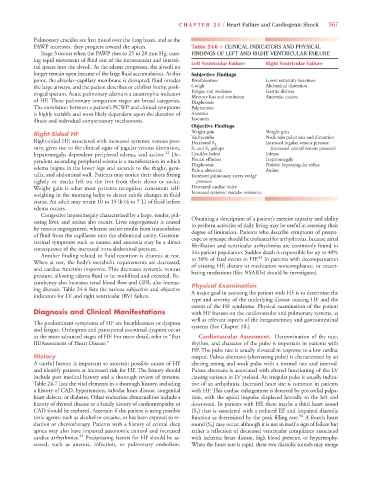
                   PAWP increases, they progress toward the apices.    Table 24-6 ■ CLINICAL INDICATORS AND PHYSICAL
                     Stage 3 occurs when the PAWP rises to 25 to 28 mm Hg, caus-  FINDINGS OF LEFT AND RIGHT VENTRICULAR FAILURE
                   ing rapid movement of fluid out of the intravascular and intersti-  Left Ventricular Failure  Right Ventricular Failure
                   tial spaces into the alveoli. As the edema progresses, the alveoli no
                   longer remain open because of the large fluid accumulation. At this  Subjective Findings
                   point, the alveolar–capillary membrane is disrupted, fluid invades  Breathlessness  Lower extremity heaviness
                   the large airways, and the patient describes or exhibits frothy, pink-  Cough  Abdominal distention
                   tinged sputum. Acute pulmonary edema is a catastrophic indicator  Fatigue and weakness  Gastric distress
                                                                       Memory loss and confusion
                                                                                               Anorexia, nausea
                   of HF. These pulmonary congestion stages are broad categories.  Diaphoresis
                   The correlation between a patient’s PCWP and clinical symptoms  Palpitations
                   is highly variable and most likely dependent upon the duration of  Anorexia
                   illness and individual compensatory mechanisms.     Insomnia
                                                                       Objective Findings
                   Right-Sided HF                                      Weight gain             Weight gain
                                                                       Tachycardia
                                                                                               Neck vein pulsations and distention
                   Right-sided HF, associated with increased systemic venous pres-             Increased jugular venous pressure
                                                                       Decreased S 1
                   sure, gives rise to the clinical signs of jugular venous distension,  S 3 and S 4 gallops  (increased central venous pressure)
                   hepatomegaly, dependent peripheral edema, and ascites. 22  De-  Crackles (rales)  Edema
                   pendent ascending peripheral edema is a manifestation in which  Pleural effusion  Hepatomegaly
                                                                       Diaphoresis
                                                                                               Positive hepatojugular reflux
                   edema begins in the lower legs and ascends to the thighs, geni-  Pulsus alternans  Ascites
                   talia, and abdominal wall. Patients may notice their shoes fitting  Increased pulmonary artery wedge
                   tightly or marks  left on the  feet  from their shoes or socks.  pressure
                   Weight gain is what most patients recognize; consistent self-  Decreased cardiac index
                   weighing in the morning helps to detect subtle changes in fluid  Increased systemic vascular resistance
                   status. An adult may retain 10 to 15 lb (4 to 7 L) of fluid before
                   edema occurs.
                     Congestive hepatomegaly characterized by a large, tender, pul-  Obtaining a description of a patient’s exercise capacity and ability
                   sating liver, and ascites also occurs. Liver engorgement is caused  to perform activities of daily living may be useful in assessing their
                   by venous engorgement, whereas ascites results from transudation  degree of limitation. Patients who describe symptoms of presyn-
                   of fluid from the capillaries into the abdominal cavity. Gastroin-  cope or syncope should be evaluated for arrhythmias, because atrial
                   testinal symptoms such as nausea and anorexia may be a direct  fibrillation and ventricular arrhythmias are commonly found in
                   consequence of the increased intra-abdominal pressure.  this patient population. Sudden death is responsible for up to 40%
                     Another finding related to fluid retention is diuresis at rest.  to 50% of fatal events in HF. 43  In patients with decompensation
                   When at rest, the body’s metabolic requirements are decreased,  of existing HF, dietary or medication noncompliance, or exacer-
                   and cardiac function improves. This decreases systemic venous  bating mediations (like NSAIDs) should be investigated.
                   pressure, allowing edema fluid to be mobilized and excreted. Re-
                   cumbency also increases renal blood flow and GFR, also increas-  Physical Examination
                   ing diuresis. Table 24-6 lists the various subjective and objective  A major goal in assessing the patient with HF is to determine the
                   indicators for LV and right ventricular (RV) failure.
                                                                       type and severity of the underlying disease causing HF and the
                                                                       extent of the HF syndrome. Physical examination of the patient
                   Diagnosis and Clinical Manifestations               with HF focuses on the cardiovascular and pulmonary systems, as
                                                                       well as relevant aspects of the integumentary and gastrointestinal
                   The predominant symptoms of HF are breathlessness or dyspnea  systems (See Chapter 10.)
                   and fatigue. Orthopnea and paroxysmal nocturnal dyspnea occur
                   in the more advanced stages of HF. For more detail, refer to “Part  Cardiovascular Assessment. Determination of the rate,
                   III/Assessment of Heart Disease.”                   rhythm, and character of the pulse is important in patients with
                                                                       HF. The pulse rate is usually elevated in response to a low cardiac
                   History                                             output. Pulsus alternans (alternating pulse) is characterized by an
                   A careful history is important to ascertain possible causes of HF  altering strong and weak pulse with a normal rate and interval.
                   and identify patients at increased risk for HF. The history should  Pulsus alternans is associated with altered functioning of the LV
                   include past medical history and a thorough review of systems.  causing variance in LV preload. An irregular pulse is usually indica-
                   Table 24-7 lists the vital elements in a thorough history, including  tive of an arrhythmia. Increased heart size is common in patients
                   a history of CAD, hypertension, valvular heart disease, congenital  with HF. This cardiac enlargement is detected by precordial palpa-
                   heart defects, or diabetes. Other endocrine abnormalities include a  tion, with the apical impulse displaced laterally to the left and
                   history of thyroid disease or a family history of cardiomyopathy or  downward. In patients with HF, there maybe a third heart sound
                   CAD should be explored. Ascertain if the patient is using possible  (S 3 ) that is associated with a reduced EF and impaired diastolic
                   toxic agents, such as alcohol or cocaine, or has been exposed to ra-  function as determined by the peak filling rate. 44  A fourth heart
                   diation or chemotherapy. Patients with a history of central sleep  sound (S 4 ) may occur, although it is not in itself a sign of failure but
                   apnea may also have impaired autonomic control and increased  rather a reflection of decreased ventricular compliance associated
                   cardiac arrhythmias. 42  Precipitating factors for HF should be as-  with ischemic heart disease, high blood pressure, or hypertrophy.
                   sessed, such as anemia, infection, or pulmonary embolism.  When the heart rate is rapid, these two diastolic sounds may merge

