


Page 589 - Cardiac Nursing
P. 589
3 P
                      5-5
                      5-5
                                      1:4
                        94.
                        94.
                                      1:4
                                        3 P
                                            Pa
                                            Pa
                                              g
                                          M
                                          M
                    55
                    55
                                     0
                              0/0
                              0/0
                             3
                                  009
                                6/2
                                6/2
                                  009
                             3
                          q
                          q
                                     0
                          q
                              3
                           xd
                           xd
                                                     ara
                                                     ara
                                                    t
                                                   p
                                                    t
                 24_
         LWBK340-c24_
         LWB K34 0-c 24_ p p pp555-594.qxd  30/06/2009  01:43 PM  Page 565 Aptara
         LWB
               0-c
            K34
                                                   p
                                                65
                                              g
                                              g
                                                65
                                              e 5
                                                  A
                                                   p
                                              e 5
                                                  A
                                                                   C HAPTER 24 / Heart Failure and Cardiogenic Shock  565
                                                                       IL-8, IL-12). The cardiac myocytes themselves are capable of syn-
                                                                       thesizing these proinflammatory cytokines in response to various
                                                                                       34
                                                                       forms of cardiac injury. The local inflammatory response can ap-
                                         Brain                         pear within minutes of an abnormal stress. Local inflammation of
                                                                       the cytokines and other mediators includes deleterious effects of
                                                Paraventricular
                             Supraoptic         neurons                LV remodeling, which include myocyte hypertrophy, alteration in
                             neurons                                   fetal gene expression, contractile defects, and progressive myocyte
                                                                       loss through apoptosis. In addition, there may be promotion of
                                                                       LV remodeling through alterations of the extracellular matrix. A
                                                                       number of studies have shown that the local proinflammatory
                              Pituitary,                               molecules are activated as early as New York Heart Association
                              posterior                                (NYHA) class I, which is before some of the classic neurohor-
                              lobe
                                                                       monal responses, that tend to be activated in the latter stages
                                                                       (NYHA II thru IV). There are important signaling interactions
                                                                       between the RAAS and the sympathetic nervous system, along
                                                                       with the proinflammatory cytokines. 35
                                                       Baroreceptors     Activation of the systemic inflammatory response is found in
                      Angiotensin II
                     Hyperosmolarity   Vasopressin      Natriuretic    advanced HF. Cardiac cachexia and skeletal muscle myopathy,
                                                         peptides
                                                                       which contributes to the fatigue and muscle weakness seen in HF,
                                                                       is a part of the systemic inflammatory response; the elevation of
                                                                       the proinflammatory cytokines correlates with the severity of the
                                 Vasoconstriction  Inhibition of       syndrome. The knowledge of the role of inflammation remains in-
                                               renin secretion         complete. As with the hemodynamic defence reaction, the in-
                                                                       flammatory response may be initially beneficial, but when sus-
                       Increased arterial                              tained becomes deleterious.
                        baroreceptor                      Renal H 2O
                         sensitivity                     reabsorption
                                                                       Systolic and Diastolic Dysfunction
                                                                       HF is commonly subdivided into two entities. Patients with
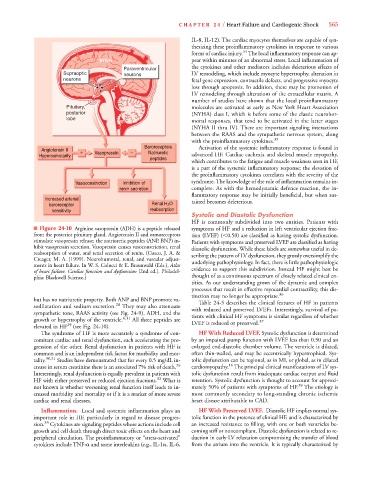
                   ■ Figure 24-10 Arginine vasopressin (ADH) is a peptide released  symptoms of HF and a reduction in left ventricular ejection frac-
                   from the posterior pituitary gland. Angiotensin II and osmoreceptors  tion (LVEF) ( 0.50) are classified as having systolic dysfunction.
                   stimulate vasopressin release; the natriuretic peptides (ANP, BNP) in-  Patients with symptoms and preserved LVEF are classified as having
                   hibit vasopressin secretion. Vasopressin causes vasoconstriction, renal  diastolic dysfunction. While these labels are somewhat useful in de-
                   reabsorption of water, and renal secretion of renin. (Cusco, J. A. &  scribing the pattern of LV dysfunction, they grossly oversimplify the
                   Creager, M. A. [1999]. Neurohumoral, renal, and vascular adjust-
                   ments in heart failure. In W. S. Colucci & E. Braunwald (Eds.), Atlas  underlying pathophysiology. In fact, there is little pathophysiologic
                   of heart failure. Cardiac function and dysfunction [2nd ed.]. Philadel-  evidence to support this subdivision. Instead HF might best be
                   phia: Blackwell Science.)                           thought of as a continuous spectrum of closely related clinical en-
                                                                       tities. As our understanding grows of the dynamic and complex
                                                                       processes that result in effective myocardial contractility, this dis-
                                                                       tinction may no longer be appropriate. 36
                   but has no natriuretic property. Both ANP and BNP promote va-  Table 24-5 describes the clinical features of HF in patients
                   sodilatation and sodium excretion. 28  They may also attenuate  with reduced and preserved LVEFs. Interestingly, survival of pa-
                   sympathetic tone, RAAS activity (see Fig. 24-9), ADH, and the  tients with clinical HF symptoms is similar regardless of whether
                   growth or hypertrophy of the ventricle. 6,11  All three peptides are  LVEF is reduced or preserved. 37
                   elevated in HF 29  (see Fig. 24-10).
                     The syndrome of HF is more accurately a syndrome of con-  HF With Reduced LVEF. Systolic dysfunction is determined
                   comitant cardiac and renal dysfunction, each accelerating the pro-  by an impaired pump function with LVEF less than 0.50 and an
                   gression of the other. Renal dysfunction in patients with HF is  enlarged end-diastolic chamber volume. The ventricle is dilated,
                   common and is an independent risk factor for morbidity and mor-  often thin-walled, and may be eccentrically hypertrophied. Sys-
                   tality. 30,31  Studies have demonstrated that for every 0.5 mg/dL in-  tolic dysfunction can be regional, as in MI, or global, as in dilated
                                                                                   16
                   crease in serum creatinine there is an associated 7% risk of death. 26  cardiomyopathy. The principal clinical manifestations of LV sys-
                   Interestingly, renal dysfunction is equally prevalent in patients with  tolic dysfunction result from inadequate cardiac output and fluid
                   HF with either preserved or reduced ejection fractions. 32  What is  retention. Systolic dysfunction is thought to account for approxi-
                   not known is whether worsening renal function itself leads to in-  mately 50% of patients with symptoms of HF. 38  The etiology is
                   creased morbidity and mortality or if it is a marker of more severe  most commonly secondary to long-standing chronic ischemic
                   cardiac and renal diseases.                         heart disease attributable to CAD.
                     Inflammation. Local and systemic inflammation plays an  HF With Preserved LVEF. Diastolic HF implies normal sys-
                   important role in HF, particularly in regard to disease progres-  tolic function in the presence of clinical HF, and is characterized by
                      33
                   sion. Cytokines are signaling peptides whose actions include cell  an increased resistance to filling, with one or both ventricles be-
                   growth and cell death through direct toxic effects on the heart and  coming stiff or noncompliant. Diastolic dysfunction is related to re-
                   peripheral circulation. The proinflammatory or “stress-activated”  duction in early LV relaxation compromising the transfer of blood
                   cytokines include TNF-  and some interleukins (e.g., IL-1 , IL-6,  from the atrium into the ventricle. It is typically characterizedby

