


Page 596 - Cardiac Nursing
P. 596
LWBK340-c24_p555-594.qxd  30/06/2009  01:43 PM  Page 572 Aptara


                  572    PA R T  IV / Pathophysiology and Management of Heart Disease

                  reverses vasoconstriction (reducing afterload), and inhibit en-  activity associated with the syndrome of HF.  -Adrenergic blockers
                  docrine, paracrine, and cellular growth effect of AT. 71  ACE-I  should be administered routinely to clinically stable patients who are
                  also diminish release of aldosterone (inhibiting sodium reten-  on standard therapy (usually ACE-I and diuretic). ACC/AHA stages
                  tion) and produce venodilation (reducing preload). In addition  B, C, and D therapy should be initiated at low doses and up-titrated
                  to blocking AT formation, this drug class increases levels of  slowly, generally no sooner than at 2-week intervals (Table 24-10). 1
                  bradykinin, promotes vasodilatation, and inhibits maladaptive  Table 24-11 describes strategies for management of side effects dur-
                  growth, including ventricular remodeling, hypertrophy, fibro-  ing titration of  -adrenergic blockers.  -Adrenergic blockers have
                  sis, and improves endothelial and vascular function. The unique  been shown in multiple studies to reduce mortality, morbidity, and
                  characteristics of this class of neurohormonal inhibitors support  improve symptoms. 84–89  The safety of beta-blockers in asympto-
                  the use of ACE-I as first-line drugs in all patients with HF or  matic LV dysfunction has not been tested.
                  asymptomatic LV systolic dysfunction. 1,72  Clinical benefits also
                  extend to patients with evidence of atherosclerotic disease. The  Diuretics. The kidney is the target organ of many of the
                  doses used should be titrated to target levels. NSAIDs should be  neurohormonal and hemodynamic changes that occur in HF. 90
                  avoided in patients in HF, and particularly in those patients us-  Diuretics and dietary salt restriction exert their primary benefit
                  ing ACE-I therapy.                                  by decreasing extracellular fluid and intravascular blood vol-
                                                                      ume. The elimination of dependent edema helps reduce tissue
                     AT Receptor Blockers. AT receptor blockers differ in their  pressure, oppose venous pooling, and therefore improve the ca-
                  mechanism of action compared to ACE-I. Rather than inhibiting  pacitance of the venous system. Similarly, the decrease in in-
                  the production of angiotensin by blockade of the ACE, ARBs  travascular volume also reduces ventricular preload directly,
                  block the cell surface receptor for AT 1 . 70  Hemodynamic effects  thereby helping to diminish the filling pressures in the pul-
                  are similar to those of ACE-I with respect to reducing preload and  monary and systemic circulations. Thiazide diuretics may be
                  afterload and increasing cardiac output. The potential concern of  helpful in patients with mild fluid overload and normal renal
                  this class of drug is that the blockade of AT 1 elevates serum AT,  function, but most patients require loop diuretics. Administra-
                  which, because the AT 2 receptors are not blocked, can increase  tion of the aldosterone antagonist spironolactone should
                  counter regulatory actions of AT 2 activation. 73   be considered (see previous section). With advanced HF and
                     There is ongoing interest in and investigation of combination  compromised renal function, multiple diuretics with different
                  therapy with ACE-I and ARBs, 74  but at the present time this  sites of renal action are usually needed. 1
                  combination cannot be recommended as routine therapy. ACE-I
                  rather than ARBs continue to be the agent of choice for blockade  Digitalis Glycosides. The cardiac glycosides have important
                  of the RAAS in HF, and the use of ARBs are usually reserved for  effects in HF, including augmenting contractility (positive inotropy),
                  patients truly intolerant to ACE inhibitor because of cough. 73,75
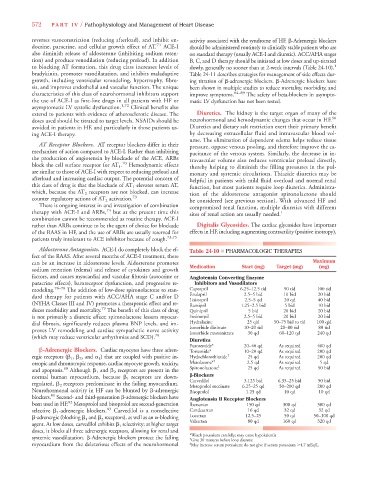
                     Aldosterone Antagonists. ACE-I do completely block the ef-  Table 24-10 ■ PHARMACOLOGIC THERAPIES
                  fect of the RAAS. After several months of ACE-I treatment, there
                  can be an increase in aldosterone levels. Aldosterone promotes                              Maximum
                  sodium retention (edema) and release of cytokines and growth  Medication  Start (mg)  Target (mg)  (mg)
                  factors, and causes myocardial and vascular fibrosis (autocrine or  Angiotensin Converting Enzyme
                  paracrine effects), baroreceptor dysfunction, and progressive re-  Inhibitors and Vasodilators
                  modeling. 76–78  The addition of low-dose spironolactone to stan-  Captopril   6.25–12.5 tid  50 tid  100 tid
                  dard therapy for patients with ACC/AHA stage C and/or D  Enalapril    2.5–5 bid    10 bid     20 bid
                                                                      Lisinopril
                                                                                        2.5–5 qd
                                                                                                                40 bid
                                                                                                     20 qd
                  (NYHA Classes III and IV) promotes a therapeutic effect and re-  Ramipril   1.25–2.5 bid  5 bid  10 bid
                                         79
                  duces morbidity and mortality. The benefit of this class of drug  Quinipril   5 bid  20 bid    20 bid
                  is not primarily a diuretic effect; spironolactone lessens myocar-  Fosinorpil   2.5–5 bid  20 bid  20 bid
                  dial fibrosis, significantly reduces plasma BNP levels, and im-  Hydralazine   25 qid  50–75 bid to tid  100 qid
                                                                                                    20–80 tid
                                                                                                                80 tid
                  proves LV remodeling and cardiac sympathetic nerve activity  Isosorbide dinitrate   10–20 tid  60–120 qd  240 qd
                                                                      Isosorbide mononitrate
                                                                                         30 qd
                  (which may reduce ventricular arrhythmias and SCD). 79
                                                                      Diuretics
                                                                      Furosemide*       20–40 qd   As required  480 qd
                      -Adrenergic Blockers. Cardiac myocytes have three adren-  Torsemide*  10–20 qd  As required  200 qd
                  ergic receptors (  1 ,   2 , and   1 ) that are coupled with positive in-  Hydochlorothiazide †  25 qd  As required  200 qd
                  otropic and chronotropic response, cardiac myocyte growth, toxicity,  Metolazone* †  ‡  2.5 qd  As required  5 qd
                  and apoptosis. 80  Although   1 and   2 receptors are present in the  Spironolactone  25 qd  As required  50 bid
                  normal human myocardium, because   1 receptors are down-   -Blockers
                                                                                        3.125 bid
                                                                                                                50 bid
                  regulated,   2 receptors predominate in the failing myocardium.  Carvedilol  6.25–25 qd  6.35–25 bid  200 qd
                                                                      Metoprolol succinate
                                                                                                   50–200 qd
                  Neurohormonal activity in HF can be blunted by  -adrenergic  Bisoprolol   1.25 qd  10 qd      10 qd
                         81
                  blockers. Second- and third-generation  -adrenergic blockers have  Angiotensin II Receptor Blockers
                              82
                  been used in HF. Metoprolol and bisoprolol are second-generation  Ibersartan   150 qd  300 qd  300 qd
                  selective   1 -adrenergic blockers. 83  Carvedilol is a nonselective   Candesartan   16 qd  32 qd  32 qd
                   -adrenergic (blocking   1 and   2 receptors), as well as an  -blocking  Losartan  12.5–25  50 qd  50–100 qd
                  agent. At low doses, carvedilol exhibits   1 selectivity; at higher target  Valsartan   80 qd  160 qd  320 qd
                  doses, it blocks all three adrenergic receptors, allowing for renal and
                                                                      *Watch potassium carefully; may cause hypokalemia
                  systemic vasodilatation.  -Adrenergic blockers protect the failing
                                                                      †
                                                                       Give 30 minutes before loop diuretic
                  myocardium from the deleterious effects of the neurohormonal  ‡ May increase serum potassium; do not give if serum potassium  4.7 mEq/L

