


Page 590 - Cardiac Nursing
P. 590
LWBK340-c24_p555-594.qxd  30/06/2009  01:43 PM  Page 566 Aptara


                  566    PA R T  IV / Pathophysiology and Management of Heart Disease


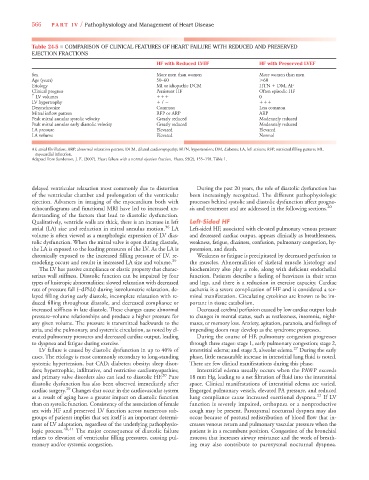
                  Table 24-5 ■ COMPARISON OF CLINICAL FEATURES OF HEART FAILURE WITH REDUCED AND PRESERVED
                  EJECTION FRACTIONS
                                                           HF with Reduced LVEF              HF with Preserved LVEF
                  Sex                                      More men than women               More women than men
                  Age (years)                              50–60                              60
                  Etiology                                 MI or idiopathic DCM              HTN
 DM, AF
                  Clinical progress                        Persistent HF                     Often episodic HF
                  c LV volumes


                               0
                  LV hypertrophy
 /
                  Desynchronize                            Common                            Less common
                  Mitral inflow pattern                     RFP or ARP                        ARP
                  Peak mitral annular systolic velocity    Greatly reduced                   Moderately reduced
                  Peak mitral annular early diastolic velocity  Greatly reduced              Moderately reduced
                  LA pressure                              Elevated                          Elevated
                  LA volume                                Elevated                          Normal
                                                                                          f
                  AF, atrial fibrillation; ARP, abnormal relaxation pattern; DCM, dilated cardiomyopathy; HTN, hypertension; DM, diabetes; LA, left atrium; RFP, restricted filling pattern; MI,
                                                                                          f
                    myocardial infarction.
                  Adapted from Sanderson, J. E. (2007). Heart failure with a normal ejection fraction. Heart, 93(2), 155–158. Table 1.


                  delayed ventricular relaxation most commonly due to distortion  During the past 20 years, the role of diastolic dysfunction has
                  of the ventricular chamber and prolongation of the ventricular  been increasingly recognized. The  different pathophysiologic
                  ejection. Advances in imaging of the myocardium both with  processes behind systolic and diastolic dysfunction affect progno-
                  echocardiograms and functional MRI have led to increased un-  sis and treatment and are addressed in the following sections. 20
                  derstanding of the factors that lead to diastolic dysfunction.
                  Qualitatively, ventricle walls are thick, there is an increase in left  Left-Sided HF
                  atrial (LA) size and reduction in mitral annulus motion. 36  LA  Left-sided HF, associated with elevated pulmonary venous pressure
                  volume is often viewed as a morphologic expression of LV dias-  and decreased cardiac output, appears clinically as breathlessness,
                  tolic dysfunction. When the mitral valve is open during diastole,  weakness, fatigue, dizziness, confusion, pulmonary congestion, hy-
                  the LA is exposed to the loading pressures of the LV. As the LA is  potension, and death.
                  chronically exposed to the increased filling pressure of LV, re-  Weakness or fatigue is precipitated by decreased perfusion to
                  modeling occurs and results in increased LA size and volume. 39  the muscles. Abnormalities of skeletal muscle histology and
                     The LV has passive compliance or elastic property that charac-  biochemistry also play a role, along with deficient endothelial
                  terizes wall stiffness. Diastolic function can be impaired by four  function. Patients describe a feeling of heaviness in their arms
                  types of lusitropic abnormalities: slowed relaxation with decreased  and legs, and there is a reduction in exercise capacity. Cardiac
                                      t
                                    P
                                    P
                  rate of pressure fall (–dP/dt) during isovolumetric relaxation, de-  cachexia is a severe complication of HF and is considered a ter-
                  layed filling during early diastole, incomplete relaxation with re-  minal manifestation. Circulating cytokines are known to be im-
                  duced filling throughout diastole, and decreased compliance or  portant in tissue catabolism.
                  increased stiffness in late diastole. These changes cause abnormal  Decreased cerebral perfusion caused by low cardiac output leads
                  pressure–volume relationships and produce a higher pressure for  to changes in mental status, such as restlessness, insomnia, night-
                  any given volume. The pressure is transmitted backwards to the  mares, or memory loss. Anxiety, agitation, paranoia, and feelings of
                  atria, and the pulmonary, and systemic circulation, as noted by el-  impending doom may develop as the syndrome progresses.
                  evated pulmonary pressures and decreased cardiac output, leading  During the course of HF, pulmonary congestion progresses
                  to dyspnea and fatigue during exercise. 7           through three stages: stage 1, early pulmonary congestion; stage 2,
                                                                                                        27
                     LV failure is caused by diastolic dysfunction in up to 40% of  interstitial edema; and stage 3, alveolar edema. During the early
                  cases. The etiology is most commonly secondary to long-standing  phase, little measurable increase in interstitial lung fluid is noted.
                  systemic hypertension, but CAD; diabetes; obesity; sleep disor-  There are few clinical manifestations during this phase.
                  ders; hypertrophic, infiltrative, and restrictive cardiomyopathies;  Interstitial edema usually occurs when the PAWP exceeds
                  and primary valve disorders also can lead to diastolic HF. 20  Pure  18 mm Hg, leading to a net filtration of fluid into the interstitial
                  diastolic dysfunction has also been observed immediately after  space. Clinical manifestations of interstitial edema are varied.
                              20
                  cardiac surgery. Changes that occur in the cardiovascular system  Engorged pulmonary vessels, elevated PA pressure, and reduced
                  as a result of aging have a greater impact on diastolic function  lung compliance cause increased exertional dyspnea. 22  If LV
                  than on systolic function. Consistency of the association of female  function is severely impaired, orthopnea or a nonproductive
                  sex with HF and preserved LV function across numerous sub-  cough may be present. Paroxysmal nocturnal dyspnea may also
                  groups of patients implies that sex itself is an important determi-  occur because of postural redistribution of blood flow that in-
                  nant of LV adaptation, regardless of the underlying pathophysio-  creases venous return and pulmonary vascular pressure when the
                  logic process. 40,41  The major consequence of diastolic failure  patient is in a recumbent position. Congestion of the bronchial
                  relates to elevation of ventricular filling pressures, causing pul-  mucosa that increases airway resistance and the work of breath-
                  monary and/or systemic congestion.                  ing may also contribute to paroxysmal nocturnal dyspnea.

