


Page 605 - Cardiac Nursing
P. 605
0
                                     0
                                  009
                                  009
                                      1:4
                                        3 P
                                          M
                                      1:4
                                        3 P
                              3
                             3
                           xd
                           xd
                             3
                                6/2
                                6/2
                              0/0
                              0/0
                                          M
                                                   p
                                                   p
                                                  A
                                                  A
                                                   p
                                                     ara
                                                     ara
                                                    t
                                                    t
                                              g
                                              g
                                            Pa
                                            Pa
                                              g
                                                81
                                                81
                                              e 5
                                              e 5
                          q
                    55
                    55
         LWB K34 0-c 24_ p p pp555-594.qxd  30/06/2009  01:43 PM  Page 581 Aptara
         LWBK340-c24_
               0-c
                 24_
         LWB
            K34
                        94.
                          q
                          q
                        94.
                      5-5
                      5-5
                                                                   C HAPTER 24 / Heart Failure and Cardiogenic Shock  581
                   stimulation, hormones are released from the adrenal medulla, ad-  no longer able to maintain homeostasis and may become coun-
                   renal cortex, anterior and posterior pituitary gland, and kidneys,  terproductive. For example, continued profound vasoconstriction
                   which further compensate for decreased circulating blood volume.  in the presence of decreased MAP promotes inadequate tissue per-
                   The adrenal medulla releases epinephrine and NE, which enhance  fusion and cellular hypoxia.
                   vasoconstriction and myocardial contractility, and increase heart  Decreased delivery of oxygen and nutrients causes cells to
                      13
                                                                                                    7
                   rate. Epinephrine and NE also stimulate glycogenolysis, thus in-  shift to anaerobic metabolic pathways. Increasing amounts of
                   creasing serum glucose. The adrenal cortex releases glucocorticoids,  lactic acid are produced and accumulate in the cells because of
                   which also increase serum glucose. Decreased renal blood flow re-  decreased perfusion. Because anaerobic metabolism is less effi-
                   sults in the release of renin, which initiates a series of reactions in  cient in meeting the energy requirements of the cells, ATP is
                   the liver and elsewhere, resulting in the production of angiotensin.  depleted. Reduction in the available ATP results in failure of
                   Angiotensin promotes the release of aldosterone by the adrenal cor-  the membrane transport mechanisms, intracellular edema, and
                   tex and, in situations of hypovolemia, promotes profound vaso-  rupture of the cell membrane. Progressive tissue ischemia results
                   constriction. Aldosterone enhances renal sodium reabsorption ac-  in increased anaerobic metabolism and the further production of
                   companied by increased water reabsorption. Antidiuretic hormone  metabolic acidosis. 190
                   is released from the posterior pituitary and further enhances renal  Impairment of cellular function disrupts all body organs and
                   water reabsorption. Thirst is stimulated and also causes increased  organ systems. Splanchnic ischemia results in the release of endo-
                   fluid intake. 11  As a result of decreased capillary pressure, Starling  toxin  from the intestine.  The reticuloendothelial  (tissue
                   capillary forces are altered, and fluid is transferred from the inter-  macrophage) system is suppressed by splenic and hepatic is-
                   stitial space to the capillary.                     chemia. The continued renal response to ischemia leads to fur-
                                                                       ther vasoconstriction, stimulating the release of aldosterone
                   Intermediate Stage                                  from the adrenal gland and promoting the reabsorption of
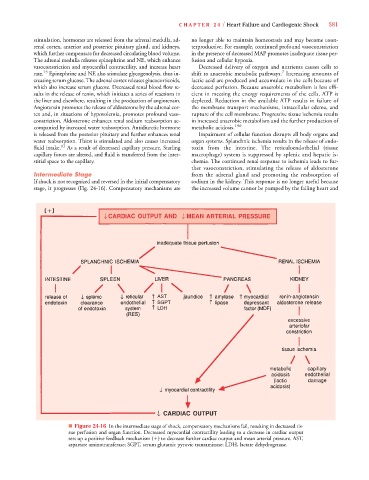
                   If shock is not recognized and reversed in the initial compensatory  sodium in the kidney. This response is no longer useful because
                   stage, it progresses (Fig. 24-16). Compensatory mechanisms are  the increased volume cannot be pumped by the failing heart and
                                                           AST
                                                           SGPT
                                                           LDH


                              ■ Figure 24-16 In the intermediate stage of shock, compensatory mechanisms fail, resulting in decreased tis-
                              sue perfusion and organ function. Decreased myocardial contractility leading to a decrease in cardiac output
                              sets up a positive feedback mechanism (
) to decrease further cardiac output and mean arterial pressure. AST,
                              aspartate aminotransferase; SGPT, serum glutamic pyruvic transaminase; LDH, lactate dehydrogenase.

