


Page 670 - Cardiac Nursing
P. 670
p
                   p
                                   2:0
                                   2:0
                                   1
                                   1
                    63
                    63
                                          Pa
                                          Pa
                                           g
                                           g
                                     1 A
                                     1 A
                                        M
                                        M
                          q
                          q
                        54.
                        54.
                           xd
                              6
                          q
                           xd
                              /30
                              /30
                                /09
                                /09
                      8-6
                      8-6
                             6
                             6
         LWB
         LWB
            K34
            K34
                                                  ara
                                                  t
                 27_
                 27_
               0-c
                                                      c.
                                                     In
                                                      c.
                                                      c.
                                                   a
                                                  ara
                                                     In
                                                   a
                                                A
                                                A
                                                A
                                                 p
                                                 p
                                            e 6
                                           g
                                            e 6
                                              46
                                              46
               0-c
         LWBK340-c27_ pp638-654.qxd  6/30/09  12:01 AM  Page 646 Aptara Inc.
                                                 p
                                                  t
                  646    PA R T  I V / Pathophysiology and Management of Heart Disease
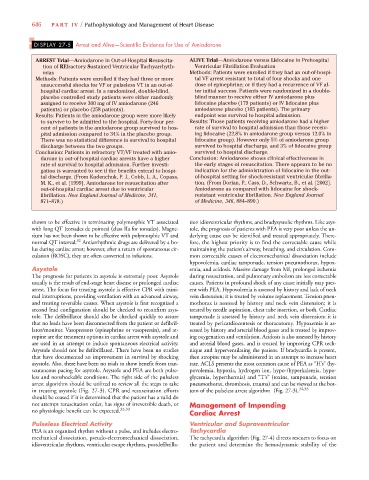
                   DISPLAY 27-5 Arrest and Alive—Scientific Evidence for Use of Amiodarone
                    ARREST Trial—Amiodarone in Out-of-Hospital Resuscita-  ALIVE Trial—Amiodarone versus Lidocaine in Prehospital
                      tion of REfractory Sustained Ventricular Tachyarrhyth-  Ventricular Fibrillation Evaluation
                      mias                                            Methods: Patients were enrolled if they had an out-of-hospi-
                    Methods: Patients were enrolled if they had three or more  tal VF arrest resistant to total of four shocks and one
                     unsuccessful shocks for VF or pulseless VT in an out-of-  dose of epinephrine; or if they had a recurrence of VF af-
                     hospital cardiac arrest. In a randomized, double-blind,  ter initial success. Patients were randomized in a double-
                     placebo controlled study patients were either randomly  blind manner to receive either IV amiodarone plus
                     assigned to receive 300 mg of IV amiodarone (246   lidocaine placebo (179 patients) or IV lidocaine plus
                     patients) or placebo (258 patients).               amiodarone placebo (165 patients). The primary
                    Results: Patients in the amiodarone group were more likely  endpoint was survival to hospital admission.
                     to survive to be admitted to the hospital. Forty-four per-  Results: Those patients receiving amiodarone had a higher
                     cent of patients in the amiodarone group survived to hos-  rate of survival to hospital admission than those receiv-
                     pital admission compared to 34% in the placebo group.  ing lidocaine (22.8% in amiodarone group versus 12.0% in
                     There was no statistical difference in survival to hospital  lidocaine group). However only 5% of amiodarone group
                     discharge between the two groups.                  survived to hospital discharge, and 3% of lidocaine group
                    Conclusion: Patients in refractory VT/VF treated with amio-  survived to hospital discharge.
                     darone in out-of-hospital cardiac arrests have a higher  Conclusion: Amiodarone shows clinical effectiveness in
                     rate of survival to hospital admission. Further investi-  the early stages of resuscitation. There appears to be no
                     gation is warranted to see if the benefits extend to hospi-  indication for the administration of lidocaine in the out-
                     tal discharge. (From Kudenchuk, P. J., Cobb, L. A., Copass,  of-hospital setting for shock-resistant ventricular fibrilla-
                     M. K., et al. [1999]. Amiodarone for resuscitation after  tion. (From Dorian, P., Cass, D., Schwartz, B., et al. [2002].
                     out-of-hospital cardiac arrest due to ventricular  Amiodarone as compared with lidocaine for shock-
                     fibrillation. New England Journal of Medicine, 341,  resistant ventricular fibrillation. New England Journal
                     871–878.)                                          of Medicine, 346, 884–890.)
                  shown to be effective in terminating polymorphic VT associated  tion idioventricular rhythms, and bradysystolic rhythms. Like asys-
                  with long QT (torsades de pointes) (class IIa for torsades). Magne-  tole, the prognosis of patients with PEA is very poor unless the un-
                  sium has not been shown to be effective with polymorphic VT and  derlying cause can be identified and treated appropriately. There-
                                 32
                  normal QT interval. Antiarrhythmic drugs are delivered by a bo-  fore, the highest priority is to find the correctable cause while
                  lus during cardiac arrest; however, after a return of spontaneous cir-  maintaining the patient’s airway, breathing, and circulation. Com-
                  culation (ROSC), they are often converted to infusions.  mon correctable causes of electromechanical dissociation include
                                                                      hypovolemia, cardiac tamponade, tension pneumothorax, hypox-
                  Asystole                                            emia, and acidosis. Massive damage from MI, prolonged ischemia
                  The prognosis for patients in asystole is extremely poor. Asystole  during resuscitation, and pulmonary embolism are less correctable
                  usually is the result of end-stage heart disease or prolonged cardiac  causes. Patients in profound shock of any cause initially may pres-
                  arrest. The focus for treating asystole is effective CPR with mini-  ent with PEA. Hypovolemia is assessed by history and lack of neck
                  mal interruptions, providing ventilation with an advanced airway,  vein distension; it is treated by volume replacement. Tension pneu-
                  and treating reversible causes. When asystole is first recognized a  mothorax is assessed by history and neck vein distension; it is
                  second lead configuration should be checked to reconfirm asys-  treated by needle aspiration, chest tube insertion, or both. Cardiac
                  tole. The defibrillator should also be checked quickly to assure  tamponade is assessed by history and neck vein distension; it is
                  that no leads have been disconnected from the patient or defibril-  treated by pericardiocentesis or thoracotomy. Hypoxemia is as-
                  lator/monitor. Vasopressors (epinephrine or vasopressin), and at-  sessed by history and arterial blood gases and is treated by improv-
                  ropine are the treatment options in cardiac arrest with asystole and  ing oxygenation and ventilation. Acidosis is also assessed by history
                  are used in an attempt to induce spontaneous electrical activity.  and arterial blood gases, and is treated by improving CPR tech-
                  Asystole should not be defibrillated. There have been no studies  nique and hyperventilating the patient. If bradycardia is present,
                  that have documented an improvement in survival by shocking  then atropine may be administered in an attempt to increase heart
                  asystole. Also, there have been no trials to show benefit from tran-  rate. ACLS presents the most common cause of PEA as “H’s” (hy-
                  scutaneous pacing for asystole. Asystole and PEA are both pulse-  povolemia, hypoxia, hydrogen ion, hypo-/hyperkalemia, hypo-
                  less and nonshockable conditions. The right side of the pulseless  glycemia, hyperthermia) and “T’s” (toxins, tamponade, tension
                  arrest algorithm should be utilized to review all the steps to take  pneumothorax, thrombosis, trauma) and can be viewed at the bot-
                  in treating asystole (Fig. 27-3). CPR and resuscitation efforts  tom of the pulseless arrest algorithm  (Fig. 27-3). 32,33
                  should be ceased if it is determined that the patient has a valid do
                  not attempt resuscitation order, has signs of irreversible death, or  Management of Impending
                  no physiologic benefit can be expected. 32,33
                                                                      Cardiac Arrest
                  Pulseless Electrical Activity                       Ventricular and Supraventricular
                  PEA is an organized rhythm without a pulse, and includes electro-  Tachycardia
                  mechanical dissociation, pseudo-electromechanical dissociation,  The tachycardia algorithm (Fig. 27-4) directs rescuers to focus on
                  idioventricular rhythms, ventricular escape rhythms, postdefibrilla-  the  patient and  determine the  hemodynamic stability of the

