


Page 69 - Cardiac Nursing
P. 69
0
                             0
                              0
                           xd
                           xd
                              6/3
                                  009
                                  009
                                0/2
                              6/3
                                0/2
                    04
                      2-0
                    04
                   p
                   p
                      2-0
                          q
                          q
                          q
                        68.
                        68.
                                     1
                                              5 A
                                                p
                                              5 A
                                            e 4
                                            e 4
                                                p
                                                  r
                                                  r
                                                 ta
                                                p
                                                 ta
                                        3
                                        3
                                      5:3
                                     1
                                      5:3
                                         Pa
                                           g
                                           g
                                           g
                                         Pa
                                         Pa
            K34
         LWBK340-c02_
                 02_
               0-c
         LWB
         LWB K34 0-c 02_ pp042-068.qxd  06/30/2009  15:33  Page 45 Aptara a a
                                                   C HAPTER 2 / Systemic and Pulmonary Circulation and Oxygen Delivery  45
                   Venoconstriction                                    which are the functional unit of lymphatic vessels, consisting of
                   In contrast to the arteries, not all veins constrict when exposed to  the valve and portion of the vessel surrounding the valve. The in-
                   norepinephrine. For example, the postcapillary venules ranging  trinsic contraction remains active during rest, anesthesia, and im-
                   from 0.007 to 2 mm in diameter do not have smooth muscle and  mobilization. 31  Lymphatic flow is also facilitated by lymph for-
                   therefore cannot constrict. 23  Most of the larger venules and small  mation, skeletal muscle contractions (e.g., walking, foot flexing),
                   veins (including veins in the skeletal muscle) contain some smooth  respiration, fluctuations of central venous pressure, gastrointesti-
                        2
                   muscle, but they are sparsely innervated and are not considered  nal peristalsis, and arterial pulsations. 32
                   sites of vasoconstriction. The lack of venoconstriction in the skele-
                   tal muscle is important because the leg veins do not constrict in or-  Vascular Smooth Muscle
                   thostasis. The splanchnic organs (liver, gastrointestinal tract, pan-  Vascular smooth muscle contains the contractile filaments, actin
                   creas, and spleen) are the exception because they are richly  and myosin; however, unlike striated smooth muscle (cardiac), the
                   innervated by sympathetic noradrenergic fibers and are capable of  filaments are not organized in any fashion. 33  Although the sar-
                   venoconstriction. In addition, the veins in the skin respond to ther-  coplasmic reticulum is not as prominent in vascular smooth mus-
                   moregulatory reflexes. In humans, significant venoconstriction oc-  cle as in cardiac muscle, it serves as the primary intracellular
                   curs only in the splanchnic circulation; in response to thermoregu-  source of calcium. 34  Additionally, the amount of myosin in
                   latory reflexes, the veins in the skin constrict and dilate. 17,24,25  smooth muscle is approximately one-fifth that found in striated
                                                                       muscle. Despite this lower amount of myosin, smooth muscle de-
                   Lymphatics                                          velops higher force per cross-sectional area than striated muscle.
                                                                       Vascular smooth muscle also usually contracts more slowly than
                   The lymphatics are a system of thin-walled vessels that collect and  striated muscle, and it maintains tonic contractions with lower en-
                   conduct lymph through active contraction of the lymphatic mi-  ergy [adenosine triphosphate (ATP)] expenditure.
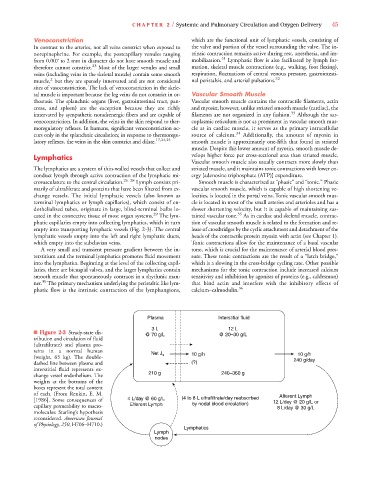
                   crovasculature to the central circulation. 26–28  Lymph consists pri-  Smooth muscle is characterized as “phasic” and “tonic.” Phasic
                   marily of ultrafiltrate and proteins that have been filtered from ex-  vascular smooth muscle, which is capable of high shortening ve-
                   change vessels.  The initial lymphatic vessels (also known as  locities, is located in the portal veins. Tonic vascular smooth mus-
                   terminal lymphatics or lymph capillaries), which consist of en-  cle is located in most of the small arteries and arterioles and has a
                   dothelialized tubes, originate in large, blind-terminal bulbs lo-  slower shortening velocity, but it is capable of maintaining sus-
                                                          29
                   cated in the connective tissue of most organ systems. The lym-  tained vascular tone. 35  As in cardiac and skeletal muscle, contrac-
                   phatic capillaries empty into collecting lymphatics, which in turn  tion of vascular smooth muscle is related to the formation and re-
                   empty into transporting lymphatic vessels (Fig. 2-3). The central  lease of crossbridges by the cyclic attachment and detachment of the
                   lymphatic vessels empty into the left and right lymphatic ducts,  heads of the contractile protein myosin with actin (see Chapter 1).
                   which empty into the subclavian veins.              Tonic contractions allow for the maintenance of a basal vascular
                     A very small and transient pressure gradient between the in-  tone, which is crucial for the maintenance of arterial blood pres-
                   terstitium and the terminal lymphatics promotes fluid movement  sure. These tonic contractions are the result of a “latch bridge,”
                   into the lymphatics. Beginning at the level of the collecting capil-  which is a slowing in the cross-bridge cycling rate. Other possible
                   laries, there are bicuspid valves, and the larger lymphatics contain  mechanisms for the tonic contraction include increased calcium
                   smooth muscle that spontaneously contracts in a rhythmic man-  sensitivity and inhibition by agonists of proteins (e.g., caldesmon)
                      30
                   ner. The primary mechanism underlying the peristaltic like lym-  that  bind actin and interfere with the inhibitory effects of
                   phatic flow is the intrinsic contraction of the lymphangions,  calcium–calmodulin. 36
                                                        Plasma                 Interstitial fluid
                                                          3 L                      12 L
                   ■ Figure 2-3 Steady-state dis-
                                                       @ 70 g/L                 @ 20–30 g/L
                   tribution and circulation of fluid
                   (ultrafiltrate) and plasma pro-
                   teins in a normal human               Net J         10 g/h                            10 g/h
                   (weight, 65 kg).  The double-             s                                          240 g/day
                   dashed line between plasma and                      (?)
                   interstitial  fluid represents ex-
                   change vessel endothelium. The        210 g                  240–360 g
                   weights at the bottoms of the
                   boxes represent the total content
                   of each. (From Renkin, E. M.                                                    Afferent Lymph
                   [1986]. Some consequences of   4 L/day @ 60 g/L  (4 to 8 L ultrafiltrate/day reabsorbed  12 L/day @ 20 g/L or
                   capillary permeability to macro-  Efferent Lymph    by nodal blood circulation)  8 L/day @ 30 g/L
                   molecules: Starling’s hypothesis
                   reconsidered. American Journal
                   of Physiology,250, H706–H710.)
                                                                    Lymphatics
                                                          Lymph
                                                           nodes

