


Page 71 - Cardiac Nursing
P. 71
LWBK340-c02_p042-068.qxd  06/30/2009  15:33  Page 47 Aptara


                                                   C HAP TE R 2 / Systemic and Pulmonary Circulation and Oxygen Delivery  47


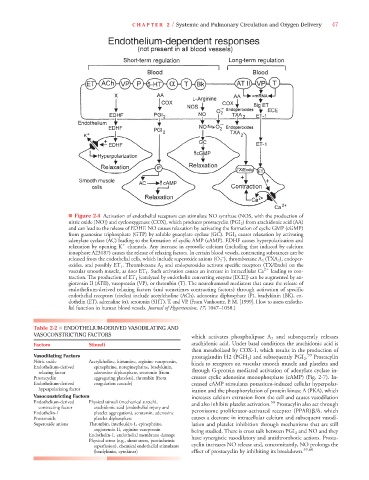
                              ■ Figure 2-4 Activation of endothelial receptors can stimulate NO synthase (NOS, with the production of
                              nitric oxide [NO]) and cyclooxygenase (COX), which produces prostacyclin (PGI 2 ) from arachidonic acid (AA)
                              and can lead to the release of EDHF. NO causes relaxation by activating the formation of cyclic GMP (cGMP)
                              from guanosine triphosphate (GTP) by soluble guanylate cyclase (GC). PGI 2 causes relaxation by activating
                              adenylate cyclase (AC) leading to the formation of cyclic AMP (cAMP). EDHF causes hyperpolarization and

                              relaxation by opening K channels. Any increase in cytosolic calcium (including that induced by calcium
                              ionophore A23187) causes the release of relaxing factors. In certain blood vessels, contracting substances can be
                                                                                 –
                              released from the endothelial cells, which include superoxide anions (O 2 ), thromboxane A 2 (TXA 2 ), endoper-
                                                                                            A
                              oxides, and possibly ET 1 . Thromboxane A 2 and endoperoxides activate specific receptors (TX/Endo) on the
                                                            A
                              vascular smooth muscle, as does ET 1 . Such activation causes an increase in intracellular Ca 2
  leading to con-
                              traction. The production of ET 1 (catalyzed by endothelin converting enzyme [ECE]) can be augmented by an-
                              giotensin II (ATII), vasopressin (VP), or thrombin (T). The neurohumoral mediators that cause the release of
                              endothelium-derived relaxing factors (and sometimes contracting factors) through activation of specific
                              endothelial receptors (circles) include acetylcholine (ACh), adenosine diphosphate (P), bradykinin (BK), en-
                              dothelin (ET), adrenaline ( ), serotonin (5HT), T, and VP. (From Vanhoutte, P. M. [1999]. How to assess endothe-
                                                                          7
                                                                          7
                              lial function in human blood vessels. Journal of Hypertension, 17, 1047–1058.)
                   Table 2-2 ■ ENDOTHELIUM-DERIVED VASODILATING AND
                   VASOCONSTRICTING FACTORS                            which activates  phospholipase  A 2 and subsequently releases
                   Factors           Stimuli                           arachidonic acid. Under basal conditions the arachidonic acid is
                                                                       then metabolized by COX-1, which results in the production of
                   Vasodilating Factors                                prostaglandin H2 (PGH 2 ) and subsequently PGI 2 . 59  Prostacylin
                   Nitric oxide      Acetylcholine, histamine, arginine vasopressin,  binds to receptors on vascular smooth muscle and platelets and
                   Endothelium-derived  epinephrine, norepinephrine, bradykinin,
                     relaxing factor   adenosine diphosphate, serotonin (from  through G-protein mediated activation of adenylate cyclase in-
                   Prostacyclin        aggregating platelets), thrombin (from  creases cyclic adenosine monophosphate (cAMP) (Fig. 2-7). In-
                   Endothelium-derived  coagulation cascade)           creased cAMP stimulates potassium-induced cellular hyperpolar-
                     hyperpolarizing factor                            ization and the phosphorylation of protein kinase A (PKA), which
                   Vasoconstricting Factors                            increases calcium extrusion from the cell and causes vasodilation
                   Endothelium-derived  Physical stimuli (mechanical stretch),    and also inhibits platelet activation. Prostacylin also act through
                                                                                                 59
                     contracting factor  arachidonic acid (endothelial injury and
                   Endothelin-1        platelet aggregation), serotonin, adenosine   peroxisome proliferator-activated receptor (PPAR) /
, which
                   Prostanoids         platelet diphosphate            causes a decrease in intracellular calcium and subsequent vasodi-
                   Superoxide anions  Thrombin, interleukin-1, epinephrine,  lation and platelet inhibition through mechanisms that are still
                                       angiotensin II, arginine vasopressin  being studied. There is cross talk between PGI 2 and NO and they
                                     Endothelin-1, endothelial membrane damage
                                     Physical stress (e.g., shear stress, postischemic  have synergistic vasodilatory and antithrombotic actions. Prosta-
                                       reperfusion), chemical endothelial stimulants  cyclin increases NO release and, concomitantly, NO prolongs the
                                       (bradykinin, cytokines)         effect of prostacyclin by inhibiting its breakdown. 59,60

