


Page 68 - Cardiac Nursing
P. 68
6/3
                              6/3
                             0
                              0
                             0
                                  009
                                     1
                                  009
                                0/2
                                0/2
                           xd
                      2-0
                        68.
                      2-0
                    04
                    04
                          q
                           xd
                          q
                        68.
                          q
                                     1
                                                p
                                                p
                                              4 A
                                            e 4
                                              4 A
                                                  r
                                                  r
                                                 ta
                                                p
                                                 ta
                                            e 4
                                        3
                                         Pa
                                        3
                                      5:3
                                      5:3
                                           g
                                           g
                                           g
                                         Pa
                                         Pa
            K34
            K34
               0-c
         LWBK340-c02_ p pp042-068.qxd  06/30/2009  15:33  Page 44 Aptara a a
         LWB
         LWB
                   p
                 02_
                 02_
               0-c
                  44    PA R T  I / Anatomy and Physiology
                    Phenotype                       Organ (function)
                    Continuous              bm      CNS (blood brain barrier)
                                                    Lymph node (lymphocyte homing)
                                                    Muscle (metabolic exchange)
                                                tj
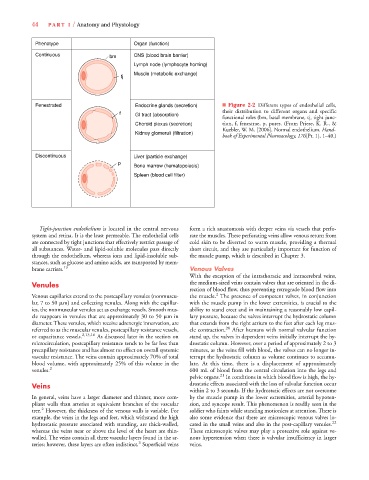
                    Fenestrated                     Endocrine glands (secretion)  ■ Figure 2-2 Different types of endothelial cells,
                                               f    GI tract (absorption)        their distribution to different organs and specific
                                                                                 functional roles (bm, basal membrane, tj, tight junc-
                                                    Choroid plexus (secretion)   tion, f, fenestrae, p, pores. (From Priese, K. R., &
                                                                                 Kuebler, W. M. [2006]. Normal endothelium. Hand-
                                                    Kidney glomeruli (filtration)
                                                                                                           6
                                                                                 book of Experimental Pharmacology, 176[Pt. 1], 1–40.)
                                                                                                           6
                    Discontinuous                   Liver (particle exchange)
                                               p
                                                    Bone marrow (hematopoiesis)
                                                    Spleen (blood cell filter)
                     Tight-junction endothelium is located in the central nervous  form a rich anastomosis with deeper veins via vessels that perfo-
                  system and retina. It is the least permeable. The endothelial cells  rate the muscles. These perforating veins allow venous return from
                  are connected by tight junctions that effectively restrict passage of  cold skin to be diverted to warm muscle, providing a thermal
                  all substances. Water- and lipid-soluble molecules pass directly  short circuit, and they are particularly important for function of
                  through the endothelium, whereas ions and lipid-insoluble sub-  the muscle pump, which is described in Chapter 3.
                  stances, such as glucose and amino acids, are transported by mem-
                  brane carriers. 19                                  Venous Valves
                                                                      With the exception of the intrathoracic and intracerebral veins,
                  Venules                                             the medium-sized veins contain valves that are oriented in the di-
                                                                      rection of blood flow, thus preventing retrograde blood flow into
                                                                               2
                  Venous capillaries extend to the postcapillary venules (nonmuscu-  the muscle. The presence of competent valves, in conjunction
                  lar, 7 to 50  m) and collecting venules. Along with the capillar-  with the muscle pump in the lower extremities, is crucial to the
                  ies, the nonmuscular venules act as exchange vessels. Smooth mus-  ability to stand erect and in maintaining a reasonably low capil-
                  cle reappears in venules that are approximately 30 to 50  m in  lary pressure, because the valves interrupt the hydrostatic column
                  diameter. These venules, which receive adrenergic innervation, are  that extends from the right atrium to the feet after each leg mus-
                  referred to as the muscular venules, postcapillary resistance vessels,  cle contraction. 20  After humans with normal valvular function
                  or capacitance vessels. 2,13,16  As discussed later in the section on  stand up, the valves in dependent veins initially interrupt the hy-
                  microcirculation, postcapillary resistance tends to be far less than  drostatic column. However, over a period of approximately 2 to 3
                  precapillary resistance and has almost no effect on overall systemic  minutes, as the veins fill with blood, the valves can no longer in-
                  vascular resistance. The veins contain approximately 70% of total  terrupt the hydrostatic column as volume continues to accumu-
                  blood volume, with approximately 25% of this volume in the  late. At this time, there is a  displacement of approximately
                  venules. 2                                          600 mL of blood from the central circulation into the legs and
                                                                                21
                                                                      pelvic organs. In conditions in which blood flow is high, the hy-
                  Veins                                               drostatic effects associated with the loss of valvular function occur
                                                                      within 2 to 3 seconds. If the hydrostatic effects are not overcome
                  In general, veins have a larger diameter and thinner, more com-  by the muscle pump in the lower extremities, arterial hypoten-
                  pliant walls than arteries at equivalent branches of the vascular  sion, and syncope result. This phenomenon is readily seen in the
                      2
                  tree. However, the thickness of the venous walls is variable. For  soldier who faints while standing motionless at attention. There is
                  example, the veins in the legs and feet, which withstand the high  also some evidence that there are microscopic venous valves lo-
                  hydrostatic pressure associated with standing, are thick-walled,  cated in the small veins and also in the post-capillary venules. 22
                  whereas the veins near or above the level of the heart are thin-  These microscopic valves may play a protective role against ve-
                  walled. The veins contain all three vascular layers found in the ar-  nous hypertension when there is valvular insufficiency in larger
                                                     3
                  teries; however, these layers are often indistinct. Superficial veins  veins.

