


Page 672 - Cardiac Nursing
P. 672
/30
                              /30
                                /09
                              6
                             6
                             6
                                   2:0
                                   2:0
                                     1 A
                                /09
                                   1
                                   1
                           xd
                                                      c.
                      8-6
                      8-6
                                                      c.
                    63
                    63
                          q
                          q
                           xd
                        54.
                        54.
                          q
                                     1 A
                                                 p
                                                  t
                                                  t
                                                A
                                                 p
                                                 p
                                                   a
                                                     In
                                                     In
                                                  ara
                                                  ara
                                                   a
                                                A
                                          Pa
                                           g
                                           g
                                        M
                                        M
                                          Pa
                                              48
                                              48
                                                A
                                           g
                                            e 6
                                            e 6
            K34
         LWB
                 27_
               0-c
         LWB K34 0-c 27_ p p pp638-654.qxd  6/30/09  12:01 AM  Page 648 Aptara Inc.
                                                      c.
         LWBK340-c27_
                  648    PA R T  I V / Pathophysiology and Management of Heart Disease
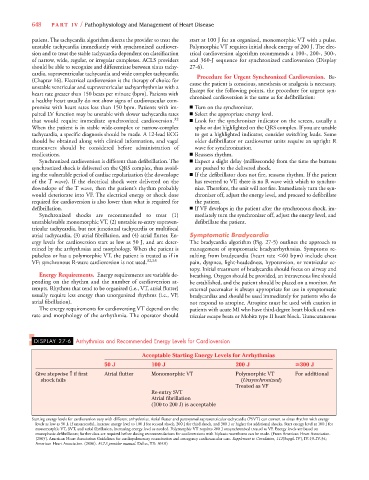
                  patient. The tachycardia algorithm directs the provider to treat the  start at 100 J for an organized, monomorphic VT with a pulse.
                  unstable tachycardia immediately with synchronized cardiover-  Polymorphic VT requires initial shock energy of 200 J. The elec-
                  sion and to treat the stable tachycardia dependent on classification  trical cardioversion algorithm recommends a 100-, 200-, 300-,
                  of narrow, wide, regular, or irregular complexes. ACLS providers  and 360-J sequence for synchronized cardioversion (Display
                  should be able to recognize and differentiate between sinus tachy-  27-6).
                  cardia, supraventricular tachycardia and wide complex tachycardia  Procedure for Urgent Synchronized Cardioversion. Be-
                  (Chapter 16). Electrical cardioversion is the therapy of choice for  cause the patient is conscious, anesthesia or analgesia is necessary.
                  unstable ventricular and supraventricular tachyarrhythmias with a  Except for the following points, the procedure for urgent syn-
                  heart rate greater than 150 beats per minute (bpm). Patients with  chronized cardioversion is the same as for defibrillation:
                  a healthy heart usually do not show signs of cardiovascular com-
                  promise with heart rates less than 150 bpm. Patients with im-  ■ Turn on the synchronizer.
                  paired LV function may be unstable with slower tachycardia rates  ■ Select the appropriate energy level.
                  that would require immediate synchronized cardioversion. 32  ■ Look for the synchronizer indicator on the screen, usually a
                  When the patient is in stable wide-complex or narrow-complex  spike or dot highlighted on the QRS complex. If you are unable
                  tachycardia, a specific diagnosis should be made. A 12-lead ECG  to get a highlighted indicator, consider switching leads. Some
                  should be obtained along with clinical information, and vagal  older defibrillator or cardioverter units require an upright R
                  maneuvers should  be considered  before administration of  wave for synchronization.
                  medications.                                        ■ Reassess rhythm.
                     Synchronized cardioversion is different than defibrillation. The  ■ Expect a slight delay (milliseconds) from the time the buttons
                  synchronized shock is delivered on the QRS complex, thus avoid-  are pushed to the delivered shock.
                  ing the vulnerable period of cardiac repolarization (the downslope  ■ If the defibrillator does not fire, reassess rhythm. If the patient
                  of the T wave). If the electrical shock were delivered on the  has reverted to VF, there is no R wave with which to synchro-
                  downslope of the T wave, then the patient’s rhythm probably  nize. Therefore, the unit will not fire. Immediately turn the syn-
                  would deteriorate into VF. The electrical energy or shock dose  chronizer off, adjust the energy level, and proceed to defibrillate
                  required for cardioversion is also lower than what is required for  the patient.
                  defibrillation.                                      ■ If VF develops in the patient after the synchronous shock, im-
                     Synchronized shocks are recommended to treat (1)   mediately turn the synchronizer off, adjust the energy level, and
                  unstable/stable monomorphic VT, (2) unstable re-entry supraven-  defibrillate the patient.
                  tricular tachycardia, but not junctional tachycardia or multifocal
                  atrial tachycardia, (3) atrial fibrillation, and (4) atrial flutter. En-  Symptomatic Bradycardia
                  ergy levels for cardioversion start as low as 50 J, and are deter-  The bradycardia algorithm (Fig. 27-5) outlines the approach to
                  mined by the arrhythmias and morphology. When the patient is  management of symptomatic bradyarrhythmias. Symptoms re-
                  pulseless or has a polymorphic VT, the patient is treated as if in  sulting from bradycardia (heart rate  60 bpm) include chest
                  VF; synchronous R-wave cardioversion is not used. 32,33  pain, dyspnea, light-headedness, hypotension, or ventricular ec-
                                                                      topy. Initial treatment of bradycardia should focus on airway and
                     Energy Requirements. Energy requirements are variable de-  breathing. Oxygen should be provided, an intravenous line should
                  pending on the rhythm and the number of cardioversion at-  be established, and the patient should be placed on a monitor. An
                  tempts. Rhythms that tend to be organized (i.e., VT, atrial flutter)  external pacemaker is always appropriate for use in symptomatic
                  usually require less energy than unorganized rhythms (i.e., VF,  bradycardias and should be used immediately for patients who do
                  atrial fibrillation).                                not respond to atropine. Atropine must be used with caution in
                     The energy requirements for cardioverting VT depend on the  patients with acute MI who have third-degree heart block and ven-
                  rate and morphology of the arrhythmia. The operator should  tricular escape beats or Mobitz type II heart block. Transcutaneous
                   DISPLAY 27-6 Arrhythmias and Recommended Energy Levels for Cardioversion
                                                      Acceptable Starting Energy Levels for Arrhythmias
                                          50 J            100 J                      200 J                300 J
                    Give stepwise c if first   Atrial flutter  Monomorphic VT          Polymorphic VT      For additional
                                                                                                   d
                                                                                                   d
                     shock fails                                                       (Unsynchronized)
                                                                                     Treated as VF
                                                          Re-entry SVT
                                                          Atrial fibrillation
                                                          (100 to 200 J) is acceptable
                  Starting energy levels for cardioversion vary with different arrhythmias. Atrial flutter and paroxysmal supraventricular tachycardia (PSVT) can convert to sinus rhythm with energy
                    levels as low as 50 J. If unsuccessful, increase energy level to 100 J for second shock, 200 J for third shock, and 300 J or higher for additional shocks. Start energy level at 100 J for
                    monomorphic VT, SVT, and atrial fibrillation, increasing energy level as needed. Polymorphic VT requires 200 J unsynchronized treated as VF. Energy levels are based on
                    monophasic defibrillators; further data are required before dosing recommendations for cardioversions with biphasic waveforms can be made. (From American Heart Association.
                    [2005]. American Heart Association Guidelines for cardiopulmonary resuscitation and emergency cardiovascular care. Supplement to Circulation, 112[Suppl. IV], IV-19–IV-34;
                    American Heart Association. (2006). ACLS provider manual. Dallas, TX: AHA)

