


Page 694 - Cardiac Nursing
P. 694
tar
                                                  Ap
                                               670
                                        AM
                                /1/
                                     49
                                           P
                         04.
                           qxd
                               7
                       5-7
                                             g
                    p65
                                 09
            K34
         LWBK340-c28_p655-704.qxd  7/1/09  9:9:49 AM  Page 670 Aptara
                 28_
               0-c
         LWB
         LWB K34 0-c 28_ p65 5-7 04. qxd  7 /1/ 09  9: 49  AM  P a a g e e  670  Ap tar a a
                  670    PA R T  I V / Pathophysiology and Management Disease
                   A
                                Pacing spike  Ventricular capture
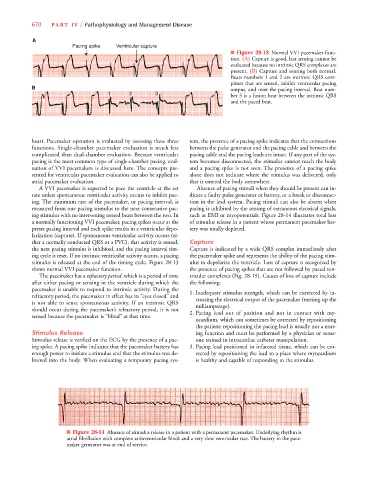
                                                                                   ■ Figure 28-13 Normal VVI pacemaker func-
                                                                                   tion. (A) Capture is good, but sensing cannot be
                                                                                   evaluated because no intrinsic QRS complexes are
                                                                                   present. (B) Capture and sensing both normal.
                                                                                   Beats numbers 1 and 2 are intrinsic QRS com-
                                                                                   plexes that are sensed, inhibit ventricular pacing
                  B                                                                output, and reset the pacing interval. Beat num-
                                           1 1 1  2 22     3 3 3 3                 ber 3 is a fusion beat between the intrinsic QRS
                                                                                   and the paced beat.
                  heart. Pacemaker operation is evaluated by assessing these three  tem, the presence of a pacing spike indicates that the connections
                  functions. Single-chamber pacemaker evaluation is much less  between the pulse generator and the pacing cable and between the
                  complicated than dual-chamber evaluation. Because ventricular  pacing cable and the pacing leads are intact. If any part of the sys-
                  pacing is the most common type of single-chamber pacing, eval-  tem becomes disconnected, the stimulus cannot reach the body
                  uation of VVI pacemakers is discussed here. The concepts pre-  and a pacing spike is not seen. The presence of a pacing spike
                  sented for ventricular pacemaker evaluation can also be applied to  alone does not indicate where the stimulus was delivered, only
                  atrial pacemaker evaluation.                        that it entered the body somewhere.
                     A VVI pacemaker is expected to pace the ventricle at the set  Absence of pacing stimuli when they should be present can in-
                  rate unless spontaneous ventricular activity occurs to inhibit pac-  dicate a faulty pulse generator or battery, or a break or disconnec-
                  ing. The minimum rate of the pacemaker, or pacing interval, is  tion in the lead system. Pacing stimuli can also be absent when
                  measured from one pacing stimulus to the next consecutive pac-  pacing is inhibited by the sensing of extraneous electrical signals,
                  ing stimulus with no intervening sensed beats between the two. In  such as EMI or myopotentials. Figure 28-14 illustrates total loss
                  a normally functioning VVI pacemaker, pacing spikes occur at the  of stimulus release in a patient whose permanent pacemaker bat-
                  preset pacing interval and each spike results in a ventricular depo-  tery was totally depleted.
                  larization (capture). If spontaneous ventricular activity occurs (ei-
                  ther a normally conducted QRS or a PVC), that activity is sensed,  Capture
                  the next pacing stimulus is inhibited, and the pacing interval tim-  Capture is indicated by a wide QRS complex immediately after
                  ing cycle is reset. If no intrinsic ventricular activity occurs, a pacing  the pacemaker spike and represents the ability of the pacing stim-
                  stimulus is released at the end of the timing cycle. Figure 28-13  ulus to depolarize the ventricle. Loss of capture is recognized by
                  shows normal VVI pacemaker function.                the presence of pacing spikes that are not followed by paced ven-
                     The pacemaker has a refractory period, which is a period of timed d  tricular complexes (Fig. 28-15). Causes of loss of capture include
                  after either pacing or sensing in the ventricle during which the  the following:
                  pacemaker is unable to respond to intrinsic activity. During the  1. Inadequate stimulus strength, which can be corrected by in-
                  refractory period, the pacemaker in effect has its “eyes closed” and  creasing the electrical output of the pacemaker (turning up the
                  is not able to sense spontaneous activity. If an intrinsic QRS  milliamperage).
                  should occur during the pacemaker’s refractory period, it is not  2. Pacing  lead out of position and not in contact with my-
                  sensed because the pacemaker is “blind” at that time.
                                                                        ocardium, which can sometimes be corrected by repositioning
                                                                        the patient; repositioning the pacing lead is usually not a nurs-
                  Stimulus Release                                      ing function and must be performed by a physician or some-
                  Stimulus release is verified on the ECG by the presence of a pac-  one trained in intracardiac catheter manipulation.
                  ing spike. A pacing spike indicates that the pacemaker battery has  3. Pacing lead positioned in infarcted tissue, which can be cor-
                  enough power to initiate a stimulus and that the stimulus was de-  rected by repositioning the lead to a place where myocardium
                  livered into the body. When evaluating a temporary pacing sys-  is healthy and capable of responding to the stimulus.


                              ■ Figure 28-14 Absence of stimulus release in a patient with a permanent pacemaker. Underlying rhythm is
                              atrial fibrillation with complete atrioventricular block and a very slow ventricular rate. The battery in the pace-
                              maker generator was at end of service.

