


Page 695 - Cardiac Nursing
P. 695
g
                                             g
                                              e
                                            a
                               7
                               7
                                                  Ap
                                                  Ap
                                                    tar
                                              e
                                               671
                                               671
                                        AM
                                     49
                                     49
                                           P
                                           P
                                        AM
                                /1/
                                /1/
                                            a
                                    9:
                                 09
                                 09
                           qxd
                 28_
                 28_
            K34
               0-c
                    p65
                    p65
               0-c
            K34
                         04.
                       5-7
                           qxd
                         04.
         LWBK340-c28_p655-704.qxd  7/1/09  9:9:49 AM  Page 671 Aptara a a
                                                    tar
                       5-7
                                                              C HAPTER 2 8 / Pacemakers and Implantable Defibrillators  671
                               A
                                                                 Pacing spikes with loss of capture
                              B
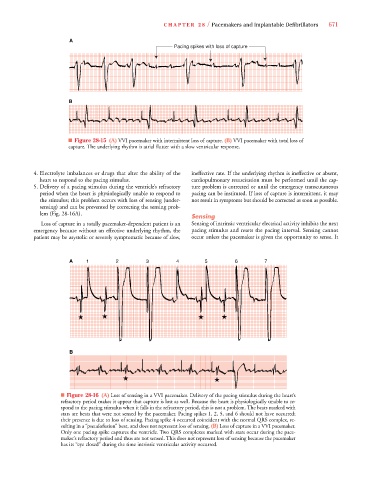
                              ■ Figure 28-15 (A) VVI pacemaker with intermittent loss of capture. (B) VVI pacemaker with total loss of
                              capture. The underlying rhythm is atrial flutter with a slow ventricular response.
                   4. Electrolyte imbalances or drugs that alter the ability of the  ineffective rate. If the underlying rhythm is ineffective or absent,
                     heart to respond to the pacing stimulus.          cardiopulmonary resuscitation must be performed until the cap-
                   5. Delivery of a pacing stimulus during the ventricle’s refractory  ture problem is corrected or until the emergency transcutaneous
                     period when the heart is physiologically unable to respond to  pacing can be instituted. If loss of capture is intermittent, it may
                     the stimulus; this problem occurs with loss of sensing (under-  not result in symptoms but should be corrected as soon as possible.
                     sensing) and can be prevented by correcting the sensing prob-
                     lem (Fig. 28-16A).
                                                                       Sensing
                     Loss of capture in a totally pacemaker-dependent patient is an  Sensing of intrinsic ventricular electrical activity inhibits the next
                   emergency because without an effective underlying rhythm, the  pacing stimulus and resets the pacing interval. Sensing cannot
                   patient may be asystolic or severely symptomatic because of slow,  occur unless the pacemaker is given the opportunity to sense. It
                               A    1         2         3         4        5         6         7


                               B


                            ■ Figure 28-16 (A) Loss of sensing in a VVI pacemaker. Delivery of the pacing stimulus during the heart’s
                            refractory period makes it appear that capture is lost as well. Because the heart is physiologically unable to re-
                            spond to the pacing stimulus when it falls in the refractory period, this is not a problem. The beats marked with
                            stars are beats that were not sensed by the pacemaker. Pacing spikes 1, 2, 5, and 6 should not have occurred;
                            their presence is due to loss of sensing. Pacing spike 4 occurred coincident with the normal QRS complex, re-
                            sulting in a “pseudofusion” beat, and does not represent loss of sensing. (B) Loss of capture in a VVI pacemaker.
                            Only one pacing spike captures the ventricle. Two QRS complexes marked with stars occur during the pace-
                            maker’s refractory period and thus are not sensed. This does not represent loss of sensing because the pacemaker
                            has its “eye closed” during the time intrinsic ventricular activity occurred.

