


Page 696 - Cardiac Nursing
P. 696
g
                                           P
                                                    tar
                                     49
                                        AM
                    p65
                                 09
                           qxd
                               7
                                /1/
                         04.
                                                  Ap
                                               672
                       5-7
            K34
               0-c
                 28_
         L L LWB K34 0-c 28_ p65 5-7 04. qxd  7 /1/ 09  9: 49  AM  P a a g e e  672  Ap tar a a
         LWBK340-c28_p655-704.qxd  7/1/09  9:9:49 AM  Page 672 Aptara
         LWB
                  672    PA R T  I V / Pathophysiology and Management Disease
                  A
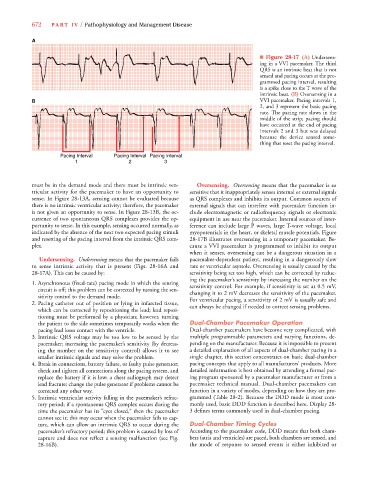
                                                                                             ■ Figure 28-17 (A) Undersens-
                                                                                             ing in a VVI pacemaker. The third
                                                                                             QRS is an intrinsic beat that is not
                                                                                             sensed and pacing occurs at the pro-
                                                                                             grammed pacing interval, resulting
                                                                                             is a spike close to the T wave of the
                                                                                             intrinsic beat. (B) Oversensing in a
                  B                                                                          VVI pacemaker. Pacing intervals 1,
                                                                                             2, and 3 represent the basic pacing
                                                                                             rate. The pacing rate slows in the
                                                                                             middle of the strip; pacing should
                                                                                             have occurred at the end of pacing
                                                                                             intervals 2 and 3 but was delayed
                                                                                             because the  device sensed some-
                                                                                             thing that reset the pacing interval.
                            Pacing Interval  Pacing Interval Pacing Interval
                                 1                2           3

                  must be in the demand mode and there must be intrinsic ven-  Oversensing. Oversensing means that the pacemaker is so
                  tricular activity for the pacemaker to have an opportunity to  sensitive that it inappropriately senses internal or external signals
                  sense. In Figure 28-13A, sensing cannot be evaluated because  as QRS complexes and inhibits its output. Common sources of
                  there is no intrinsic ventricular activity; therefore, the pacemaker  external signals that can interfere with pacemaker function in-
                  is not given an opportunity to sense. In Figure 28-13B, the oc-  clude electromagnetic or radiofrequency signals or electronic
                  currence of two spontaneous QRS complexes provides the op-  equipment in use near the pacemaker. Internal sources of inter-
                  portunity to sense. In this example, sensing occurred normally, as  ference can include large P waves, large T-wave voltage, local
                  indicated by the absence of the next two expected pacing stimuli  myopotentials in the heart, or skeletal muscle potentials. Figure
                  and resetting of the pacing interval from the intrinsic QRS com-  28-17B illustrates oversensing in a temporary pacemaker. Be-
                  plex.                                               cause a VVI pacemaker is programmed to inhibit its output
                                                                      when it senses, oversensing can be a dangerous situation in a
                     Undersensing. Undersensing means that the pacemaker fails  pacemaker-dependent patient, resulting in a dangerously slow
                  to sense intrinsic activity that is present (Figs. 28-16A and  rate or ventricular asystole. Oversensing is usually caused by the
                  28-17A). This can be caused by:                     sensitivity being set too high, which can be corrected by reduc-
                                                                      ing the pacemaker’s sensitivity by increasing the number on the
                  1. Asynchronous (fixed-rate) pacing mode in which the sensing  sensitivity control. For example, if sensitivity is set at 0.5 mV,
                    circuit is off; this problem can be corrected by turning the sen-  changing it to 2 mV decreases the sensitivity of the pacemaker.
                    sitivity control to the demand mode.              For ventricular pacing, a sensitivity of 2 mV is usually safe and
                  2. Pacing catheter out of position or lying in infarcted tissue,  can always be changed if needed to correct sensing problems.
                    which can be corrected by repositioning the lead; lead reposi-
                    tioning must be performed by a physician; however, turning
                    the patient to the side sometimes temporarily works when the  Dual-Chamber Pacemaker Operation
                    pacing lead loses contact with the ventricle.     Dual-chamber pacemakers have become very complicated, with
                  3. Intrinsic QRS voltage may be too low to be sensed by the  multiple programmable parameters and varying functions, de-
                    pacemaker; increasing the pacemaker’s sensitivity (by decreas-  pending on the manufacturer. Because it is impossible to present
                    ing the number on the sensitivity control) allows it to see  a detailed explanation of all aspects of dual-chamber pacing in a
                    smaller intrinsic signals and may solve the problem.  single chapter, this section concentrates on basic dual-chamber
                  4. Break in connections, battery failure, or faulty pulse generator;  pacing concepts that apply to all manufacturers’ products. More
                    check and tighten all connections along the pacing system, and  detailed information is best obtained by attending a formal pac-
                    replace the battery if it is low; a chest radiograph may detect  ing program sponsored by a pacemaker manufacturer or from a
                    lead fracture; change the pulse generator if problems cannot be  pacemaker technical manual. Dual-chamber pacemakers can
                    corrected any other way.                          function in a variety of modes, depending on how they are pro-
                  5. Intrinsic ventricular activity falling in the pacemaker’s refrac-  grammed (Table 28-2). Because the DDD mode is most com-
                    tory period; if a spontaneous QRS complex occurs during the  monly used, basic DDD function is described here. Display 28-
                    time the pacemaker has its “eyes closed,” then the pacemaker  3 defines terms commonly used in dual-chamber pacing.
                    cannot see it; this may occur when the pacemaker fails to cap-
                    ture, which can allow an intrinsic QRS to occur during the  Dual-Chamber Timing Cycles
                    pacemaker’s refractory period; this problem is caused by loss of  According to the pacemaker code, DDD means that both cham-
                    capture and does not reflect a sensing malfunction (see Fig.  bers (atria and ventricles) are paced, both chambers are sensed, and
                    28-16B).                                          the mode of response to sensed events is either inhibited or

