


Page 699 - Cardiac Nursing
P. 699
AM
                                     49
                                                    tar
                                           P
                               7
                                 09
                                /1/
                       5-7
                         04.
                           qxd
                    p65
                                                  Ap
                                               675
                                             g
            K34
               0-c
                 28_
         LWB K34 0-c 28_ p65 5-7 04. qxd  7 /1/ 09  9: 49  AM  P a a g e e  675  Ap tar a a
         L L LWB
         LWBK340-c28_p655-704.qxd  7/1/09  9:9:49 AM  Page 675 Aptara
                                                              C HAPTER 2 8 / Pacemakers and Implantable Defibrillators  675
                       1      2       3     4     5  6      7          always easy to see. The atrial response to pacing is often so small
                                                                       that it cannot be seen in many monitoring leads, so we cannot rely
                                                                       on the presence of a P wave after atrial pacing spikes as evidence of
                                                                       atrial capture. In the absence of a clear P wave, atrial capture can
                                                                       be assumed only when an atrial pacing spike is followed by a nor-
                                                                       mally conducted QRS complex within the programmed AV de-
                                                                       lay. If the atrial spike captures the atrium and there is intact AV
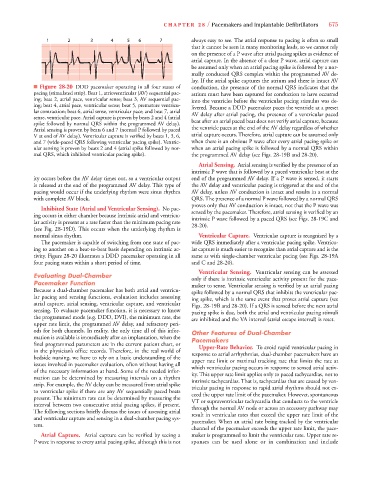
                   ■ Figure 28-20 DDD pacemaker operating in all four states of  conduction, the presence of the normal QRS indicates that the
                   pacing (stimulated strip). Beat 1, atrioventricular (AV) sequential pac-  atrium must have been captured for conduction to have occurred
                   ing; beat 2, atrial pace, ventricular sense; beat 3, AV sequential pac-  into the ventricles before the ventricular pacing stimulus was de-
                   ing; beat 4, atrial pace, ventricular sense; beat 5, premature ventricu-  livered. Because a DDD pacemaker paces the ventricle at a preset
                   lar contraction; beat 6, atrial sense, ventricular pace; and beat 7, atrial  AV delay after atrial pacing, the presence of a ventricular paced
                   sense, ventricular pace. Atrial capture is proven by beats 2 and 4 (atrial
                   spike followed by normal QRS within the programmed AV delay).  beat after an atrial paced beat does not verify atrial capture, because
                   Atrial sensing is proven by beats 6 and 7 (normal P followed by paced  the ventricle paces at the end of the AV delay regardless of whether
                   V at end of AV delay). Ventricular capture is verified by beats 1, 3, 6,  atrial capture occurs. Therefore, atrial capture can be assumed only
                   and 7 (wide-paced QRS following ventricular pacing spike). Ventric-  when there is an obvious P wave after every atrial pacing spike or
                   ular sensing is proven by beats 2 and 4 (atrial spike followed by nor-  when an atrial pacing spike is followed by a normal QRS within
                   mal QRS, which inhibited ventricular pacing spike).  the programmed AV delay (see Figs. 28-19B and 28-20).
                                                                         Atrial Sensing. Atrial sensing is verified by the presence of an
                                                                       intrinsic P wave that is followed by a paced ventricular beat at the
                   ity occurs before the AV delay times out, so a ventricular output  end of the programmed AV delay. If a P wave is sensed, it starts
                   is released at the end of the programmed AV delay. This type of  the AV delay and ventricular pacing is triggered at the end of the
                   pacing would occur if the underlying rhythm were sinus rhythm  AV delay, unless AV conduction is intact and results in a normal
                   with complete AV block.                             QRS. The presence of a normal P wave followed by a normal QRS
                                                                       proves only that AV conduction is intact, not that the P wave was
                     Inhibited State (Atrial and Ventricular Sensing). No pac-
                                                                       sensed by the pacemaker. Therefore, atrial sensing is verified by an
                   ing occurs in either chamber because intrinsic atrial and ventricu-
                                                                       intrinsic P wave followed by a paced QRS (see Figs. 28-19C and
                   lar activity is present at a rate faster than the minimum pacing rate
                                                                       28-20).
                   (see Fig. 28-19D). This occurs when the underlying rhythm is
                   normal sinus rhythm.                                  Ventricular Capture. Ventricular capture is recognized by a
                     The pacemaker is capable of switching from one state of pac-  wide QRS immediately after a ventricular pacing spike. Ventricu-
                   ing to another on a beat-to-beat basis depending on intrinsic ac-  lar capture is much easier to recognize than atrial capture and is the
                   tivity. Figure 28-20 illustrates a DDD pacemaker operating in all  same as with single-chamber ventricular pacing (see Figs. 28-19A
                   four pacing states within a short period of time.   and C and 28-20).
                                                                         Ventricular Sensing. Ventricular sensing can be assessed
                   Evaluating Dual-Chamber                             only if there is intrinsic ventricular activity present for the pace-
                   Pacemaker Function                                  maker to sense. Ventricular sensing is verified by an atrial pacing
                   Because a dual-chamber pacemaker has both atrial and ventricu-  spike followed by a normal QRS that inhibits the ventricular pac-
                   lar pacing and sensing functions, evaluation includes assessing  ing spike, which is the same event that proves atrial capture (see
                   atrial capture, atrial sensing, ventricular capture, and ventricular  Figs. 28-19B and 28-20). If a QRS is sensed before the next atrial
                   sensing. To evaluate pacemaker function, it is necessary to know  pacing spike is due, both the atrial and ventricular pacing stimuli
                   the programmed mode (e.g. DDD, DVI), the minimum rate, the  are inhibited and the VA interval (atrial escape interval) is reset.
                   upper rate limit, the programmed AV delay, and refractory peri-
                   ods for both channels. In reality, the only time all of this infor-  Other Features of Dual-Chamber
                   mation is available is immediately after an implantation, when the  Pacemakers
                   final programmed parameters are in the current patient chart, or
                   in the physician’s office records. Therefore, in the real world of  Upper-Rate Behavior. To avoid rapid ventricular pacing in
                   bedside nursing, we have to rely on a basic understanding of the  response to atrial arrhythmias, dual-chamber pacemakers have an
                   issues involved in pacemaker evaluation, often without having all  upper rate limit or maximal tracking rate that limits the rate at
                   of the necessary information at hand. Some of the needed infor-  which ventricular pacing occurs in response to sensed atrial activ-
                   mation can be determined by measuring intervals on a rhythm  ity. This upper rate limit applies only to paced tachycardias, not to
                   strip. For example, the AV delay can be measured from atrial spike  intrinsic tachycardias. That is, tachycardias that are caused by ven-
                   to ventricular spike if there are any AV sequentially paced beats  tricular pacing in response to rapid atrial rhythms should not ex-
                   present. The minimum rate can be determined by measuring the  ceed the upper rate limit of the pacemaker. However, spontaneous
                   interval between two consecutive atrial pacing spikes, if present.  VT or supraventricular tachycardia that conducts to the ventricle
                   The following sections briefly discuss the issues of assessing atrial  through the normal AV node or across an accessory pathway may
                   and ventricular capture and sensing in a dual-chamber pacing sys-  result in ventricular rates that exceed the upper rate limit of the
                   tem.                                                pacemaker. When an atrial rate being tracked by the ventricular
                                                                       channel of the pacemaker exceeds the upper rate limit, the pace-
                     Atrial Capture. Atrial capture can be verified by seeing a   maker is programmed to limit the ventricular rate. Upper rate re-
                   P wave in response to every atrial pacing spike, although this is not  sponses can  be used alone or in combination and include

