


Page 698 - Cardiac Nursing
P. 698
9:
                                 09
                                 09
                                     49
                                        AM
                                        AM
                                     49
                           qxd
                           qxd
                         04.
                               7
                                /1/
                                /1/
                               7
                                               674
                                               674
                                              e
                                                  Ap
                                                    tar
                                                    tar
                                                  Ap
                                            a
                                           P
                                           P
                                            a
                                              e
                                             g
                                             g
            K34
            K34
         LWB
               0-c
                    p65
                    p65
               0-c
                         04.
                 28_
                 28_
         LWBK340-c28_p655-704.qxd  7/1/09  9:9:49 AM  Page 674 Aptara a a
                       5-7
                       5-7
         L L LWB
                  674    PA R T  I V / Pathophysiology and Management Disease
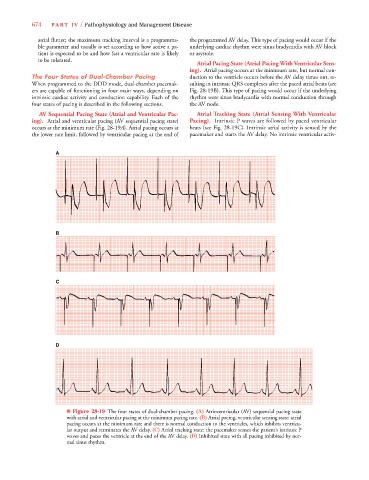
                    atrial flutter; the maximum tracking interval is a programma-  the programmed AV delay. This type of pacing would occur if the
                    ble parameter and usually is set according to how active a pa-  underlying cardiac rhythm were sinus bradycardia with AV block
                    tient is expected to be and how fast a ventricular rate is likely  or asystole.
                    to be tolerated.
                                                                        Atrial Pacing State (Atrial Pacing With Ventricular Sens-
                                                                      ing). Atrial pacing occurs at the minimum rate, but normal con-
                  The Four States of Dual-Chamber Pacing              duction to the ventricle occurs before the AV delay times out, re-
                  When programmed to the DDD mode, dual-chamber pacemak-  sulting in intrinsic QRS complexes after the paced atrial beats (see
                  ers are capable of functioning in four main ways, depending on  Fig. 28-19B). This type of pacing would occur if the underlying
                  intrinsic cardiac activity and conduction capability. Each of the  rhythm were sinus bradycardia with normal conduction through
                  four states of pacing is described in the following sections.  the AV node.
                     AV Sequential Pacing State (Atrial and Ventricular Pac-  Atrial Tracking State (Atrial Sensing With Ventricular
                  ing). Atrial and ventricular pacing (AV sequential pacing state)  Pacing). Intrinsic P waves are followed by paced ventricular
                                              9
                  occurs at the minimum rate (Fig. 28-19A). Atrial pacing occurs at  beats (see Fig. 28-19C). Intrinsic atrial activity is sensed by the
                                              9
                  the lower rate limit, followed by ventricular pacing at the end of  pacemaker and starts the AV delay. No intrinsic ventricular activ-
                          A
                          B
                          C


                          D


                              ■ Figure 28-19 The four states of dual-chamber pacing. (A) Atrioventricular (AV) sequential pacing state
                              with atrial and ventricular pacing at the minimum pacing rate. (B) Atrial pacing, ventricular sensing state: atrial
                              pacing occurs at the minimum rate and there is normal conduction to the ventricles, which inhibits ventricu-
                              lar output and terminates the AV delay. (C) Atrial tracking state: the pacemaker senses the patient’s intrinsic P
                              waves and paces the ventricle at the end of the AV delay. (D) Inhibited state with all pacing inhibited by nor-
                              mal sinus rhythm.

