


Page 697 - Cardiac Nursing
P. 697
qxd
                           qxd
                         04.
                               7
                                /1/
                                /1/
                               7
                         04.
                                                  Ap
                                                    tar
                                               673
                                                  Ap
                       5-7
                       5-7
                                                    tar
                                 09
                                             g
                                            a
                                            a
                                             g
                                               673
                                              e
                                              e
                                           P
                                     49
                                    9:
                                 09
                                     49
                                           P
                                        AM
                                        AM
               0-c
               0-c
            K34
            K34
                    p65
                 28_
                 28_
                    p65
         LWB
         LWBK340-c28_p655-704.qxd  7/1/09  9:9:49 AM  Page 673 Aptara a a
         L L LWB
                                                              C HAPTER 2 8 / Pacemakers and Implantable Defibrillators  673
                                                                           A
                   Table 28-2 ■ DUAL-CHAMBER PACING MODES                   Pacing Interval  AV Interval
                         Chamber(s) Chamber(s)
                   Mode  Paced      Sensed    Response to Sensing
                   DVI   Atrium and  Ventricle  Ventricular sensing inhibits atrial
                           ventricle            and ventricular pacing
                   VDD   Ventricle  Atrium and  Atrial sensing—triggers
                                     ventricle  ventricular pacing
                                              Ventricular sensing—inhibits
                                                ventricular pacing                       Atrial Escape interval (V-A interval)
                   DDI   Atrium and   Atrium and  Atrial sensing inhibits atrial
                           ventricle  ventricle  pacing
                                              Ventricular sensing inhibits     B
                                                ventricular pacing
                   DDD   Atrium and   Atrium and  Atrial sensing—inhibits atrial
                           ventricle  ventricle  pacing, triggers ventricular
                                                pacing
                                              Ventricular sensing—inhibits
                                                atrial and ventricular pacing
                                                                                        AVI    PVARP
                   triggered, depending on which chamber is sensed. When atrial ac-
                   tivity is sensed, atrial pacing is inhibited and ventricular pacing is
                                                                         C
                   triggered at the end of the programmed AV delay. When ventricular
                   activity is sensed, all pacemaker output is inhibited. The following
                   timing cycles determine how a dual-chamber pacemaker functions,
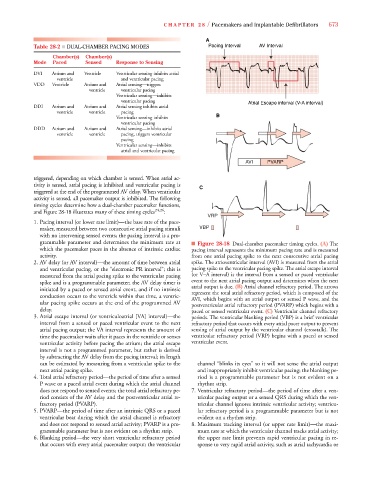
                   and Figure 28-18 illustrates many of these timing cycles 24,26 :
                                                                            VRP
                   1. Pacing interval (or lower rate limit)—the base rate of the pace-
                     maker, measured between two consecutive atrial pacing stimuli  VBP
                     with no intervening sensed events; the pacing interval is a pro-
                     grammable parameter and determines the minimum rate at  ■ Figure 28-18 Dual-chamber pacemaker timing cycles. (A) The
                     which the pacemaker paces in the absence of intrinsic cardiac  pacing interval represents the minimum pacing rate and is measured
                     activity.                                         from one atrial pacing spike to the next consecutive atrial pacing
                   2. AV delay (or AV interval)—the amount of time between atrial  spike. The atrioventricular interval (AVI) is measured from the atrial
                     and ventricular pacing, or the “electronic PR interval”; this is  pacing spike to the ventricular pacing spike. The atrial escape interval
                     measured from the atrial pacing spike to the ventricular pacing  (or V–A interval) is the interval from a sensed or paced ventricular
                     spike and is a programmable parameter; the AV delay timer is  event to the next atrial pacing output and determines when the next
                     initiated by a paced or sensed atrial event, and if no intrinsic  atrial output is due. (B) Atrial channel refractory period. The arrows
                                                                       represent the total atrial refractory period, which is composed of the
                     conduction occurs to the ventricle within that time, a ventric-  AVI, which begins with an atrial output or sensed P wave, and the
                     ular pacing spike occurs at the end of the programmed AV   postventricular atrial refractory period (PVARP) which begins with a
                     delay.                                            paced or sensed ventricular event. (C) Ventricular channel refractory
                   3. Atrial escape interval (or ventriculoatrial [VA] interval)—the  periods. The ventricular blanking period (VBP) is a brief ventricular
                     interval from a sensed or paced ventricular event to the next  refractory period that occurs with every atrial pacer output to prevent
                     atrial pacing output; the VA interval represents the amount of  sensing of atrial output by the ventricular channel (crosstalk). The
                     time the pacemaker waits after it paces in the ventricle or senses  ventricular refractory period (VRP) begins with a paced or sensed
                     ventricular activity before pacing the atrium; the atrial escape  ventricular event.
                     interval is not a programmed parameter, but rather is derived
                     by subtracting the AV delay from the pacing interval; its length
                     can be estimated by measuring from a ventricular spike to the  channel “blinks its eyes” so it will not sense the atrial output
                     next atrial pacing spike.                           and inappropriately inhibit ventricular pacing; the blanking pe-
                   4. Total atrial refractory period—the period of time after a sensed  riod is a programmable parameter but is not evident on a
                     P wave or a paced atrial event during which the atrial channel  rhythm strip.
                     does not respond to sensed events; the total atrial refractory pe-  7. Ventricular refractory period—the period of time after a ven-
                     riod consists of the AV delay and the postventricular atrial re-  tricular pacing output or a sensed QRS during which the ven-
                     fractory period (PVARP).                            tricular channel ignores intrinsic ventricular activity; ventricu-
                   5. PVARP—the period of time after an intrinsic QRS or a paced  lar refractory period is a programmable parameter but is not
                     ventricular beat during which the atrial channel is refractory  evident on a rhythm strip.
                     and does not respond to sensed atrial activity; PVARP is a pro-  8. Maximum tracking interval (or upper rate limit)—the maxi-
                     grammable parameter but is not evident on a rhythm strip.  mum rate at which the ventricular channel tracks atrial activity;
                   6. Blanking period—the very short ventricular refractory period  the upper rate limit prevents rapid ventricular pacing in re-
                     that occurs with every atrial pacemaker output; the ventricular  sponse to very rapid atrial activity, such as atrial tachycardia or

