


Page 700 - Cardiac Nursing
P. 700
09
                                     49
                                        AM
                                /1/
                         04.
                           qxd
                               7
                    p65
                                           P
                       5-7
                                             g
                                                    tar
                                                  Ap
                                               676
               0-c
         LWBK340-c28_p655-704.qxd  7/1/09  9:9:49 AM  Page 676 Aptara
            K34
         LWB K34 0-c 28_ p65 5-7 04. qxd  7 /1/ 09  9: 49  AM  P a a g e e  676  Ap tar a a
         L L LWB
                 28_
                  676    PA R T  I V / Pathophysiology and Management Disease
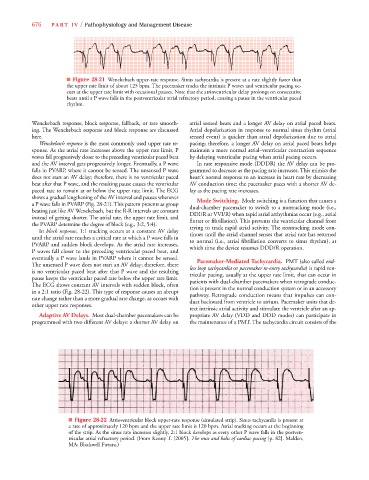
                              ■ Figure 28-21 Wenckebach upper-rate response. Sinus tachycardia is present at a rate slightly faster than
                              the upper rate limit of about 125 bpm. The pacemaker tracks the intrinsic P waves and ventricular pacing oc-
                              curs at the upper rate limit with occasional pauses. Note that the atrioventricular delay prolongs on consecutive
                              beats until a P wave falls in the postventricular atrial refractory period, causing a pause in the ventricular paced
                              rhythm.

                  Wenckebach response, block response, fallback, or rate smooth-  atrial sensed beats and a longer AV delay on atrial paced beats.
                  ing. The Wenckebach response and block response are discussed  Atrial depolarization in response to normal sinus rhythm (atrial
                  here.                                               sensed event) is quicker than atrial depolarization due to atrial
                     Wenckebach response is the most commonly used upper rate re-  pacing; therefore, a longer AV delay on atrial paced beats helps
                  sponse. As the atrial rate increases above the upper rate limit, P  maintain a more normal atrial–ventricular contraction sequence
                  waves fall progressively closer to the preceding ventricular paced beat  by delaying ventricular pacing when atrial pacing occurs.
                  and the AV interval gets progressively longer. Eventually, a P wave  In rate responsive mode (DDDR) the AV delay can be pro-
                  falls in PVARP, where it cannot be sensed. The unsensed P wave  grammed to decrease as the pacing rate increases. This mimics the
                  does not start an AV delay; therefore, there is no ventricular paced  heart’s normal response to an increase in heart rate by decreasing
                  beat after that P wave, and the resulting pause causes the ventricular  AV conduction time; the pacemaker paces with a shorter AV de-
                  paced rate to remain at or below the upper rate limit. The ECG  lay as the pacing rate increases.
                  shows a gradual lengthening of the AV interval and pauses whenever  Mode Switching. Mode switching is a function that causes a
                  a P wave falls in PVARP (Fig. 28-21). This pattern presents as group  dual-chamber pacemaker to switch to a nontracking mode (i.e.,
                  beating just like AV Wenckebach, but the R-R intervals are constant  DDI/R or VVI/R) when rapid atrial arrhythmias occur (e.g., atrial
                  instead of getting shorter. The atrial rate, the upper rate limit, and  flutter or fibrillation). This prevents the ventricular channel from
                  the PVARP determine the degree of block (e.g., 3:2, 5:4).  trying to track rapid atrial activity. The nontracking mode con-
                     In block response, 1:1 tracking occurs at a constant AV delay  tinues until the atrial channel senses that atrial rate has returned
                  until the atrial rate reaches a critical rate at which a P wave falls in  to normal (i.e., atrial fibrillation converts to sinus rhythm), at
                  PVARP and sudden block develops. As the atrial rate increases,  which time the device resumes DDD/R operation.
                  P waves fall closer to the preceding ventricular paced beat, and
                  eventually a P wave lands in PVARP where it cannot be sensed.  Pacemaker-Mediated Tachycardia. PMT (also called end-
                  The unsensed P wave does not start an AV delay; therefore, there  less loop tachycardia or pacemaker re-entry tachycardia) is rapid ven-
                  is no ventricular paced beat after that P wave and the resulting  tricular pacing, usually at the upper rate limit, that can occur in
                  pause keeps the ventricular paced rate below the upper rate limit.  patients with dual-chamber pacemakers when retrograde conduc-
                  The ECG shows constant AV intervals with sudden block, often  tion is present in the normal conduction system or in an accessory
                  in a 2:1 ratio (Fig. 28-22). This type of response causes an abrupt  pathway. Retrograde conduction means that impulses can con-
                  rate change rather than a more gradual rate change, as occurs with  duct backward from ventricle to atrium. Pacemaker units that de-
                  other upper rate responses.
                                                                      tect intrinsic atrial activity and stimulate the ventricle after an ap-
                     Adaptive AV Delays. Most dual-chamber pacemakers can be  propriate AV delay (VDD and DDD modes) can participate in
                  programmed with two different AV delays: a shorter AV delay on  the maintenance of a PMT. The tachycardia circuit consists of the


                              ■ Figure 28-22 Atrioventricular block upper-rate response (simulated strip). Sinus tachycardia is present at
                              a rate of approximately 120 bpm and the upper rate limit is 120 bpm. Atrial tracking occurs at the beginning
                              of the strip. As the sinus rate increases slightly, 2:1 block develops as every other P wave falls in the postven-
                              tricular atrial refractory period. (From Kenny T. [2005]. The nuts and bolts of cardiac pacing [p. 82]. Malden,
                              MA: Blackwell Futura.)

