


Page 709 - Cardiac Nursing
P. 709
09
                                             g
                                           P
                                                  Ap
                                               685
                       5-7
                           qxd
                         04.
                                     49
                                        AM
                                /1/
                               7
                                                    tar
               0-c
            K34
                    p65
                 28_
         LWB K34 0-c 28_ p65 5-7 04. qxd  7 /1/ 09  9: 49  AM  P a a g e e  685  Ap tar a a
         L L LWB
         LWBK340-c28_p655-704.qxd  7/1/09  9:9:49 AM  Page 685 Aptara
                                                              C HAPTER 2 8 / Pacemakers and Implantable Defibrillators  685
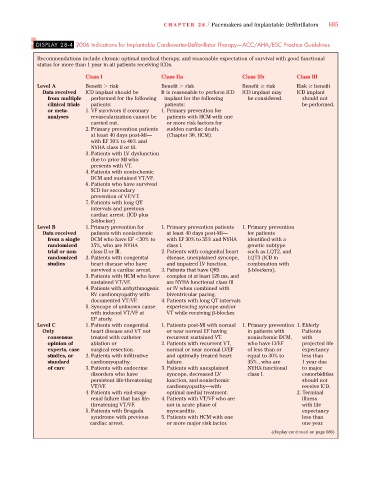
                    DISPLAY 28-4 2006 Indications for Implantable Cardioverter-Defibrillator Therapy—ACC/AHA/ESC Practice Guidelines
                    Recommendations include chronic optimal medical therapy, and reasonable expectation of survival with good functional
                    status for more than 1 year in all patients receiving ICDs.
                                    Class I                  Class IIa                 Class IIb         Class III
                    Level A         Benefit   risk            Benefit   risk             Benefit   risk     Risk   benefit
                      Data received  ICD implant should be   It is reasonable to perform ICD   ICD implant may  ICD implant
                        from multiple  performed for the following   implant for the following   be considered.  should not
                        clinical trials  patients:            patients:                                    be performed.
                        or meta-    1. VF survivors if coronary  1. Primary prevention for
                        analyses      revascularization cannot be  patients with HCM with one
                                      carried out.             or more risk factors for
                                    2. Primary prevention patients  sudden cardiac death.
                                      at least 40 days post-MI—  (Chapter 30, HCM).
                                      with EF 30% to 40% and
                                      NYHA class II or III.
                                    3. Patients with LV dysfunction
                                      due to prior MI who
                                      presents with VT.
                                    4. Patients with nonischemic
                                      DCM and sustained VT/VF.
                                    6. Patients who have survived
                                      SCD for secondary
                                      prevention of VF/VT.
                                    7. Patients with long QT
                                      intervals and previous
                                      cardiac arrest. (ICD plus
                                       -blocker)
                    Level B         1. Primary prevention for    1. Primary prevention patients   1. Primary prevention
                      Data received   patients with nonischemic    at least 40 days post-MI—   for patients
                        from a single  DCM who have EF  30% to   with EF 30% to 35% and NYHA   identified with a
                        randomized    35%, who are NYHA       class I.                   genetic subtype
                        trial or non-  class II or III.      2. Patients with congenital heart   such as LQT2, and
                        randomized  2. Patients with congenital   disease, unexplained syncope,  LQT3 (ICD in
                        studies       heart disease who have  and impaired LV function.  combination with
                                      survived a cardiac arrest.  3. Patients that have QRS    -blockers).
                                    3. Patients with HCM who have  complex of at least 120 ms, and
                                      sustained VT/VF.        are NYHA functional class III
                                    4. Patients with arrhythmogenic  or IV when combined with
                                      RV cardiomyopathy with   biventricular pacing.
                                      documented VT/VF.      4. Patients with long QT intervals
                                    5. Syncope of unknown cause   experiencing syncope and/or
                                      with induced VT/VF at   VT while receiving  -blocker.
                                      EP study.
                    Level C         1. Patients with congenital   1. Patients post-MI with normal   1. Primary prevention 1. Elderly
                      Only            heart disease and VT not   or near normal EF having    in patients with   Patients
                        consensus     treated with catheter   recurrent sustained VT.    nonischemic DCM,  with
                        opinion of    ablation or            2. Patients with recurrent VT,   who have LVEF  projected life
                        experts, case  surgical resection.    normal or near normal LVEF  of less than or  expectancy
                        studies, or   2. Patients with infiltrative  and optimally treated heart   equal to 30% to  less than
                        standard      cardiomyopathy.         failure.                   35% , who are     1 year due
                        of care     3. Patients with endocrine   3. Patients with unexplained    NYHA functional  to major
                                      disorders who have      syncope, decreased LV      class I.          comorbidities
                                      persistent life-threatening   function, and nonischemic              should not
                                      VT/VF.                  cardiomyopathy—with                          receive ICD.
                                    4. Patients with end-stage   optimal medial treatment.               2. Terminal
                                      renal failure that has life-  4. Patients with VT/VF who are         illness
                                      threatening VT/VF.      not in acute phase of                        with life
                                    5. Patients with Brugada   myocarditis.                                expectancy
                                      syndrome with previous  5. Patients with HCM with one                less than
                                     cardiac arrest.           or more major risk factor.                  one year.
                                                                                                 (display continued on page 686)

