


Page 704 - Cardiac Nursing
P. 704
5-7
                         04.
                           qxd
                    p65
                                               680
                                                    tar
                                                  Ap
                                        AM
                                           P
                                             g
                                     49
                               7
                                /1/
                                 09
            K34
               0-c
                 28_
         LWB K34 0-c 28_ p65 5-7 04. qxd  7 /1/ 09  9: 49  AM  P a a g e e  680  Ap tar a a
         LWB
         LWBK340-c28_p655-704.qxd  7/1/09  9:9:49 AM  Page 680 Aptara
                  680    PA R T  I V / Pathophysiology and Management Disease
                  A
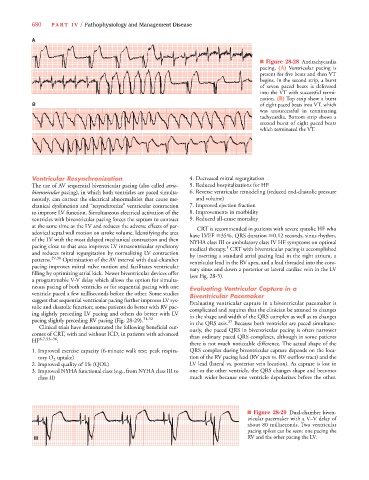
                                                                                             ■ Figure 28-28 Antitachycardia
                                                                                             pacing.  (A) Ventricular pacing is
                                                                                             present for five beats and then VT
                                                                                             begins. In the second strip, a burst
                                                                                             of seven paced  beats is  delivered
                                                                                             into the VT with successful termi-
                                                                                             nation. (B) Top strip show a burst
                  B                                                                          of eight paced beats into VT, which
                                                                                             was unsuccessful in terminating
                                                                                             tachycardia. Bottom strip shows a
                                                                                             second burst of eight paced beats
                                                                                             which terminated the VT.


                  Ventricular Resynchronization                       4. Decreased mitral regurgitation
                  The use of AV sequential biventricular pacing (also called atrio-  5.Reduced hospitalizations for HF
                  biventricular pacing), in which both ventricles are paced simulta-  6. Reverse ventricular remodeling (reduced end-diastolic pressure
                  neously, can correct the electrical abnormalities that cause me-  and volume)
                  chanical dysfunction and “resynchronize” ventricular contraction  7. Improved ejection fraction
                  to improve LV function. Simultaneous electrical activation of the  8. Improvements in morbidity
                  ventricles with biventricular pacing forces the septum to contract  9. Reduced all-cause mortality
                  at the same time as the LV and reduces the adverse effects of par-  CRT is recommended in patients with severe systolic HF who
                  adoxical septal wall motion on stroke volume. Identifying the area  have LVEF  35%, QRS duration  0.12 seconds, sinus rhythm,
                  of the LV with the most delayed mechanical contraction and then  NYHA class III or ambulatory class IV HF symptoms on optimal
                  pacing close to that area improves LV intraventricular synchrony  medical therapy. CRT with biventricular pacing is accomplished
                                                                                  1
                  and reduces mitral regurgitation by normalizing LV contraction  by inserting a standard atrial pacing lead in the right atrium, a
                  patterns. 29,30  Optimization of the AV interval with dual-chamber  ventricular lead in the RV apex, and a lead threaded into the coro-
                  pacing improves mitral valve motion and facilitates ventricular  nary sinus and down a posterior or lateral cardiac vein in the LV
                  filling by optimizing atrial kick. Newer biventricular devices offer  (see Fig. 28-5).
                  a programmable V-V delay which allows the option for simulta-
                  neous pacing of both ventricles or for sequential pacing with one  Evaluating Ventricular Capture in a
                  ventricle paced a few milliseconds before the other. Some studies  Biventricular Pacemaker
                  suggest that sequential ventricular pacing further improves LV sys-  Evaluating ventricular capture in a biventricular pacemaker is
                  tolic and diastolic function; some patients do better with RV pac-  complicated and requires that the clinician be attuned to changes
                  ing slightly preceding LV pacing and others do better with LV  in the shape and width of the QRS complex as well as to changes
                  pacing slightly preceding RV pacing (Fig. 28-29). 31,32  in the QRS axis. 37  Because both ventricles are paced simultane-
                     Clinical trials have demonstrated the following beneficial out-  ously, the paced QRS in biventricular pacing is often narrower
                  comes of CRT, with and without ICD, in patients with advanced  than ordinary paced QRS complexes, although in some patients
                  HF 6,7,33–36 :
                                                                      there is not much noticeable difference. The actual shape of the
                  1. Improved exercise capacity (6-minute walk test; peak respira-  QRS complex during biventricular capture depends on the loca-
                    tory O 2 uptake)                                  tion of the RV pacing lead (RV apex vs. RV outflow tract) and the
                  2. Improved quality of life (QOL)                   LV lead (lateral vs. posterior vein location). As capture is lost in
                  3. Improved NYHA functional class (e.g., from NYHA class III to  one or the other ventricle, the QRS changes shape and becomes
                    class II)                                         much wider because one ventricle depolarizes before the other.


                                                                                         ■ Figure 28-29 Dual-chamber biven-
                                                                                         tricular pacemaker with a V–V delay of
                                                                                         about 80 milliseconds. Two ventricular
                                                                                         pacing spikes can be seen: one pacing the
                    I I II II II                                                         RV and the other pacing the LV.

