


Page 713 - Cardiac Nursing
P. 713
04.
                           qxd
                               7
                                           P
                       5-7
                                                    tar
                                /1/
                                                  Ap
                                               689
                                             g
                                 09
                                     49
                                        AM
                    p65
            K34
               0-c
                 28_
         LWBK340-c28_p655-704.qxd  7/1/09  9:9:49 AM  Page 689 Aptara
         LWB K34 0-c 28_ p65 5-7 04. qxd  7 /1/ 09  9: 49  AM  P a a g e e  689  Ap tar a a
         LWB
                                                              C HAPTER 2 8 / Pacemakers and Implantable Defibrillators  689


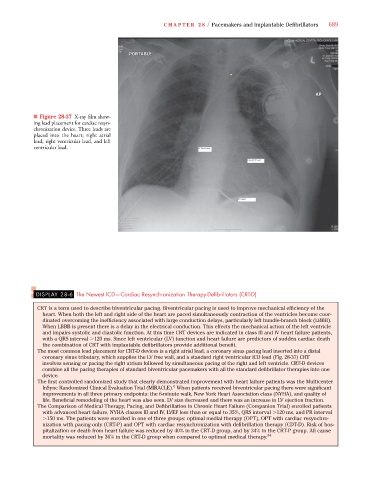
                   ■ Figure 28-37 X-ray film show-
                   ing lead placement for cardiac resyn-
                   chronization device. Three leads are
                   placed into the  heart; right atrial
                   lead, right ventricular lead, and left
                   ventricular lead.


                    DISPLAY 28-6 The Newest ICD—Cardiac Resynchronization Therapy-Defibrillators (CRT-D)

                    CRT is a term used to describe biventricular pacing. Biventricular pacing is used to improve mechanical efficiency of the
                      heart. When both the left and right side of the heart are paced simultaneously contraction of the ventricles become coor-
                      dinated overcoming the inefficiency associated with large conduction delays, particularly left bundle-branch block (LBBB).
                      When LBBB is present there is a delay in the electrical conduction. This effects the mechanical action of the left ventricle
                      and impairs systolic and diastolic function. At this time CRT devices are indicated in class III and IV heart failure patients,
                      with a QRS interval  120 ms. Since left ventricular (LV) function and heart failure are predictors of sudden cardiac death
                      the combination of CRT with implantable defibrillators provide additional benefit.
                    The most common lead placement for CRT-D devices is a right atrial lead, a coronary sinus pacing lead inserted into a distal
                      coronary sinus tributary, which supplies the LV free wall, and a standard right ventricular ICD lead (Fig. 28-37) CRT
                      involves sensing or pacing the right atrium followed by simultaneous pacing of the right and left ventricle. CRT-D devices
                      combine all the pacing therapies of standard biventricular pacemakers with all the standard defibrillator therapies into one
                      device.
                    The first controlled randomized study that clearly demonstrated improvement with heart failure patients was the Multicenter
                                                                 6
                      InSync Randomized Clinical Evaluation Trial (MIRACLE). When patients received biventricular pacing there were significant
                      improvements in all three primary endpoints: the 6-minute walk, New York Heart Association class (NYHA), and quality of
                      life. Beneficial remodeling of the heart was also seen. LV size decreased and there was an increase in LV ejection fraction.
                    The Comparison of Medical Therapy, Pacing, and Defibrillation in Chronic Heart Failure (Companion Trial) enrolled patients
                      with advanced heart failure, NYHA classes III and IV, LVEF less than or equal to 35%, QRS interval  120 ms, and PR interval
                       150 ms. The patients were enrolled in one of three groups: optimal medial therapy (OPT), OPT with cardiac resynchro-
                      nization with pacing only (CRT-P) and OPT with cardiac resynchronization with defibrillation therapy (CDT-D). Risk of hos-
                      pitalization or death from heart failure was reduced by 40% in the CRT-D group, and by 34% in the CRT-P group. All cause
                      mortality was reduced by 36% in the CRT-D group when compared to optimal medical therapy. 34

