


Page 706 - Cardiac Nursing
P. 706
p65
                    p65
                                     49
                       5-7
                                    9:
                                     49
                                           P
                                            a
                                           P
                                        AM
                                        AM
                                /1/
                                 09
                                /1/
                               7
                               7
                                 09
                         04.
                       5-7
                         04.
                           qxd
                           qxd
                                            a
         LWB
                 28_
         LWBK340-c28_p655-704.qxd  7/1/09  9:9:49 AM  Page 682 Aptara a a
                                                    tar
         LWB
               0-c
            K34
               0-c
            K34
                 28_
                                              e
                                               682
                                              e
                                             g
                                             g
                                               682
                                                  Ap
                                                    tar
                                                  Ap
                  682    PA R T  I V / Pathophysiology and Management Disease
                                                 Search Begins                                   Return to Programmed
                                                                                                      AV Delay
                           31          32       1          2                                                  2
                       200 ms                 400 ms       350 ms                            400 ms    200 ms
                       AV Delay              AV Delay    PR Interval                        AV Delay   AV Delay
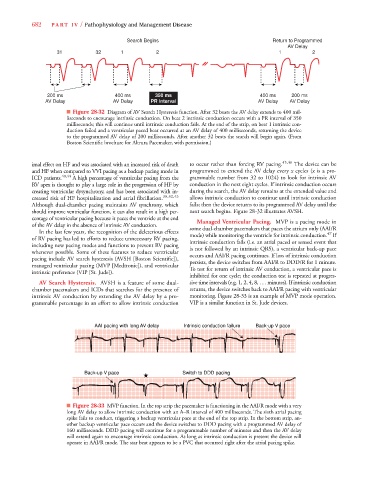
                              ■ Figure 28-32 Diagram of AV Search Hysteresis function. After 32 beats the AV delay extends to 400 mil-
                              liseconds to encourage intrinsic conduction. On beat 2 intrinsic conduction occurs with a PR interval of 350
                              milliseconds; this will continue until intrinsic conduction fails. At the end of the strip, on beat 1 intrinsic con-
                              duction failed and a ventricular paced beat occurred at an AV delay of 400 milliseconds, returning the device
                              to the programmed AV delay of 200 milliseconds. After another 32 beats the search will begin again. (From
                              Boston Scientific brochure for Altrura Pacemaker, with permission.)
                  imal effect on HF and was associated with an increased risk of death  to occur rather than forcing RV pacing. 45,46  The device can be
                  and HF when compared to VVI pacing as a backup pacing mode in  programmed to extend the AV delay every x cycles (x is a pro-
                  ICD patients. 40,44  A high percentage of ventricular pacing from the  grammable number from 32 to 1024) to look for intrinsic AV
                  RV apex is thought to play a large role in the progression of HF by  conduction in the next eight cycles. If intrinsic conduction occurs
                  creating ventricular dysynchrony, and has been associated with in-  during the search, the AV delay remains at the extended value and
                  creased risk of HF hospitalization and atrial fibrillation. 38,42,43  allows intrinsic conduction to continue until intrinsic conduction
                  Although dual-chamber pacing maintains AV synchrony, which  fails; then the device returns to its programmed AV delay until the
                  should improve ventricular function, it can also result in a high per-  next search begins. Figure 28-32 illustrates AVSH.
                  centage of ventricular pacing because it paces the ventricle at the end
                  of the AV delay in the absence of intrinsic AV conduction.  Managed Ventricular Pacing. MVP is a pacing mode in
                     In the last few years, the recognition of the deleterious effects  some dual-chamber pacemakers that paces the atrium only (AAI/R
                                                                                                                   47
                  of RV pacing has led to efforts to reduce unnecessary RV pacing,  mode) while monitoring the ventricle for intrinsic conduction. If
                  including new pacing modes and functions to prevent RV pacing  intrinsic conduction fails (i.e. an atrial paced or sensed event that
                  whenever possible. Some of these features to reduce ventricular  is not followed by an intrinsic QRS), a ventricular back-up pace
                  pacing include AV search hysteresis (AVSH [Boston Scientific]),  occurs and AAI/R pacing continues. If loss of intrinsic conduction
                  managed ventricular pacing (MVP [Medtronic]), and ventricular  persists, the device switches from AAI/R to DDD/R for 1 minute.
                  intrinsic preference (VIP [St. Jude]).              To test for return of intrinsic AV conduction, a ventricular pace is
                                                                      inhibited for one cycle; the conduction test is repeated at progres-
                     AV Search Hysteresis. AVSH is a feature of some dual-  sive time intervals (e.g. 1, 2, 4, 8, . . . minutes). If intrinsic conduction
                  chamber pacemakers and ICDs that searches for the presence of  returns, the device switches back to AAI/R pacing with ventricular
                  intrinsic AV conduction by extending the AV delay by a pro-  monitoring. Figure 28-33 is an example of MVP mode operation.
                  grammable percentage in an effort to allow intrinsic conduction  VIP is a similar function in St. Jude devices.
                                       AAI pacing with long AV delay  Intrinsic conduction failure  Back-up V pace
                                    Back-up V pace                  Switch to DDD pacing


                              ■ Figure 28-33 MVP function. In the top strip the pacemaker is functioning in the AAI/R mode with a very
                              long AV delay to allow intrinsic conduction with an A–R interval of 400 milliseconds. The sixth atrial pacing
                              spike fails to conduct, triggering a backup ventricular pace at the end of the top strip. In the bottom strip, an-
                              other backup ventricular pace occurs and the device switches to DDD pacing with a programmed AV delay of
                              160 milliseconds. DDD pacing will continue for a programmable number of minutes and then the AV delay
                              will extend again to encourage intrinsic conduction. As long as intrinsic conduction is present the device will
                              operate in AAI/R mode. The star beat appears to be a PVC that occurred right after the atrial pacing spike.

