


Page 705 - Cardiac Nursing
P. 705
qxd
                                                    tar
                                     49
                         04.
                                               681
                                                  Ap
                               7
                                        AM
                                           P
                                             g
                                /1/
                    p65
                       5-7
                                 09
            K34
               0-c
                 28_
         LWB K34 0-c 28_ p65 5-7 04. qxd  7 /1/ 09  9: 49  AM  P a a g e e  681  Ap tar a a
         LWBK340-c28_p655-704.qxd  7/1/09  9:9:49 AM  Page 681 Aptara
         LWB
                                                              C HAPTER 2 8 / Pacemakers and Implantable Defibrillators  681
                   When capture is lost in both ventricles, the QRS resumes its  A
                   prepaced shape and width, usually a pattern of LBBB.         VI VI VI V
                     Lead V 1 should logically be a good lead for evaluating ventricu-
                   lar capture in a biventricular pacemaker because of its ability to dif-
                   ferentiate RV from LV activation (see discussion of bundle-branch
                   block patterns in Chapter 15). Leads I and III or aVF are often used
                   to evaluate the QRS axis. It is recommended that a total of four 12-
                   lead ECGs should be recorded during implantation of a biventricu-
                                                                              B
                   lar device: (1) QRS morphology during intrinsic conduction prior to  VI VI VI V
                   any pacing, (2) paced QRS complexes during RV pacing alone, (3)
                   paced QRS complexes during LV pacing alone, and (4) paced QRS
                                               37
                   complexes during biventricular capture. The lead or leads that best
                   show an obvious difference in QRS morphology among these four
                   pacing states should be used as the continuous bedside monitoring
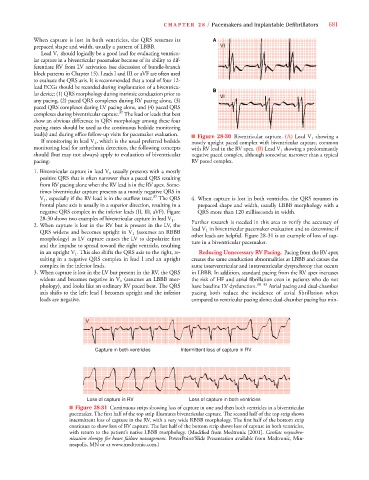
                   lead(s) and during office follow-up visits for pacemaker evaluation.  ■ Figure 28-30 Biventricular capture. (A) Lead V 1 showing a
                     If monitoring in lead V 1 , which is the usual preferred bedside  mostly upright paced complex with biventricular capture, common
                   monitoring lead for arrhythmia detection, the following concepts  with RV lead in the RV apex. (B) Lead V 1 showing a predominantly
                   should (but may not always) apply to evaluation of biventricular  negative paced complex, although somewhat narrower than a typical
                   pacing:                                             RV paced complex.
                   1. Biventricular capture in lead V 1 usually presents with a mostly
                     positive QRS that is often narrower than a paced QRS resulting
                     from RV pacing alone when the RV lead is in the RV apex. Some-
                     times biventricular capture presents as a mostly negative QRS in
                                                          37
                     V 1 , especially if the RV lead is in the outflow tract. The QRS  4. When capture is lost in both ventricles, the QRS resumes its
                     frontal plane axis is usually in a superior direction, resulting in a  prepaced shape and width, usually LBBB morphology with a
                     negative QRS complex in the inferior leads (II, III, aVF). Figure  QRS more than 120 milliseconds in width.
                     28-30 shows two examples of biventricular capture in lead V 1 .
                                                                       Further research is needed in this area to verify the accuracy of
                   2. When capture is lost in the RV but is present in the LV, the
                                                                       lead V 1 in biventricular pacemaker evaluation and to determine if
                     QRS widens and becomes upright in V 1 (assumes an RBBB
                                                                       other leads are helpful. Figure 28-31 is an example of loss of cap-
                     morphology) as LV capture causes the LV to depolarize first
                                                                       ture in a biventricular pacemaker.
                     and the impulse to spread toward the right ventricle, resulting
                     in an upright V 1 . This also shifts the QRS axis to the right, re-  Reducing Unnecessary RV Pacing. Pacing from the RV apex
                     sulting in a negative QRS complex in lead I and an upright  creates the same conduction abnormalities as LBBB and causes the
                     complex in the inferior leads.                    same interventricular and intraventricular dysynchrony that occurs
                   3. When capture is lost in the LV but present in the RV, the QRS  in LBBB. In addition, standard pacing from the RV apex increases
                     widens and becomes negative in V 1 (assumes an LBBB mor-  the risk of HF and atrial fibrillation even in patients who do not
                     phology), and looks like an ordinary RV paced beat. The QRS  have baseline LV dysfunction. 38–43  Atrial pacing and dual-chamber
                     axis shifts to the left; lead I becomes upright and the inferior  pacing both reduce the incidence of atrial fibrillation when
                     leads are negative.                               compared to ventricular pacing alone; dual-chamber pacing has min-

                                    V V V V


                                       Capture in both ventricles  Intermittent loss of capture in RV


                                    Loss of capture in RV             Loss of capture in both ventricles
                               ■ Figure 28-31 Continuous strips showing loss of capture in one and then both ventricles in a biventricular
                               pacemaker. The first half of the top strip illustrates biventricular capture. The second half of the top strip shows
                               intermittent loss of capture in the RV, with a very wide RBBB morphology. The first half of the bottom strip
                               continues to show loss of RV capture. The last half of the bottom strip shows loss of capture in both ventricles,
                               with return to the patient’s native LBBB morphology. (Modified from Medtronic [2001]. Cardiac resynchro-
                               nization therapy for heart failure management. PowerPoint/Slide Presentation available from Medtronic, Min-
                               neapolis, MN or at www.medtronic.com.)

