


Page 711 - Cardiac Nursing
P. 711
51
                                 09
                                        P
                                           P
                                         M
                                /1/
                       5-7
                    p65
                         04.
                               7
                           qxd
                                             g
            K34
               0-c
                 28_
         L L LWB K34 0-c 28_ p65 5-7 04. qxd  7 /1/ 09  5: 51  P M  P a a g e e  687  Ap tar a a
         LWB
         LWBK340-c28_p655-704.qxd  7/1/09  5:5:51 PM  Page 687 Aptara
                                                    tar
                                                  Ap
                                               687
                                                              C HAPTER 2 8 / Pacemakers and Implantable Defibrillators  687
                    DISPLAY 28-5  Secondary and Primary Prevention Trials of Sudden Cardiac Death
                    Study            Randomization             Population                  Main Finding
                    Secondary Prevention
                    AVID 62          Antiarrhythmic medications   Survived VT/VF SCA VT with   Reduction in total mortality with
                      (n   1016) 1997  97% amiodarone, 3% sotalol   syncope; VT with LVEF  40%  ICD, HR, 0.66; 95% CI
                                     vs. ICD
                    CIDS 64          Amiodarone vs. ICD        Survived VT/VF SCA; VT with   Reduction in death from any
                      (n   659) 2000                           syncope LVEF  35% and       cause with ICD therapy,
                                                               CL  400 ms (HR, 150)        HR, 0.85; 95% CI
                    CASH 63          Antiarrhythmic medications   Survived VT/VF SCA       Reduction in total mortality with
                      (n   288) 200  propafenone (withdrawn)                               ICD. HR, 0.82; 95% CI
                    Primary Prevention
                    MADIT I 69       Antiarrhythmic therapy (74%  Prior MI; LVEF  35%      Reduction in total mortality
                      (n   196) 1996  amiodarone) vs. ICD      asymptomatic NSVT;          with ICD 54% HR, 0.46; 95% CI
                                                               NYHA I-III; inducible
                                                               VT refractory to
                                                               procainamide on EPS
                    MADIT II 50      Conventional therapy vs. ICD  Prior MI; LVEF  30%     Reduction in total mortality with
                      (n   1232) 2002                                                      ICD therapy 31%; HR, 0.69; 95% CI
                    DEFINITE 70      Conventional therapy vs. ICD  Nonischemic CM heart failure   Trend in reduction in all cause
                      (n   458) 2004                           patients; NYHA classes I to III;   mortality by 35%; HR, 0.65
                                                               EF  36%
                                                               PVCs or NSVT
                    DINAMIT 71       Acute MI patients,        Acute MI 6 to 40 days;      No difference seen in mortality at
                      (n   674) 2004  optimal therapy; with or   LVEF 35%; impaired        2.5 years follow-up, HR, 1.08
                                     without ICD               Autonomic function
                    SCD-HeFT 51      Conventional therapy vs.   NYHA class II/III CHF ischemic and  Overall reduction in mortality
                      (n   1676)     amiodarone vs. ICD        nonischemic LVEF  35%       with ICD 23%; HR, 0.77;
                                                                                           97.5 % CI

                   AVID, Antiarrhythmics Versus Implantable Defibrillators; CASH, Cardiac Arrest Study Hamburg; CI, confidence interval; CIDS, Canadian Implantable Defibrillator Study; DEFI-
                    NITE, Defibrillators in Nonischemic Cardiomyopathy Treatment Evaluation; DINAMIT, Defibrillator in Acute Myocardial Infarction; HR, hazard ratio; MADIT I and II, Multi-
                    center Automatic Defibrillator Trial; SCD-HeFT, Sudden Cardiac Death in Heart Failure Trial.


                   syndrome, and arrhythmogenic RV dysplasia have been shown to
                   have better survival rates when treated with an ICD. 55–57

                   Functional Characteristics
                   The ICD system consists of a pulse generator and defibrillation
                   lead electrodes for arrhythmia detection and therapy delivery. ICD
                   systems are implanted transvenously, like pacemakers, and no
                   longer require cardiac surgery. However, devices that use defibrilla-
                   tion patches on the ventricle are still in use, and if these leads are
                   still functional at the time of generator change for depleted battery,
                   the original leads may be retained and used. In most ICD systems,
                   the implanted pulse generator serves as part of the electrical path-
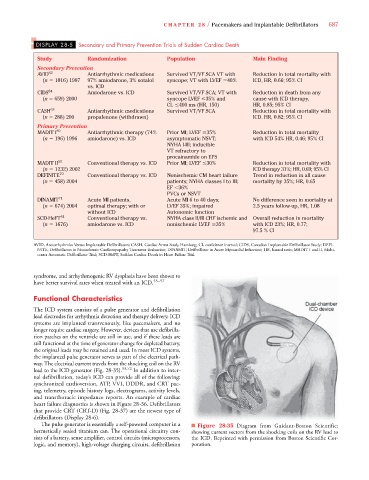
                   way. The electrical current travels from the shocking coil on the RV
                   lead to the ICD generator (Fig. 28-35). 55,72  In addition to inter-
                   nal defibrillation, today’s ICD can provide all of the following:
                   synchronized cardioversion, ATP, VVI, DDDR, and CRT pac-
                   ing, telemetry, episode history logs, electrograms, activity levels,
                   and transthoracic impedance reports. An example of cardiac
                   heart failure diagnostics is shown in Figure 28-36. Defibrillators
                   that provide CRT (CRT-D) (Fig. 28-37) are the newest type of
                   defibrillators (Display 28-6).
                     The pulse generator is essentially a self-powered computer in a  ■ Figure 28-35 Diagram from Guidant-Boston Scientific;
                   hermetically sealed titanium can. The operational circuitry con-  showing current vectors from the shocking coils on the RV lead to
                   sists of a battery, sense amplifier, control circuits (microprocessors,  the ICD. Reprinted with permission from Boston Scientific Cor-
                   logic, and memory), high-voltage charging circuits, defibrillation  poration.

