


Page 708 - Cardiac Nursing
P. 708
49
                                        AM
                                 09
                               7
                                /1/
                                                  Ap
                                               684
                                                    tar
                                           P
                                             g
                           qxd
            K34
               0-c
         LWB
         LWB K34 0-c 28_ p65 5-7 04. qxd  7 /1/ 09  9: 49  AM  P a a g e e  684  Ap tar a a
         LWBK340-c28_p655-704.qxd  7/1/09  9:9:49 AM  Page 684 Aptara
                       5-7
                    p65
                         04.
                 28_
                  684    PA R T  I V / Pathophysiology and Management Disease
                                                                      plantation. Class III indication means there is evidence to sug-
                                                                      gest the ICD would not be useful and in some cases may be
                                                                      harmful. The indications are then given level A, B, and C rank-
                                                                      ings. Level A indicates that data were derived from multiple,
                                                                      randomized clinical trials. Level B indicates data were derived
                                                                      from a single randomized trial or from well-designed, nonran-
                                                                      domized studies. Level C indicates that the consensus opinion
                                                                      of experts, or from case studies was the primary source of the
                                                                      recommendation. 56
                                                                        The rapid evolution of ICD technology, with the results of
                                                                      studies documenting efficacy of the ICD over antiarrhythmic
                                                                      drugs in both secondary and primary prevention of SCD, has led
                                                                      to the expansion of indications for the ICD. 55–57  Patients who re-
                                                                      ceive an ICD usually fall into one of four categories: cardiac arrest
                                                                      survivors, those with spontaneous sustained VT, those with syn-
                                                                      cope of unknown origin with inducible VT/VF per electrophysi-
                                                                      ologic testing, and patients at high risk for future life-threatening
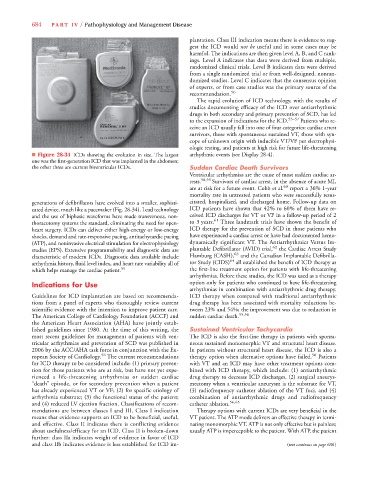
                  ■ Figure 28-34 ICDs showing the evolution in size. The largest  arrhythmic events (see Display 28-4).
                  one was the first-generation ICD that was implanted in the abdomen;
                  the other three are current biventricular ICDs.     Sudden Cardiac Death Survivors
                                                                      Ventricular arrhythmias are the cause of most sudden cardiac ar-
                                                                      rests.  58,59  Survivors of cardiac arrest, in the absence of acute MI,
                                                                      are at risk for a future event. Cobb et al. 60  report a 36% 1-year
                                                                      mortality rate in untreated patients who were successfully resus-
                  generations of defibrillators have evolved into a smaller, sophisti-  citated, hospitalized, and discharged home. Follow-up data on
                  cated device, much like a pacemaker (Fig. 28-34). Lead technology  ICD patients have shown that 42% to 60% of them have re-
                  and the use of biphasic waveforms have made transvenous, non-  ceived ICD discharges for VT or VF in a follow-up period of 2
                  thoracotomy systems the standard, eliminating the need for open-  to 3 years. 61  Three landmark trials have shown the benefit of
                  heart surgery. ICDs can deliver either high-energy or low-energy  ICD therapy for the prevention of SCD in those patients who
                  shocks, demand and rate-responsive pacing, antitachycardic pacing  have experienced a cardiac arrest or have had documented hemo-
                  (ATP), and noninvasive electrical stimulation for electrophysiology  dynamically significant VT. The Antiarrhythmics Versus Im-
                  studies (EPS). Extensive programmability and diagnostic data are  plantable Defibrillator (AVID) trial, 62  the Cardiac Arrest Study
                  characteristic of modern ICDs. Diagnostic data available include  Hamburg (CASH), 63  and the Canadian Implantable Defibrilla-
                  arrhythmia history, fluid level index, and heart rate variability all of  tor Study (CIDS) 64  all established the benefit of ICD therapy as
                  which helps manage the cardiac patient. 55          the first-line treatment option for patients with life-threatening
                                                                      arrhythmias. Before these studies, the ICD was used as a therapy
                  Indications for Use                                 option only for patients who continued to have life-threatening
                                                                      arrhythmias in combination with antiarrhythmic drug therapy.
                  Guidelines for ICD implantation are based on recommenda-  ICD therapy when compared with traditional antiarrhythmic
                  tions from a panel of experts who thoroughly review current   drug therapy has been associated with mortality reductions be-
                  scientific evidence with the intention to improve patient care.  tween 23% and 54%; the improvement was due to reduction in
                  The American College of Cardiology Foundation (ACCF) and  sudden cardiac death. 55,56
                  the American Heart Association (AHA) have jointly estab-
                  lished guidelines since 1980. At the time of this writing, the  Sustained Ventricular Tachycardia
                  most recent guidelines for management of patients with ven-  The ICD is also the first-line therapy in patients with sponta-
                  tricular arrhythmias and prevention of SCD was published in  neous sustained monomorphic VT and structural heart disease.
                  2006 by the ACC/AHA task force in conjunction with the Eu-  In patients without structural heart disease, the ICD is also a
                  ropean Society of Cardiology.  56  The current recommendations  therapy option when alternative options have failed. 56  Patients
                  for ICD therapy to be considered include: (1) primary preven-  with VT and an ICD may have other treatment options com-
                  tion for those patients who are at risk, but have not yet expe-  bined with ICD therapy, which include: (1) antiarrhythmic
                  rienced a  life-threatening arrhythmias or sudden cardiac  drug therapy to decrease ICD discharges, (2) surgical aneurys-
                  “death” episode, or for secondary prevention when a patient  mectomy when a ventricular aneurysm is the substrate for VT,
                  has already experienced VT or VF; (2) for specific etiology of  (3) radiofrequency catheter ablation of the VT foci, and (4)
                  arrhythmia substrate; (3) the functional status of the patient;  combination of antiarrhythmic  drugs and radiofrequency
                  and (4) reduced LV ejection fraction. Classifications of recom-  catheter ablation. 56,65
                  mendations are between classes I and III. Class I indication  Therapy options with current ICDs are very beneficial in the
                  means that evidence supports an ICD to be beneficial, useful,  VT patient. The ATP mode delivers an effective therapy in termi-
                  and effective. Class II indicates there is conflicting evidence  nating monomorphic VT. ATP is not only effective but is painless;
                  about usefulness/efficacy for an ICD. Class II is broken-down  usually ATP is imperceptible to the patient. With ATP, the patient
                  further: class IIa indicates weight of evidence in favor of ICD
                  and class IIb indicates evidence is less established for ICD im-                    (text continues on page 686 )

