


Page 719 - Cardiac Nursing
P. 719
P
                                             g
                                               695
                                        AM
                                /1/
                                 09
                                     49
                         04.
                           qxd
                               7
                       5-7
                                                  Ap
                    p65
                                                    tar
            K34
               0-c
                 28_
         LWB K34 0-c 28_ p65 5-7 04. qxd  7 /1/ 09  9: 49  AM  P a a g e e  695  Ap tar a a
         L L LWB
         LWBK340-c28_p655-704.qxd  7/1/09  9:9:49 AM  Page 695 Aptara
                                                              C HAPTER 2 8 / Pacemakers and Implantable Defibrillators  695
                   known to accelerate VT to VF. If low-energy cardioversion is un-  Device Implantation
                   successful, a high-energy shock is delivered. 87
                                                                       ICD implants are preferably implanted in the left pectoral region
                   Bradycardia Pacing                                  as a result of the shock vector formed by the lead system and ac-
                   Bradycardia pacing (VVI) is a standard feature available on all  tive can. The ICD in the unipolar system is known as the active
                   ICDs. Dual-chamber pacing, and biventricular pacing now com-  can or hot can. There is more surface area covered with a shock
                   prise the majority of pacing in ICD patients. Review of data from  when the system is placed on the left side and the current travels
                   the first year (2006) of the National ICD Registry revealed that  from the right ventricle to the active can on the left side. The lead
                   108,341 ICDs were placed and there were 23.4% single chamber,  is inserted in either the subclavian vein or the cephalic vein and
                   38.8% dual-chamber, and 37.5% biventricular ICDs placed. 88  advanced to the RV apex, using techniques similar to those for
                   Pacing rate, hysteresis, sensitivity, pulse width, pulse amplitude,  permanent pacemaker implantation. Defibrillation testing is com-
                   and blanking after pacing are all programmable. In the dual-  pleted once the lead is in place and secured. Delivering a small
                   chamber device, atrial tachycardia rate and mode-switch capabili-  shock, approximately 1 J, to the vulnerable part of the T wave in-
                   ties can also be programmed. Pacing thresholds during VT when  duces VF. Induction of VF is necessary to test whether the ICD
                   ATP applied, and after defibrillation are usually higher than  can detect the fine fibrillatory waves of VF and if the programmed
                   needed for bradycardia pacing, and they can be independently  energy level of the ICD can convert the VF to sinus rhythm. If the
                   programmed in some of the devices.                  first shock fails, a second shock at maximum output is delivered.
                                                                       If the second shock fails, a 200 to 360 J external shock is deliv-
                   Magnet Mode                                         ered. There are different techniques for DFT, but the 10 J safety
                                                                                                                     91
                   All ICDs have a magnet mode, a feature that is activated when a  margin for defibrillation is the acceptable “standard of care.”
                   magnet is placed over the pulse generator. Magnet modes allow  With the current “active can” ICD and biphasic waveform, it is
                   for therapy to be suppressed in emergency situations when the pa-  very rare for implant criteria not to be met. The ICD may be im-
                   tient is receiving inappropriate shocks. Some generators emit au-  planted in the electrophysiology laboratory, catheterization labo-
                   dible tones when a magnet is placed over the unit. Magnet re-  ratory, or OR. Anesthesia can be local or general, and the device
                   sponse with pacemakers and ICDs are often very confusing.  can be placed subcutaneously or submuscularly. Most patients
                   Generally, magnets disable only the VT/VF function of an ICD.  with an ICD placed transvenously are discharged on the day after
                   Pacing function of the ICD will not be affected with magnet ap-  surgery. A postimplantation noninvasive study is often performed
                   plication except  for ELA Medical, which paces DDD at 96  before discharge to verify proper functioning of the device and to
                                                                                                  80
                   bpm. 89  Guidant magnet response can be programmed on or off,  “fine-tune” the device programming.
                   and in fact programming the magnet response off is required to
                   correct an advisory alert in a subset of devices. 90  If a magnet is  Complications
                   placed over the ICD, the patient should be monitored, as they are
                   unprotected from life-threatening arrhythmias. Many facilities  Postoperative complications have been reduced with the advent of the
                   have polices requiring ICD interrogation pre- and postmagnet ap-  transvenous pectoral technique for ICD implantation. Complica-
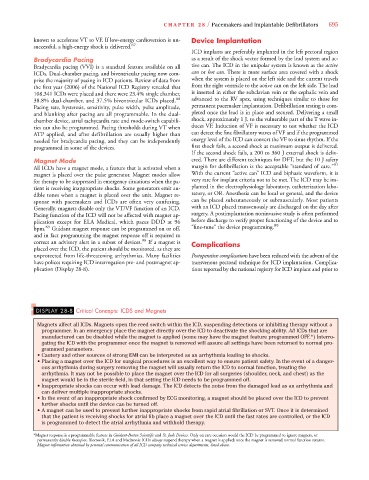
                   plication (Display 28-8).                           tions reported by the national registry for ICD implant and prior to


                    DISPLAY 28-8 Critical Concepts: ICDS and Magnets

                    Magnets affect all ICDs. Magnets open the reed switch within the ICD, suspending detections or inhibiting therapy without a
                      programmer. In an emergency place the magnet directly over the ICD to deactivate the shocking ability. All ICDs that are
                      manufactured can be disabled while the magnet is applied (some may have the magnet feature programmed OFF.*) Interro-
                      gating the ICD with the programmer once the magnet is removed will assure all settings have been returned to normal pro-
                      grammed parameters.
                    • Cautery and other sources of strong EMI can be interpreted as an arrhythmia leading to shocks.
                    • Placing a magnet over the ICD for surgical procedures is an excellent way to ensure patient safety. In the event of a danger-
                      ous arrhythmia during surgery removing the magnet will usually return the ICD to normal function, treating the
                      arrhythmia. It may not be possible to place the magnet over the ICD for all surgeries (shoulder, neck, and chest) as the
                      magnet would be in the sterile field, in that setting the ICD needs to be programmed off.
                    • Inappropriate shocks can occur with lead damage. The ICD detects the noise from the damaged lead as an arrhythmia and
                      can deliver multiple inappropriate shocks.
                    • In the event of an inappropriate shock confirmed by ECG monitoring, a magnet should be placed over the ICD to prevent
                      further shocks until the device can be turned off.
                    • A magnet can be used to prevent further inappropriate shocks from rapid atrial fibrillation or SVT. Once it is determined
                      that the patient is receiving shocks for atrial fib place a magnet over the ICD until the fast rates are controlled, or the ICD
                      is programmed to detect the atrial arrhythmia and withhold therapy.

                   *Magnet response is a programmable feature in Guidant-Boston Scientific and St. Jude Devices. Only on rare occasion would the ICD be programmed to ignore magnets, or
                    permanently disable therapies. Biotronik, ELA and Medtronic ICDs always suspend therapy when a magnet is applied; once the magnet is removed normal function returns.
                    Magnet information obtained by personal communication of all ICD company technical service departments, listed above.

