


Page 718 - Cardiac Nursing
P. 718
09
                                /1/
                                     49
                                           P
                                        AM
                       5-7
                    p65
                         04.
                               7
                           qxd
                                             g
            K34
               0-c
         LWBK340-c28_p655-704.qxd  7/1/09  9:9:49 AM  Page 694 Aptara
         LWB K34 0-c 28_ p65 5-7 04. qxd  7 /1/ 09  9: 49  AM  P a a g e e  694  Ap tar a a
         LWB
                                                  Ap
                                               694
                                                    tar
                 28_
                  694    PA R T  I V / Pathophysiology and Management Disease

                      2 2 2 2  3 3 3 3  3 3 3 3  3 3 3 3  3 3 3 3  3 3 3 3  3 3 3 3  3 3 3 3  3 3 3 3  3 3 3 3  2 2 2 2  3 3 3 3  2 2 2 2  3 3 3 3  2 2 2 2  5 5 5 5 5  5 5 5 5  2 2 2 2  8 8 8 8  0 0 0 0  5 5 5 5  2 2 2 2  4 4 4 4 4
                      8 8 8  9 9 9  4 4 4  5 5 5  5 5 5  4 4 4  5 5 5  4 4 4  5 5 5  5 5 5  5 5 5  4 4 4  5 5 5  4 4 4  5 5 5  3 3 3 3  2 2 2  5 5 5  9 9 9  0 0 0  1 1  5 5 5  8 8 8 8
                      0 0 0  0 0 0  0 0 0  0 0 0  0 0 0  0 0 0  0 0 0  0 0 0  0 0 0  0 0 0  0 0 0  0 0 0  0 0 0  0 0 0  0 0 0  0 0 0 0  0 0 0  0 0 0  0 0 0  0 0 0  0 0 0  0 0 0  0 0 0 0
                     A A A A A  A A A A  A A A A  A A A A  A A A A A  A A A A  A A A A  A A A A  A A A A A  A A A A  A A A A  A A A A  A A A A  A A A A  A A A A  A A A A  A A A A  A A A A  A A A A A  A A A A  A A A A A  A A A A  A A A A
                     R R R R  R R R  R R R  R R R  R R R R  R R R  R R R  R R R  R R R  R R R  R R R  R R R  R R R  b b b  S S S  R R R  S S S  S S S  S S S S  S S S  S S S S  R R R  R R R
                     F F F  F F F  F F F  F F F  F F F  F F F  F F F  F F F  F F F  T T T  T T T  T T T  T T T  F F F  T T T  T T T  T T T  T T T  T T T  T T T  T T T  T T T  V V V  V V V  V V V  V V V
                     S S S  S S S  S S S  S S S  S S S  S S S  S S S S  S S S  S S S S  F F F  F F F  F F F  F F F  D D D  P P P  P P P  P P P  P P P  P P P  P P P  P P P  P P P  P P P  8 8 8  8 8 8  8 8 8
                      2 2 2  2 2 2  2 2 2 2  2 2 2  2 2 2 2  2 2 2  2 2 2 2  2 2 2  3 3 3  3 3 3  3 3 3  3 3 3  0 0 0  2 2 2  2 2 2  2 2 2  2 2 2  2 2 2  2 2 2  2 2 2  2 2 2  6 6 6  6 6 6  4 4 4  3 3 3
                      5 5 5  7 7 7  0 0 0 0  3 3 3  9 9 9 9  9 9 9  9 9 9 9  9 9 9  0 0 0  0 0 0  0 0 0  0 0 0  0 0 0  6 6 6  6 6 6  6 6 6  6 6 6  6 6 6  6 6 6  6 6 6  6 6 6  2 2 2  7 7 7  3 3 3  2 2 2
                      0 0 0 0  0 0 0 0  0 0 0 0 0  0 0 0 0  0 0 0 0 0  0 0 0 0  0 0 0 0 0  0 0 0 0  0 0 0 0  0 0 0 0  0 0 0 0  0 0 0 0  0 0 0 0  0 0 0 0  0 0 0 0  0 0 0 0  0 0 0 0  0 0 0 0  0 0 0 0  0 0 0 0  0 0 0 0  0 0 0 0  0 0 0 0  0 0 0 0  0 0 0 0
                                                                                             1
                                                                                              D
                                                                                              Defib
                                                                                        VF Rx 1 Defibb
                                                                                        VF
                                                                                          Rx
                                                                VF F                    VF  Rx x  1  Def
                                                                V V
                                                                VF
                                                                            g
                                                                          h
                                                                              g
                                                         V V F R  1  B r ust  Du rin g g C har gin g
                                                         VF Rx 1 Brust During Charging
                                                         VF Rx 1 Brust Dur
                                                                     u
                                                            Rx
                                                                      i
                                                                      ng Charging
                                                            R
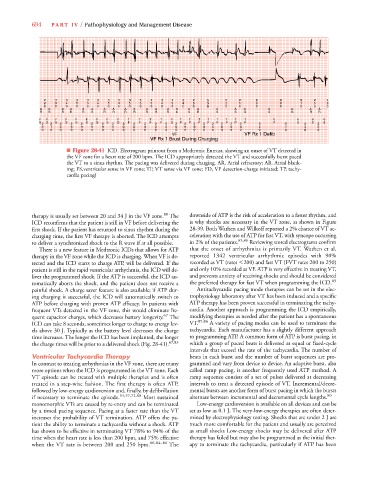
                              ■ Figure 28-41 ICD. Electrogram printout from a Medtronic Entrust, showing an onset of VT detected in
                              the VF zone for a heart rate of 200 bpm. The ICD appropriately detected the VT and successfully burst paced
                              the VT to a sinus rhythm. The pacing was delivered during charging. AR, Atrial refractory; AB, Atrial blank-
                              ing; FS,ventricular sense in VF zone; TF, VT sense via VF zone; FD, VF detection-charge initiated; TP, tachy-
                              cardia pacing)
                                                              80
                  therapy is usually set between 20 and 34 J in the VF zone. The  downside of ATP is the risk of acceleration to a faster rhythm, and
                  ICD reconfirms that the patient is still in VF before delivering the  is why shocks are necessary in the VT zone, as shown in Figure
                  first shock. If the patient has returned to sinus rhythm during the  28-39. Both Wathen and Wilkoff reported a 2% chance of VT ac-
                  charging time, the first VF therapy is aborted. The ICD attempts  celeration with the use of ATP for fast VT, with syncope occurring
                  to deliver a synchronized shock to the R wave if at all possible.  in 2% of the patients. 85,86  Reviewing stored electrograms confirm
                     There is a new feature in Medtronic ICDs that allows for ATP  that the onset of arrhythmias is primarily VT. Wathen et al.
                  therapy in the VF zone while the ICD is charging. When VF is de-  reported 1342 ventricular arrhythmic episodes with 90%
                  tected and the ICD starts to charge ATP, will be delivered. If the  recorded as VT (rates  200) and fast VT (FVT rates 200 to 250)
                  patient is still in the rapid ventricular arrhythmia, the ICD will de-  and only 10% recorded as VF. ATP is very effective in treating VT,
                  liver the programmed shock. If the ATP is successful, the ICD au-  and prevents anxiety of receiving shocks and should be considered
                  tomatically aborts the shock, and the patient does not receive a  the preferred therapy for fast VT when programming the ICD. 85
                  painful shock. A charge saver feature is also available; if ATP dur-  Antitachycardic pacing mode therapies can be set in the elec-
                  ing charging is successful, the ICD will automatically switch to  trophysiology laboratory after VT has been induced and a specific
                  ATP before charging with proven ATP efficacy. In patients with  ATP therapy has been proven successful in terminating the tachy-
                  frequent VTs detected in the VF zone, this would eliminate fre-  cardia. Another approach is programming the ICD empirically,
                  quent capacitor charges, which decreases battery longevity. 67  The  modifying therapies as needed after the patient has a spontaneous
                  ICD can take 8 seconds, sometimes longer to charge to energy lev-  VT. 85,86  A variety of pacing modes can be used to terminate the
                  els above 30 J. Typically as the battery level decreases the charge  tachycardia. Each manufacturer has a slightly different approach
                  time increases. The longer the ICD has been implanted, the longer  to programming ATP. A common form of ATP is burst pacing, in
                  the charge times will be prior to a delivered shock (Fig. 28-41). 67,83   which a group of paced beats is delivered at equal or fixed-cycle
                                                                      intervals that exceed the rate of the tachycardia. The number of
                  Ventricular Tachycardia Therapy                     beats in each burst and the number of burst sequences are pro-
                  In contrast to treating arrhythmias in the VF zone, there are many  grammed and vary from device to device. An adaptive burst, also
                  more options when the ICD is programmed in the VT zone. Each  called ramp pacing, is another frequently used ATP method. A
                  VT episode can be treated with multiple therapies and is often  ramp sequence consists of a set of pulses delivered at decreasing
                  treated in a step-wise fashion. The first therapy is often ATP,   intervals to treat a detected episode of VT. Incremental/decre-
                  followed by low-energy cardioversion and, finally, by defibrillation  mental bursts are another form of burst pacing in which the bursts
                  if necessary to terminate the episode. 54,57,72,80  Most sustained  alternate between incremental and decremental cycle lengths. 80
                  monomorphic VTs are caused by re-entry and can be terminated  Low-energy cardioversion is available on all devices and can be
                  by a timed pacing sequence. Pacing at a faster rate than the VT   set as low as 0.1 J. The very-low-energy therapies are often deter-
                  increases the probability of VT termination. ATP offers the pa-  mined by electrophysiology testing. Shocks that are under 2 J are
                  tient the ability to terminate a tachycardia without a shock. ATP  much more comfortable for the patient and usually are perceived
                  has shown to be effective in terminating VT 78% to 94% of the  as small shocks Low-energy shocks may be delivered after ATP
                  time when the heart rate is less than 200 bpm, and 75% effective  therapy has failed but may also be programmed as the initial ther-
                  when the VT rate is between 200 and 250 bpm. 66,84–86  The  apy to terminate the tachycardia, particularly if ATP has been

