


Page 733 - Cardiac Nursing
P. 733
4 A
                                        M
                                     4 A
                                   2:0
                                   2:0
                                          Pa
                                           g
                                          Pa
                                        M
                                          Pa
                                   1
                              /30
                              /30
                             6
                           xd
                             6
                                    1
                                   1
                                /09
                                /09
                                /09
                                           g
                                                  ara
                                                   a
                                                  ara
                                                  t
                                                  t
                                                      c.
                                                      c.
                                                     In
                                                   a
                                                     In
                                                 p
                                              09
                                              09
                                            e 7
                                           g
                                            e 7
                                                 p
                                                 p
                                                A
                                              09
                                                A
                   p
                   p
         LWB
                      5-7
                    70
                    70
            K34
                 29_
                 29_
                 29_
            K34
               0-c
               0-c
                          q
                        21.
                          q
                           xd
                          q
                      5-7
         LWBK340-c29_ pp705-721.qxd  6/30/09  12:04 AM  Page 709 Aptara Inc.
         LWB
                        21.
                                                                      C HAPTER 2 9 / Acquired Valvular Heart Disease  709
                   atrial enlargement, elevation of the left mainstem bronchus caused  Interventional and Surgical
                   by distention of the left atrium, and distribution of blood flow  Management
                   from the lower to upper lobes. Although heart size remains nor-
                   mal, central pulmonary arteries become prominent. Kerley B lines  Percutaneous Mitral Catheter
                   and interstitial edema are often present.           Balloon Valvuloplasty
                                                                       Percutaneous mitral catheter balloon valvuloplasty is an alterna-
                                                                       tive, less invasive procedure than surgical treatment for mitral
                   Medical Management
                                                                       stenosis. Balloon valvuloplasty is performed in the cardiac
                   Medical therapy for mitral stenosis is aimed at preventing the  catheterization laboratory by a cardiologist experienced with inva-
                   complications of systemic embolization and bacterial endocarditis  sive techniques. A small balloon valvuloplasty catheter is intro-
                                               9
                   as well as atrial fibrillation if it occurs. Patients who have asymp-  duced percutaneously at the femoral vein and passed into the right
                   tomatic mitral stenosis require only antibiotic prophylaxis.  atrium. The catheter is then directed transseptally and positioned
                   Patients with mild pulmonary congestion can be managed with  across the mitral valve. Mitral balloon valvuloplasty is recom-
                   diuretics alone.  -Blockers can be used to reduce heart rate and  mended in patients with moderate-to-severe mitral stenosis that is
                   improve diastolic filling time. When patients have atrial fibrilla-  symptomatic with favorable valve morphology. 10
                   tion, digoxin,  -blockers, or calcium channel blockers can be used  Inflation of either one large balloon (23 to 25 mm) or two
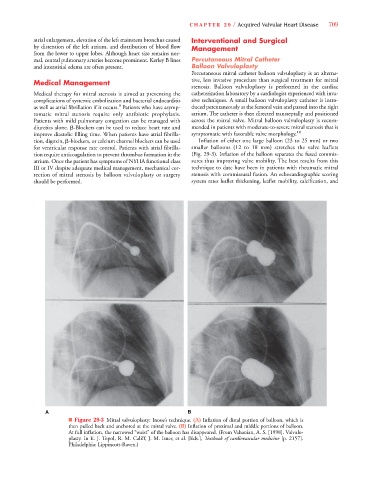
                   for ventricular response rate control. Patients with atrial fibrilla-  smaller  balloons (12 to 18 mm) stretches the valve  leaflets
                   tion require anticoagulation to prevent thrombus formation in the  (Fig. 29-3). Inflation of the balloon separates the fused commis-
                   atrium. Once the patient has symptoms of NYHA functional class  sures thus improving valve mobility. The best results from this
                   III or IV despite adequate medical management, mechanical cor-  technique to date have been in patients with rheumatic mitral
                   rection of mitral stenosis by balloon valvuloplasty or surgery  stenosis with commissural fusion. An echocardiographic scoring
                   should be performed.                                system rates leaflet thickening, leaflet mobility, calcification, and
                       A                                             B
                              ■ Figure 29-3 Mitral valvuloplasty: Inoue’s technique. (A) Inflation of distal portion of balloon, which is
                              then pulled back and anchored at the mitral valve. (B) Inflation of proximal and middle portions of balloon.
                              At full inflation, the narrowed “waist” of the balloon has disappeared. (From Vahanian, A. S. [1998]. Valvulo-
                              plasty. In E. J. Topol, R. M. Califf, J. M. Isner, et al. [Eds.], Textbook of cardiovascular medicine [p. 2157].
                              Philadelphia: Lippincott-Raven.)

