


Page 732 - Cardiac Nursing
P. 732
LWBK340-c29_p705-721.qxd  6/30/09  12:04 AM  Page 708 Aptara Inc.


                  708    PA R T  IV / Pathophysiology and Management of Heart Disease

                  in pulmonary hypertension and pulmonary congestion. Left atrial  creased pulmonic S 2 intensity associated with pulmonary hyper-
                  enlargement may lead to atrial fibrillation and worsening of symp-  tension (Table 29-2).
                  toms related to the loss of atrial kick. 10  Patients have left-sided  Patients with mitral stenosis may exhibit malar blush (pink
                  CHF without left ventricular dysfunction. Mitral stenosis has a  discoloration of the cheeks). Patients with severe mitral stenosis
                  sparing effect on the left ventricle. Symptoms of mitral stenosis  may have weak pulses secondary to reduced cardiac output. The
                  are usually related to obstruction of the mitral valve rather than  apical pulse is tapping in quality and is nondisplaced. A lower left
                  ventricular dysfunction. As pulmonary pressure increases, right-  parasternal lift or heave caused by right ventricular hypertrophy
                  sided heart failure may occur.                      may be present. Cardiac rhythm is often irregularly irregular, in-
                                                                      dicating atrial fibrillation.
                  Clinical Manifestations
                                                                      Diagnostic Tests
                  Mild dyspnea on exertion occurs as the most common symptom
                                                         2
                  of mild mitral stenosis (valve area of 1.6 to 2.0 cm ). As mitral  Echocardiography is used in the evaluation of mitral stenosis to (1)
                                                            2
                  stenosis becomes more severe (valve area of 1 to 1.5 cm ), dysp-  quantify the valve area and gradient; (2) quantify the degree of mi-
                  nea, fatigue, paroxysmal nocturnal dyspnea, and atrial fibrillation  tral insufficiency; (3) define the degree of left atrial enlargement;
                  may occur. When mitral stenosis becomes severe (valve area of   (4) assess mitral annular calcification; (5) assess pulmonary artery
                      2
                  1 cm or less), symptoms include fatigue and dyspnea with mild  pressures and degree of pulmonary hypertension; and (6) evaluate
                  exertion or rest. With advanced mitral stenosis, pulmonary hy-  right- and left-sided ventricular function. A TEE provides better
                  pertension and symptoms of right-sided heart failure occur (i.e.,  detail of the mitral valve and better visualization of atrial throm-
                  edema, hepatomegaly, ascites, elevated jugular venous pressure).  bus than does TTE. 12
                  Chest pain and hemoptysis may also occur. Increased left atrial  Cardiac catheterization is used less in diagnosis of mitral steno-
                  pressure, atrial fibrillation, and stagnation of left atrial blood flow  sis as echocardiography techniques improve. Cardiac catheteriza-
                  can result in the formation of mural thrombi, with resultant em-  tion does allow for accurate assessment of valve area and can also
                  bolic events, including cerebral vascular accidents. Women who  identify associated mitral regurgitation. For patients with known
                  had previously been asymptomatic with mitral stenosis may be-  or suspected CHD, coronary angiography can delineate coronary
                  come symptomatic and even experience severe hemodynamic de-  anatomy. Right heart catheterization can evaluate right heart and
                  compensation during pregnancy due to increased cardiac output  pulmonary artery pressures.
                  and increased heart rate. Tachycardia reduces diastolic filling time  Electrocardiography is nonspecific and does not indicate the
                  and worsens the mitral valve gradient while atrial fibrillation may  severity of mitral stenosis. If the patient remains in sinus rhythm
                  precipitate pulmonary edema. 11                     and left atrial enlargement has occurred, characteristic P mitrale
                                                                      (broad, bifid P waves in leads II and V 1 ) may be identified. Right
                  Physical Assessment                                 axis deviation and right ventricular hypertrophy may be noted in
                                                                      severe mitral stenosis. Atrial fibrillation is common in patients with
                  In severe mitral stenosis, on auscultation, there are four typical  long-standing mitral stenosis and is usually coarse in appearance.
                  findings including (1) an accentuated S 1 ; (2) an opening diastolic  Chest radiography correlates with the degree of mitral stenosis.
                  snap; (3) a middiastolic rumble noted best at the apex (in sinus  As mitral stenosis becomes more severe, the chest radiograph
                  rhythm), followed by presystolic accentuation; and (4) an in-  demonstrates straightening of the left heart border caused by left


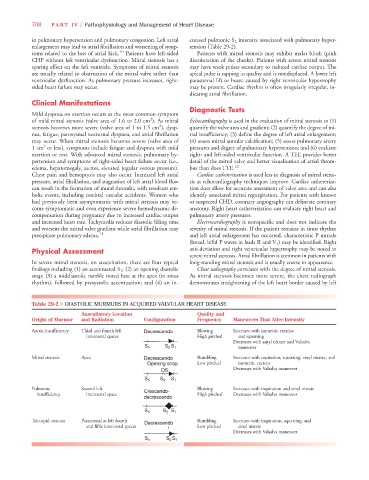
                  Table 29-2 ■ DIASTOLIC MURMURS IN ACQUIRED VALVULAR HEART DISEASE
                                   Auscultatory Location                 Quality and
                  Origin of Murmur  and Radiation      Configuration      Frequency  Maneuvers That Alter Intensity
                  Aortic insufficiency  Third and fourth left             Blowing    Increases with isometric exercise
                                    intercostal spaces                   High pitched  and squatting
                                                                                    Decreases with amyl nitrate and Valsalva
                                                       S 1    S 2  S 1                maneuver
                  Mitral stenosis  Apex                                  Rumbling   Increases with expiration, squatting, amyl nitrate, and
                                                        Opening snap     Low pitched  isometric exercise
                                                             OS                     Decreases with Valsalva maneuver
                                                       S 1  S 2  S 1
                  Pulmonic         Second left         Crescendo-        Blowing    Increases with inspiration and amyl nitrate
                    insufficiency    intercostal space                    High pitched  Decreases with Valsalva maneuver
                                                       decrescendo

                                                       S 1   S 2  S 1
                  Tricuspid stenosis  Parasternal at left fourth   Decrescendo  Rumbling  Increases with inspiration, squatting, and
                                    and fifth intercostal spaces          Low pitched  amyl nitrate
                                                                                    Decreases with Valsalva maneuver
                                                       S 1    S 2  S 1

