


Page 771 - Cardiac Nursing
P. 771
CHAPTER 31 / Adult Congenital Heart Disease  747


                                                               ent, causing a quadruple rhythm. Murmurs vary from early sys-
                                                               tolic to holosystolic and are of medium frequency.

                                                               Management
                                                               Medical management of patients with Ebstein’s anomaly is di-
                                                               rected toward the prevention of complications and to the treat-
                                                               ment of symptoms as they present themselves. Those patients
                                                               with supraventricular tachycardia, or persistent atrial fibrillation
                                                               or flutter may be treated with radiofrequency catheter ablation, al-
                                                               though complete ablation of accessory pathways has a lower rate
                                                               of success in patients with Ebstein’s anomaly than in patients with
                                                                                   52
                                                               a structurally normal heart. Surgical repair of the tricuspid valve
                                                               and closure of the ASD are recommended in symptomatic pa-
                                                               tients. Valve repair using annuloplasty ring is preferred to replace-
                                                               ment, which is reserved for nonreparable valves. When required,
                                                               a bioprosthetic valve is preferred to mechanical prosthesis. 50
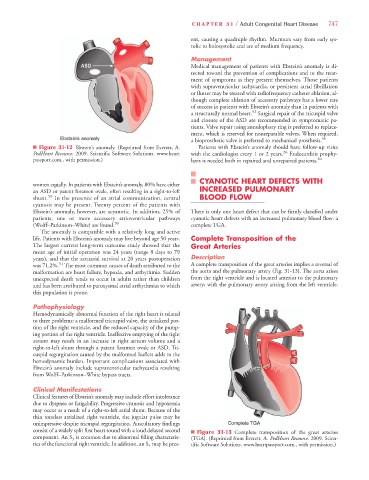
            n Figure 31-12 Ebstein’s anomaly. (Reprinted from Everett, A.  Patients with Ebstein’s anomaly should have follow-up visits
            PedHeart Resource. 2009. Scientific Software Solutions. www.heart  with the cardiologist every 1 or 2 years. 26  Endocarditis prophy-
            passport.com., with permission.)                   laxis is needed both in repaired and unrepaired patients. 20


                                                                  CYANOTIC HEART DEFECTS WITH
            women equally. In patients with Ebstein’s anomaly, 80% have either
            an ASD or patent foramen ovale, often resulting in a right-to-left  INCREASED PULMONARY
            shunt. 50  In the presence of an atrial communication, central  BLOOD FLOW
            cyanosis may be present. Twenty percent of the patients with
            Ebstein’s anomaly, however, are acyanotic. In addition, 25% of  There is only one heart defect that can be firmly classified under
            patients, one or more accessory atrioventricular pathways  cyanotic heart defects with an increased pulmonary blood flow: a
            (Wolff–Parkinson–White) are found. 50              complete TGA.
              The anomaly is compatible with a relatively long and active
            life. Patients with Ebstein’s anomaly may live beyond age 50 years.  Complete Transposition of the
            The largest current long-term outcome study showed that the  Great Arteries
            mean age of initial operation was 24 years (range 8 days to 79
            years), and that the actuarial survival at 20 years postoperation  Description
                    51
            was 71.2%. The most common causes of death attributed to the  A complete transposition of the great arteries implies a reversal of
            malformation are heart failure, hypoxia, and arrhythmia. Sudden  the aorta and the pulmonary artery (Fig. 31-13). The aorta arises
            unexpected death tends to occur in adults rather than children  from the right ventricle and is located anterior to the pulmonary
            and has been attributed to paroxysmal atrial arrhythmias to which  artery; with the pulmonary artery arising from the left ventricle.
            this population is prone.

            Pathophysiology
            Hemodynamically abnormal function of the right heart is related
            to three problems: a malformed tricuspid valve, the atrialized por-
            tion of the right ventricle, and the reduced capacity of the pump-
            ing portion of the right ventricle. Ineffective emptying of the right
            atrium may result in an increase in right atrium volume and a
            right-to-left shunt through a patent foramen ovale or ASD. Tri-
            cuspid regurgitation caused by the malformed leaflets adds to the
            hemodynamic burden. Important complications associated with
            Ebstein’s anomaly include supraventricular tachycardia resulting
            from Wolff–Parkinson–White bypass tracts.

            Clinical Manifestations
            Clinical features of Ebstein’s anomaly may include effort intolerance
            due to dyspnea or fatigability. Progressive cyanosis and hypoxemia
            may occur as a result of a right-to-left atrial shunt. Because of the
            thin toneless atrialized right ventricle, the jugular pulse may be
            unimpressive despite tricuspid regurgitation. Auscultatory findings
            consist of a widely split first heart sound with a loud delayed second  n Figure 31-13 Complete transposition of the great arteries
            component. An S 3 is common due to abnormal filling characteris-  (TGA). (Reprinted from Everett, A. PedHeart Resource. 2009. Scien-
            tics of the functional right ventricle. In addition, an S 4 may be pres-  tific Software Solutions. www.heartpassport.com., with permission.)

