


Page 769 - Cardiac Nursing
P. 769
CHAPTER 31 / Adult Congenital Heart Disease  745


            rendering balloon valvuloplasty less effective. Valve replacement  configuration (25% to 30%). If a right-lo-left shunt is present, the
            in the presence of significant obstruction with calcification of the  patient should be classified as cyanotic. Surgical intervention is
            pulmonic valve is seen in older adults. Prophylaxis against endo-  only indicated to repair associated anomalies such as VSD or pul-
            carditis is not required in patients with pulmonic valve stenosis,  monary stenosis. While most cases are detected in childhood,
            unless prosthetic cardiac valves have been placed. 20  many go unnoticed until clinical signs become apparent. Patients
                                                               with corrected transposition without associated anomalies may
                                                               reach adulthood, leading normal lives. Generally, 20-year survival
               MALPOSITION AND                                 rate of 75% in patients with CCTGA is  reported. 44
               MALCONNECTION                                   Pathophysiology
                                                               The most common clinical sequelae and/or complications with
            A number of defects are characterized by a malposition of the  CCTGA include right ventricular dysfunction, tricuspid regurgi-
            heart or a malconnection of the great vessels and are generally cat-  tation, residual left ventricle outflow obstruction, and complete
            egorized as acyanotic defects (Fig. 31-1). A relevant heart defect in  heart block. Progressive right ventricle dysfunction resulting in
            this category is a congenitally corrected transposition of the great  heart failure is associated with increasing age, typically in the fifth
            arteries (CCTGA).                                  decade, as the morphological right ventricle begins to fail as the
                                                               systemic ventricle. Complete heart block, if not present at birth,
            Congenitally Corrected Transposition               is likely to develop at a rate of 2% per year, due to the unusual
            of the Great Arteries                              location and course of the atrioventricular node. In patients with-
                                                               out associated lesions, it is expected that up to 27% are in need of
            Description                                        a pacemaker. This percentage increased up to 45% in patients
            CCTGA occurs only in 1% of all cardiac anomalies. CCTGA is  with associated heart defects. 45
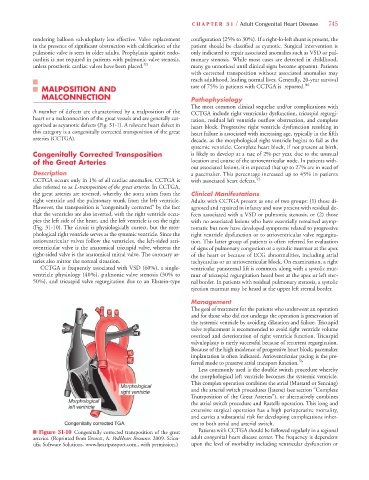
            also referred to as L-transposition of the great arteries. In CCTGA,
            the great arteries are reversed, whereby the aorta arises from the  Clinical Manifestations
            right ventricle and the pulmonary trunk from the left ventricle.  Adults with CCTGA present as one of two groups: (1) those di-
            However, the transposition is “congenitally corrected” by the fact  agnosed and repaired in infancy and now present with residual de-
            that the ventricles are also inverted, with the right ventricle occu-  fects associated with a VSD or pulmonic stenosis, or (2) those
            pies the left side of the heart, and the left ventricle is on the right  with no associated lesions who have essentially remained asymp-
            (Fig. 31-10). The circuit is physiologically correct, but the mor-  tomatic but now have developed symptoms related to progressive
            phological right ventricle serves as the systemic ventricle. Since the  right ventricle dysfunction or to atrioventricular valve regurgita-
            atrioventricular valves follow the ventricles, the left-sided atri-  tion. This latter group of patients is often referred for evaluation
            oventricular valve is the anatomical tricuspid valve, whereas the  of signs of pulmonary congestion or a systolic murmur at the apex
            right-sided valve is the anatomical mitral valve. The coronary ar-  of the heart or because of ECG abnormalities, including atrial
            teries also mirror the normal situation.           tachycardias or an atrioventricular block. On examination, a right
              CCTGA is frequently associated with VSD (60%), a single-  ventricular parasternal lift is common, along with a systolic mur-
            ventricle physiology (40%), pulmonic valve stenosis (30% to  mur of tricuspid regurgitation heard best at the apex or left ster-
            50%), and tricuspid valve regurgitation due to an Ebstein-type  nal border. In patients with residual pulmonary stenosis, a systolic
                                                               ejection murmur may be heard at the upper left sternal border.

                                                               Management
                                                               The goal of treatment for the patients who underwent an operation
                                                               and for those who did not undergo the operation is preservation of
                                                               the systemic ventricle by avoiding dilatation and failure. Tricuspid
                                                               valve replacement is recommended to avoid right ventricle volume
                                                               overload and deterioration of right ventricle function. Tricuspid
                                                               valvuloplasty is rarely successful because of recurrent regurgitation.
                                                               Because of the high incidence of progressive heart block, pacemaker
                                                               implantation is often indicated. Atrioventricular pacing is the pre-
                                                               ferred mode to preserve atrial transport function. 46
                                                                  Less commonly used is the double switch procedure whereby
                                                               the morphological left ventricle becomes the systemic ventricle.
                                                               This complex operation combines the atrial (Mustard or Senning)
                                                               and the arterial switch procedures (Jatene) (see section “Complete
                                                               Transposition of the Great Arteries”), or alternatively combines
                                                               the atrial switch procedure and Rastelli operation. This long and
                                                               extensive surgical operation has a high perioperative mortality,
                                                               and carries a substantial risk for developing complications inher-
                                                               ent to both atrial and arterial switch.
            n Figure 31-10 Congenitally corrected transposition of the great  Patients with CCTGA should be followed regularly in a regional
            arteries. (Reprinted from Everett, A. PedHeart Resource. 2009. Scien-  adult congenital heart disease center. The frequency is dependent
            tific Software Solutions. www.heartpassport.com., with permission.)  upon the level of morbidity including ventricular dysfunction or

