


Page 77 - Cardiac Nursing
P. 77
6/3
                              6/3
                             0
                              0
                             0
                                0/2
                                  009
                                     1
                                  009
                                0/2
                                0/2
                      2-0
                        68.
                      2-0
                    04
                    04
                        68.
                           xd
                           xd
                          q
                          q
                          q
                                              3 A
                                                p
                                              3 A
                                            e 5
                                            e 5
                                                p
                                                  r
                                                  r
                                                 ta
                                                p
                                                 ta
                                        3
                                        3
                                      5:3
                                     1
                                      5:3
                                         Pa
                                           g
                                           g
                                           g
                                         Pa
                                         Pa
               0-c
            K34
                 02_
               0-c
         LWBK340-c02_
         LWB K34 0-c 02_ p p pp042-068.qxd  06/30/2009  15:33  Page 53 Aptara a a
         LWB
                                                   C HAPTER 2 / Systemic and Pulmonary Circulation and Oxygen Delivery  53
                   pressure control. Exogenous vasopressin may be beneficial in
                   refractory vasodilatory shock when there is a relative vasopressin  CALCIUM
                   deficiency (e.g., septic shock, intraoperative hypotension). 122
                   During cardiopulmonary resuscitation, vasopressin increases coro-  The major endpoint of extrinsic neurohormonalfactors andlocal
                   nary and cerebral blood flow, and is part of the protocol for   regulation of vascular tone involves a cascade of messengers that
                   resuscitation of ventricular fibrillation. 123,124   influence calcium movement in and out of the cell or sarcoplas-
                                                                       mic reticulum, thus influencing the contractile process. 129  Knowl-
                   Intracellular Signals for Vasodilation and          edge of the role of calcium is important because the modulation
                   Vasoconstriction                                    of calcium flux is the focus of pharmacologic control of vascular
                   The two major messengers for vasodilation are the intracellular nu-  resistance.
                   cleotides cAMP and cyclic guanosine monophosphate (cGMP).  As with cardiac and skeletal muscle, the changes in intracellu-
                   The primary messenger for vasoconstriction is IP 3 .  lar calcium are responsible for vascular smooth muscle contraction
                                                                       and relaxation. However, unlike skeletal and cardiac muscle in
                     Cyclic Guanosine Monophosphate. Nitric oxide, atrial
                                                                       which calcium reverses the inhibitory effect of troponin on the
                   natriuretic peptides, and nitrovasodilators (e.g., nitroglycerin
                                                                       actin–myosin interaction, vascular smooth muscle cross-bridge
                   and nitroprusside) activate membrane bound or soluble guany-
                                                                       formation and muscle contraction result from the indirect activa-
                   late cyclase, which generates cGMP from guanosine triphos-
                                                                       tion of myosin by calcium. 35,130
                   phate. The cGMP then activates phosphokinase G, which is
                   thought to decrease intracellular calcium and subsequently cause
                   vasorelaxation by (1) increasing the uptake or extrusion of cal-  Sources of Calcium
                   cium by the cytoplasm, (2) inhibiting calcium release from the
                                                                       The increased intracellular calcium comes from an influx of calcium
                   sarcoplasmic reticulum, (3) regulating the levels of IP 3 , (4) in-
                                                                       across the sarcolemma andfrom the sarcoplasmic reticulum. 130 The
                   hibiting calcium-activated potassium channels, and (5) decreas-
                   ing contractile protein sensitivity to calcium. 125–127  Phosphoki-  calcium influx across the sarcolemma is through voltage-gated ion
                                                                       channels, which are alteredby the activation of the IP 3 -regulated
                   nase G also directly inhibits MLCK, thus inhibiting contraction.
                                                                       channels or ryanodine receptors. These receptors display calcium-
                   Additionally, cGMP hyperpolarizes the cell, which further de-        129,131
                   creases intracellular calcium. 43  Nitric oxide also, independent of  induced calcium release.
                   cGMP, increases the uptake of cytosolic calcium into the sar-
                   coplasmic reticulum. 127                            Calcium Signaling
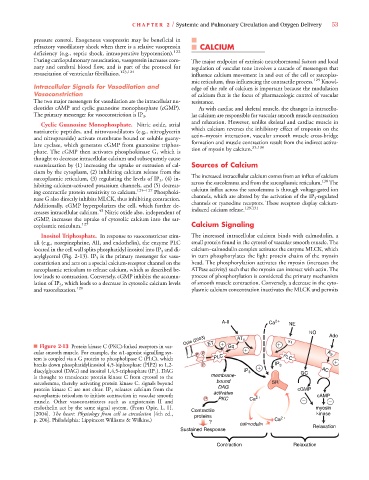
                     Inositol Triphosphate. In response to vasoconstrictor stim-  The increased intracellular calcium binds with calmodulin, a
                   uli (e.g., norepinephrine, AII, and endothelin), the enzyme PLC  small protein found in the cytosol of vascular smooth muscle. The
                   located in the cell wall splits phosphatidyl inositol into IP 3 and di-  calcium–calmodulin complex activates the enzyme MLCK, which
                   acylglycerol (Fig. 2-13). IP 3 is the primary messenger for vaso-  in turn phosphorylates the light protein chains of the myosin
                   constriction and acts on a special calcium-receptor channel on the  head. The phosphorylation activates the myosin (increases the
                   sarcoplasmic reticulum to release calcium, which as described be-  ATPase activity) such that the myosin can interact with actin. The
                   low leads to contraction. Conversely, cGMP inhibits the accumu-  process of phosphorylation is considered the primary mechanism
                   lation of IP 3 , which leads to a decrease in cytosolic calcium levels  of smooth muscle contraction. Conversely, a decrease in the cyto-
                   and vasorelaxation. 128                             plasmic calcium concentration inactivates the MLCK and permits
                                                                                 A-II           Ca 2
  NE
                                                                                                             NO     Ado
                                                                    Opie (2003)      AT 1               1
                   ■ Figure 2-13 Protein kinase C (PKC)-linked receptors in vas-  ET
  Gq
                   cular smooth muscle. For example, the  1-agonist signalling sys-  P P P P
                    A 2
                   tem is coupled via a G protein to phospholipase C (PLC), which  PLC              PLC
                   breaks down phosphatidylinositol 4,5-biphosphate (PIP2) to 1,2-  P P
     IP 3
                   diacylglycerol (DAG) and inositol 1,4,5-triphosphate (IP 3 ). DAG    IP 3              GC     AC
                   is thought to translocate protein kinase C from cytosol to the  membrane-
                                                                               bound
                   sarcolemma, thereby activating protein kinase C. signals beyond               SR
                   protein kinase C are not clear. IP 3 releases calcium from the   DAG                  cGMP
                                                                                  t t
                                                                              activates
                   sarcoplasmic reticulum to initiate contraction in vascular smooth  P P  PKC  Ca 2
           cAMP
                   muscle. Other vasoconstrictors such as angiotensin II and
                   endothelin act by the same signal system. (From Opie, L. H.  Contractile                    myosin
                   [2004]. The heart: Physiology from cell to circulation [4th ed.,   proteins                 kinase
                   p. 206]. Philadelphia: Lippincott Williams & Wilkins.)   ?                     Ca 2
                                                                                        l l
                                                                                      calmodulin i i
                                                                                                              Relaxation
                                                                   Sustained Response
                                                                               Contraction              Relaxation

