


Page 834 - Cardiac Nursing
P. 834
LWBK340-c35_p799-822.qxd  29/06/2009  08:59 PM  Page 810 Aptara


                  810    PA R T  V / Health Promotion and Disease Prevention

                  who were followed over a median of 4.1 years. With identical re-  and the need to consider using a medication with dual functions
                  ductions in BP ( 26/12 mm Hg), the group treated with the  but the question of whether it is the agent that is critical or the
                  ACE inhibitor had fewer cardiovascular events or deaths than the  lowering of SBP still remains. As noted by Frohlich, clinicians
                  group treated with diuretics with a hazard ratio of 0.89 (95% con-  must consider coexisting conditions of their patients, health care
                  fidence interval: 0.79 to 1.00). However, the primary endpoint for  resources, and the fact that most persons with HTN will need at
                  benefit was restricted to men, and the final publication states that  least two classes of medications to control BP . 160  Clinicians must
                  this observation needs to be interpreted with caution and requires  also consider that only 37% of all hypertensive patients are at goal
                  confirmation. 158  Although these studies were well designed, there  BP and greater titration, use of multiple agents, and attention to
                  were differences in designs, study populations, medications, and  national guidelines may all support better HTN control. 38
                  endpoints.
                     Following the release of these two major trials, another study  Treatment Based on JNC 7 Guidelines
                  in Europe, the Anglo-Scandanavian Cardiac Outcomes Trial—  The current recommended guidelines from the JNC 7 provides an
                  Blood Pressure Lowering Arm (ASCOT–BPLA), was pub-  algorithm for the management of pharmacotherapy in hyperten-
                                                                                  7
                  lished. 159  This trial was an open-label, controlled study of 19,257  sive individuals. As shown in Figure 35-1, on the basis of the
                  hypertensive patients who were 40 to 79 years of age, with  3  results of ALLHAT and other trials, the JNC 7 expert panel rec-
                  other cardiovascular risk factors. Patients received either amlodip-  ommends that unless there are other compelling reasons, thiazide
                  ine or atenolol, titrated to maximum dose followed by perindopril  diuretics should  be the initial therapy in most  persons with
                  with was added to amlodipine and  bendroflumethiazide and  HTN. 7,157  Compelling indications for the use of other classes of
                  potassium added to atenolol. If necessary, doxazosin was then  antihypertensive medications in those patients with coexisting
                  added in both groups. The study was terminated at 5.5 years and  medical conditions broaden the choice of agents used in the treat-
                  no significant difference was found in the primary endpoint of  ment of patients with Stage 1 or 2 HTN. Table 35-5 includes the
                  nonfatal myocardial infarction and fatal coronary heart disease be-  comorbid conditions that need to be considered when selecting
                  tween those patients receiving amlodipine and those receiving  medications for the person with HTN. In persons with Stage 2
                  atenolol (8.2 vs. 9.1 per 1,000 P   0.105). 159  Secondary end-  HTN ( 160 mm Hg SBP or  100 mm Hg DBP) two medica-
                  points were better for the amlodipine group including total coro-  tions are recommended for initial treatment with a thiazide di-
                  nary endpoints, total cardiovascular procedures, cardiovascular  uretic recommended as the choice of one of these agents. Other
                  mortality, stroke, peripheral arterial disease, and the development  factors that need to be considered when prescribing antihyperten-
                  of diabetes. However, it has also been noted that in the amlodipine  sive treatment include the cost, formulary, duration of action, fre-
                  group both SBP and DBP demonstrated significant reductions,  quency of adverse effects, patient preference, adherence, quality of
                  which may have been the contributing factor for better patient  life, and other medications the patient is using including over-the-
                  outcomes. What is notable from this study is that those patients  counter agents that may be used for other conditions.
                  treated in the amlodipine group had a reduction in cardiovascular  Seven classes of medications are available in the treatment of
                  events beginning as early as 1 month following treatment, again  HTN including (1) diuretics; (2) adrenergic inhibitors including
                  likely due to the greater decline in BP.             -blocking agents, central-acting inhibitors, central  -agonists,
                     Since the ALLHAT, ANBP2, and ASCOT studies were done,   -adrenergic blockers, and combined  -adrenergic and  -adren-
                  there have been many other trials looking at the value of the five  ergic blockers; (3) vasodilators; (4) calcium channel blockers; (5)
                  major classes of medications to treat HTN. Clearly, there may be  ACE inhibitors; (6) angiotensin II receptor blockers; and (7)
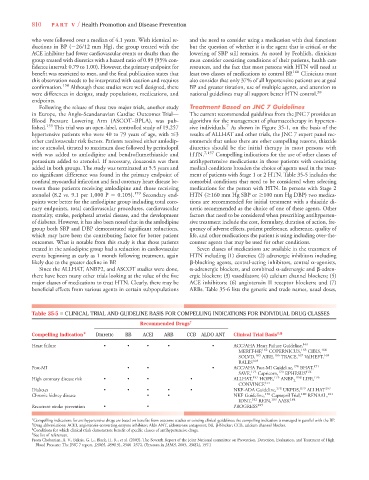
                  beneficial effects from various agents in certain subpopulations  ARBs. Table 35-6 lists the generic and trade names, usual doses,


                  Table 35-5 ■ CLINICAL TRIAL AND GUIDELINE BASIS FOR COMPELLING INDICATIONS FOR INDIVIDUAL DRUG CLASSES
                                                      Recommended Drugs †
                  Compelling Indication*  Diuretic  BB  ACEI  ARB    CCB  ALDO ANT  Clinical Trial Basis ‡,§
                  Heart failure           •       •     •      •             •      ACC/AHA Heart Failure Guideline, 161
                                                                                      MERIT-HF, 162  COPERNICUS, 163  CIBIS, 164
                                                                                      SOLVD, 165  AIRE, 166  TRACE, 167  ValHEFT, 168
                                                                                      RALES 169
                  Post-MI                         •     •                    •      ACC/AHA Post-MI Guideline, 170  BHAT, 171
                                                                                      SAVE, 172  Capricorn, 173  EPHESUS 174
                  High coronary disease risk  •   •     •             •             ALLHAT, 157  HOPE, 175  ANBP 2, 158  LIFE, 176
                                                                                      CONVINCE 177
                  Diabetes                •       •     •      •      •             NKF-ADA Guideline, 178  UKPDS, 179  ALLHAT 157
                  Chronic kidney disease                •      •                    NKF Guideline, 178  Captopril Trial, 180  RENAAL, 181
                                                                                      IDNT, 182  REIN, 183  AASK 184
                  Recurrent stroke prevention  •        •                           PROGRESS 185

                  *Compelling indications for antihypertensive drugs are based on benefits from outcome studies or existing clinical guidelines; the compelling indication is managed in parallel with the BP.
                  †
                   Drug abbreviations: ACEI, angiotensin-converting enzyme inhibitor; Aldo ANT, aldosterone antagonist; BB,  -blocker; CCB, calcium channel blocker.
                  ‡
                   Conditions for which clinical trials demonstrate benefit of specific classes of antihypertensive drugs.
                  §
                   See list of references.
                  From Chobanian, A. V., Bakris, G. L., Black, H. R., et al. (2003). The Seventh Report of the Joint National committee on Prevention, Detection, Evaluation, and Treatment of High
                    Blood Pressure: The JNC 7 report. JAMA, 289(19), 2560–2572. (Erratum in JAMA, 2003, 290[2], 197.)

