


Page 108 - untitled
P. 108
AAAC47  21/5/05  10:53 AM  Page 107
                                        Nerve to vastus medialis
                                                                                          Rectus femoris
                                                                                          Vastus lateralis
                           Saphenous nerve
                                                                                          Vastus medialis
                           Sartorius                                                      Iliotibial tract
                           Femoral vessels
                                                                                          Vastus intermedius
                           Great saphenous vein
                                                                                          Sciatic nerve
                           Adductor longus
                           Profunda vessels
                                                                                          Short
                           Gracilis                                                             heads of biceps
                                                                                          Long
                           Adductor brevis
                                                                                          Semimembranosus
                           Adductor magnus
                                                                                          Semitendinosus

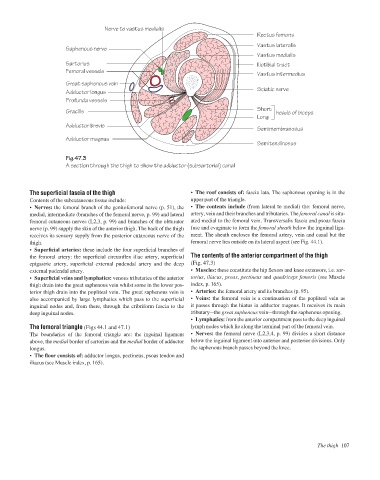
                           Fig.47.3
                           A section through the thigh to show the adductor (subsartorial) canal


               The superficial fascia of the thigh                   • The roof consists of: fascia lata. The saphenous opening is in the
               Contents of the subcutaneous tissue include:         upper part of the triangle.
               • Nerves: the femoral branch of the genitofemoral nerve (p. 51), the  • The contents include (from lateral to medial) the: femoral nerve,
               medial, intermediate (branches of the femoral nerve, p. 99) and lateral  artery, vein and their branches and tributaries. The femoral canal is situ-
               femoral cutaneous nerves (L2,3, p. 99) and branches of the obturator  ated medial to the femoral vein. Transversalis fascia and psoas fascia
               nerve (p. 99) supply the skin of the anterior thigh. The back of the thigh  fuse and evaginate to form the femoral sheath below the inguinal liga-
               receives its sensory supply from the posterior cutaneous nerve of the  ment. The sheath encloses the femoral artery, vein and canal but the
               thigh.                                               femoral nerve lies outside on its lateral aspect (see Fig. 44.1).
               • Superficial arteries: these include the four superficial branches of
               the femoral artery: the superficial circumflex iliac artery, superficial  The contents of the anterior compartment of the thigh
               epigastric artery, superficial external pudendal artery and the deep  (Fig. 47.3)
               external pudendal artery.                            • Muscles: these constitute the hip flexors and knee extensors, i.e. sar-
               • Superficial veins and lymphatics: venous tributaries of the anterior  torius, iliacus, psoas, pectineus and quadriceps femoris (see Muscle
               thigh drain into the great saphenous vein whilst some in the lower pos-  index, p. 165).
               terior thigh drain into the popliteal vein. The great saphenous vein is  • Arteries: the femoral artery and its branches (p. 95).
               also accompanied by large lymphatics which pass to the superficial  • Veins: the femoral vein is a continuation of the popliteal vein as
               inguinal nodes and, from there, through the cribriform fascia to the  it passes through the hiatus in adductor magnus. It receives its main
               deep inguinal nodes.                                 tributaryathe great saphenous veinathrough the saphenous opening.
                                                                    • Lymphatics: from the anterior compartment pass to the deep inguinal
               The femoral triangle (Figs 44.1 and 47.1)            lymph nodes which lie along the terminal part of the femoral vein.
               The boundaries of the femoral triangle are: the inguinal ligament  • Nerves: the femoral nerve (L2,3,4, p. 99) divides a short distance
               above, the medial border of sartorius and the medial border of adductor  below the inguinal ligament into anterior and posterior divisions. Only
               longus.                                              the saphenous branch passes beyond the knee.
               • The floor consists of: adductor longus, pectineus, psoas tendon and
               iliacus (see Muscle index, p. 165).


                                                                                                             The thigh 107

