


Page 111 - untitled
P. 111
AAAC48  21/5/05  10:52 AM  Page 110
                                                                Medial condyle
                                                                Posterior cruciate ligament
                   Lateral condyle                              Anterior cruciate ligament
                                                                Medial meniscus
                   Fibular collateral ligament                  Coronary ligament
                                                                Fat

                   Ligamentum patellae
                                                                Tibial collateral ligament


                                                                Patella (turned back)

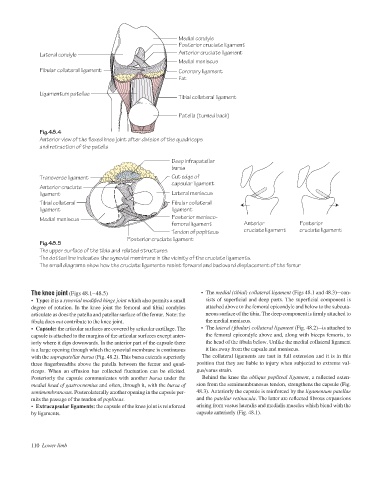
                   Fig.48.4
                   Anterior view of the flexed knee joint after division of the quadriceps
                   and retraction of the patella

                                                              Deep infrapatellar
                                                              bursa
                   Transverse ligament                        Cut edge of
                                                              capsular ligament
                   Anterior cruciate
                   ligament                                   Lateral meniscus
                   Tibial collateral                          Fibular collateral
                   ligament                                   ligament
                   Medial meniscus                            Posterior menisco-
                                                              femoral ligament       Anterior           Posterior
                                                              Tendon of popliteus    cruciate ligament  cruciate ligament
                                               Posterior cruciate ligament
                   Fig.48.5
                   The upper surface of the tibia and related structures.
                   The dotted line indicates the synovial membrane in the vicinity of the cruciate ligaments.
                   The small diagrams show how the cruciate ligaments resist forward and backward displacement of the femur


                The knee joint (Figs 48.1–48.5)                        • The medial (tibial) collateral ligament (Figs 48.1 and 48.3)acon-
                • Type: it is a synovial modified hinge joint which also permits a small  sists of superficial and deep parts. The superficial component is
                degree of rotation. In the knee joint the femoral and tibial condyles  attached above to the femoral epicondyle and below to the subcuta-
                articulate as does the patella and patellar surface of the femur. Note: the  neous surface of the tibia. The deep component is firmly attached to
                fibula does not contribute to the knee joint.             the medial meniscus.
                • Capsule: the articular surfaces are covered by articular cartilage. The  • The lateral (fibular) collateral ligament (Fig. 48.2)ais attached to
                capsule is attached to the margins of the articular surfaces except anter-  the femoral epicondyle above and, along with biceps femoris, to
                iorly where it dips downwards. In the anterior part of the capsule there  the head of the fibula below. Unlike the medial collateral ligament
                is a large opening through which the synovial membrane is continuous  it lies away from the capsule and meniscus.
                with the suprapatellar bursa (Fig. 48.2). This bursa extends superiorly  The collateral ligaments are taut in full extension and it is in this
                three fingerbreadths above the patella between the femur and quad-  position that they are liable to injury when subjected to extreme val-
                riceps. When an effusion has collected fluctuation can be elicited.  gus/varus strain.
                Posteriorly the capsule communicates with another bursa under the  Behind the knee the oblique popliteal ligament, a reflected exten-
                medial head of gastrocnemius and often, through it, with the bursa of  sion from the semimembranosus tendon, strengthens the capsule (Fig.
                semimembranosus. Posterolaterally another opening in the capsule per-  48.3). Anteriorly the capsule is reinforced by the ligamentum patellae
                mits the passage of the tendon of popliteus.          and the patellar retinacula. The latter are reflected fibrous expansions
                • Extracapsular ligaments: the capsule of the knee joint is reinforced  arising from vastus lateralis and medialis muscles which blend with the
                by ligaments.                                         capsule anteriorly (Fig. 48.1).


                110 Lower limb

