


Page 205 - ACCCN's Critical Care Nursing
P. 205
182  P R I N C I P L E S   A N D   P R A C T I C E   O F   C R I T I C A L   C A R E


                                                                                        Red cell in
                               A band                                                   capillary

                                                                                        Capillary
                                I band                                                  endothelium
                          Invagination of                                               Connective
                         sarcolemma by                                                  tissue
                        transverse tubule
                       Transverse tubule                                                Intercalated
                                                                                        disk
                           Mitochondria
                              M line in                                                 Gap junction
                               H zone
                                                                                        Sarcolemma
                                Z line


                              Sarcomere                                                 Sarcoplasmic
                                                                                        reticulum


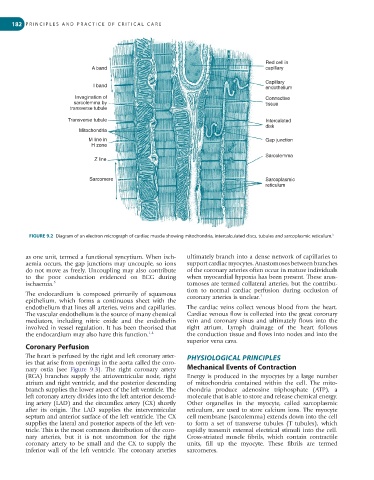
           FIGURE 9.2  Diagram of an electron micrograph of cardiac muscle showing mitochondria, intercalculated discs, tubules and sarcoplasmic reticulum.   5


         as one unit, termed a functional syncytium. When isch-  ultimately branch into a dense network of capillaries to
         aemia occurs, the gap junctions may uncouple, so ions   support cardiac myocytes. Anastomoses between branches
         do not move as freely. Uncoupling may also contribute   of the coronary arteries often occur in mature individuals
         to  the  poor  conduction  evidenced  on  ECG  during   when myocardial hypoxia has been present. These anas-
         ischaemia. 5                                         tomoses are termed collateral arteries, but the contribu-
                                                              tion  to  normal  cardiac  perfusion  during  occlusion  of
         The  endocardium  is  composed  primarily  of  squamous   coronary arteries is unclear. 1
         epithelium,  which  forms  a  continuous  sheet  with  the
         endothelium that lines all arteries, veins and capillaries.   The  cardiac  veins  collect  venous  blood  from  the  heart.
         The vascular endothelium is the source of many chemical   Cardiac venous flow is collected into the great coronary
         mediators,  including  nitric  oxide  and  the  endothelin   vein  and  coronary  sinus  and  ultimately  flows  into  the
         involved in vessel regulation. It has been theorised that   right  atrium.  Lymph  drainage  of  the  heart  follows
         the endocardium may also have this function. 1,4     the conduction tissue and flows into nodes and into the
                                                              superior vena cava.
         Coronary Perfusion
         The heart is perfused by the right and left coronary arter-  PHYSIOLOGICAL PRINCIPLES
         ies that arise from openings in the aorta called the coro-
         nary  ostia  (see  Figure  9.3).  The  right  coronary  artery   Mechanical Events of Contraction
         (RCA)  branches  supply  the  atrioventricular  node,  right   Energy is produced in the myocytes by a large number
         atrium and right ventricle, and the posterior descending   of  mitochondria  contained  within  the  cell.  The  mito-
         branch supplies the lower aspect of the left ventricle. The   chondria  produce  adenosine  triphosphate  (ATP),  a
         left coronary artery divides into the left anterior descend-  molecule that is able to store and release chemical energy.
         ing artery (LAD) and the circumflex artery (CX) shortly   Other  organelles  in  the  myocyte,  called  sarcoplasmic
         after  its  origin.  The  LAD  supplies  the  interventricular   reticulum, are used to store calcium ions. The myocyte
         septum and anterior surface of the left ventricle. The CX   cell membrane (sarcolemma) extends down into the cell
         supplies the lateral and posterior aspects of the left ven-  to  form  a  set  of  transverse  tubules  (T  tubules),  which
         tricle. This is the most common distribution of the coro-  rapidly transmit external electrical stimuli into the cell.
         nary  arteries,  but  it  is  not  uncommon  for  the  right   Cross-striated  muscle  fibrils,  which  contain  contractile
         coronary  artery  to  be  small  and  the  CX  to  supply  the   units,  fill  up  the  myocyte.  These  fibrils  are  termed
         inferior  wall  of  the  left  ventricle.  The  coronary  arteries   sarcomeres.

