


Page 209 - ACCCN's Critical Care Nursing
P. 209
186  P R I N C I P L E S   A N D   P R A C T I C E   O F   C R I T I C A L   C A R E


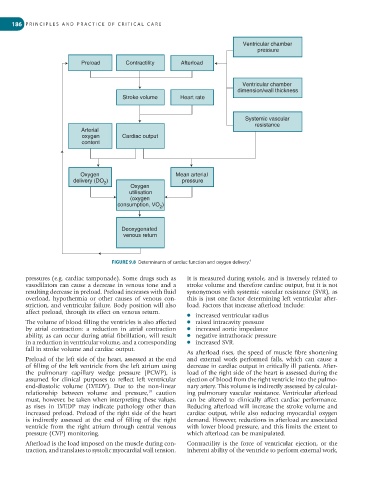
                                                                                Ventricular chamber
                                                                                     pressure
                            Preload       Contractility     Afterload


                                                                                Ventricular chamber
                                                                               dimension/wall thickness
                                         Stroke volume      Heart rate


                                                                                 Systemic vascular
                                                                                    resistance
                            Arterial
                            oxygen       Cardiac output
                            content


                           Oxygen                         Mean arterial
                         delivery (DO )                     pressure
                                   2
                                            Oxygen
                                           utilisation
                                            (oxygen
                                       consumption, VO )
                                                     2


                                         Deoxygenated
                                         venous return


                                      FIGURE 9.8  Determinants of cardiac function and oxygen delivery.   9

         pressures (e.g. cardiac tamponade). Some drugs such as   It is measured during systole, and is inversely related to
         vasodilators can cause a decrease in venous tone and a   stroke volume and therefore cardiac output, but it is not
         resulting decrease in preload. Preload increases with fluid   synonymous with systemic vascular resistance (SVR), as
         overload,  hypothermia  or  other  causes  of  venous  con-  this is just one factor determining left ventricular after-
         striction, and ventricular failure. Body position will also   load. Factors that increase afterload include:
         affect preload, through its effect on venous return.
                                                              ●  increased ventricular radius
         The volume of blood filling the ventricles is also affected   ●  raised intracavity pressure
         by  atrial  contraction:  a  reduction  in  atrial  contraction   ●  increased aortic impedance
         ability, as can occur during atrial fibrillation, will result   ●  negative intrathoracic pressure
         in a reduction in ventricular volume, and a corresponding   ●  increased SVR.
         fall in stroke volume and cardiac output.
                                                              As afterload rises, the speed of muscle fibre shortening
         Preload of the left side of the heart, assessed at the end   and  external  work  performed  falls,  which  can  cause  a
         of filling of the left ventricle from the left atrium using   decrease in cardiac output in critically ill patients. After-
         the  pulmonary  capillary  wedge  pressure  (PCWP),  is   load of the right side of the heart is assessed during the
         assumed  for  clinical  purposes  to  reflect  left  ventricular   ejection of blood from the right ventricle into the pulmo-
         end-diastolic  volume  (LVEDV).  Due  to  the  non-linear   nary artery. This volume is indirectly assessed by calculat-
         relationship  between  volume  and  pressure,   caution   ing pulmonary vascular resistance. Ventricular afterload
                                                  10
         must, however, be taken when interpreting these values,   can  be  altered  to  clinically  affect  cardiac  performance.
         as  rises  in  LVEDP  may  indicate  pathology  other  than   Reducing afterload will increase the stroke volume and
         increased preload. Preload of the right side of the heart   cardiac  output,  while  also  reducing  myocardial  oxygen
         is  indirectly  assessed  at  the  end  of  filling  of  the  right   demand. However, reductions in afterload are associated
         ventricle  from  the  right  atrium  through  central  venous   with lower blood pressure, and this limits the extent to
         pressure (CVP) monitoring.                           which afterload can be manipulated.
         Afterload is the load imposed on the muscle during con-  Contractility  is  the  force  of  ventricular  ejection,  or  the
         traction, and translates to systolic myocardial wall tension.   inherent ability of the ventricle to perform external work,

