


Page 206 - ACCCN's Critical Care Nursing
P. 206
Cardiovascular Assessment and Monitoring  183

                                    Left main coronary artery               Pulmonary veins
                       Superior
                     vena cava
                                                                                                        Superior
                                                                                                        vena cava
                                                           Left circumflex
                  Right                                                                                 Inferior vena
               coronary                                                                                 cava
                 artery
                                                                                                        Right
                                                                                                        coronary
                                                                                                        artery (RCA)


                         Left anterior                                                         Posterior
                     descending (LAD)                                                          descending artery (PDA)
                                           ANTERIOR                             POSTERIOR
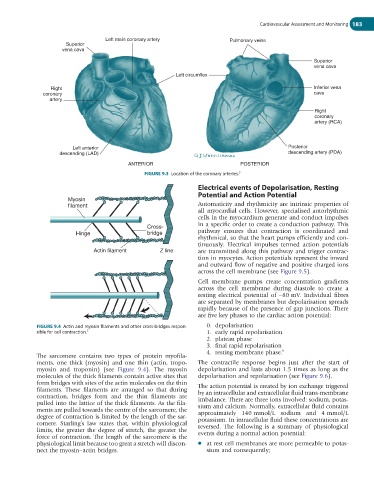
                                                FIGURE 9.3  Location of the coronary arteries.   5
                                                                  Electrical events of Depolarisation, Resting
                                                                  Potential and Action Potential
                       Myosin
                       filament                                   Automaticity and rhythmicity are intrinsic properties of
                                                                  all  myocardial  cells.  However,  specialised  autorhythmic
                                                                  cells in the myocardium generate and conduct impulses
                                                                  in a specific order to create a conduction pathway. This
                                                 Cross-
                          Hinge                  bridge           pathway  ensures  that  contraction  is  coordinated  and
                                                                  rhythmical, so that the heart pumps efficiently and con-
                                                                  tinuously.  Electrical  impulses  termed  action  potentials
                                Actin filament       Z line       are transmitted along this pathway and trigger contrac-
                                                                  tion in myocytes. Action potentials represent the inward
                                                                  and outward flow of negative and positive charged ions
                                                                  across the cell membrane (see Figure 9.5).
                                                                  Cell  membrane  pumps  create  concentration  gradients
                                                                  across  the  cell  membrane  during  diastole  to  create  a
                                                                  resting  electrical  potential  of  −80 mV.  Individual  fibres
                                                                  are separated by membranes but depolarisation spreads
                                                                  rapidly because of the presence of gap junctions. There
                                                                  are five key phases to the cardiac action potential:
             FIGURE 9.4  Actin and myosin filaments and other cross-bridges respon-  0.  depolarisation
             sible for cell contraction.   5                         1.  early rapid repolarisation
                                                                     2.  plateau phase
                                                                     3.  final rapid repolarisation
                                                                     4.  resting membrane phase. 8
             The  sarcomere  contains  two  types  of  protein  myofila-
             ments,  one  thick  (myosin)  and  one  thin  (actin,  tropo-  The  contractile  response  begins  just  after  the  start  of
             myosin  and  troponin)  (see  Figure  9.4).  The  myosin   depolarisation and lasts about 1.5 times as long as the
             molecules of the thick filaments contain active sites that   depolarisation and repolarisation (see Figure 9.6).
             form bridges with sites of the actin molecules on the thin   The action potential is created by ion exchange triggered
             filaments.  These  filaments  are  arranged  so  that  during   by an intracellular and extracellular fluid trans-membrane
             contraction,  bridges  form  and  the  thin  filaments  are   imbalance. There are three ions involved: sodium, potas-
             pulled into the lattice of the thick filaments. As the fila-  sium and calcium. Normally, extracellular fluid contains
             ments are pulled towards the centre of the sarcomere, the   approximately  140 mmol/L  sodium  and  4 mmol/L
             degree of contraction is limited by the length of the sar-  potassium. In intracellular fluid these concentrations are
             comere.  Starling’s  law  states  that,  within  physiological   reversed.  The  following  is  a  summary  of  physiological
             limits,  the  greater  the  degree  of  stretch,  the  greater  the   events during a normal action potential:
             force of contraction. The length of the sarcomere is the
             physiological limit because too great a stretch will discon-  ●  at rest cell membranes are more permeable to potas-
             nect the myosin–actin bridges.                          sium and consequently;

