


Page 207 - ACCCN's Critical Care Nursing
P. 207
184  P R I N C I P L E S   A N D   P R A C T I C E   O F   C R I T I C A L   C A R E

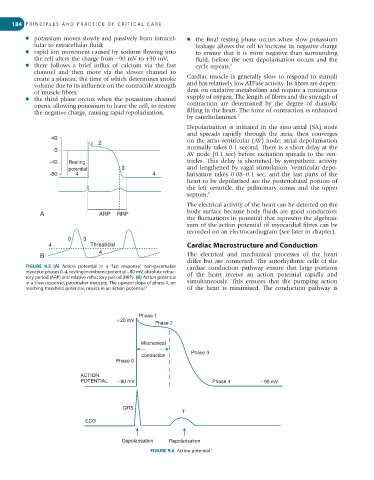
         ●  potassium moves slowly and passively from intracel-  ●  the  final  resting  phase  occurs  when  slow  potassium
            lular to extracellular fluid;                        leakage allows the cell to increase its negative charge
         ●  rapid ion movement caused by sodium flowing into     to  ensure  that  it  is  more  negative  than  surrounding
            the cell alters the charge from −90 mV to +30 mV;    fluid,  before  the  next  depolarisation  occurs  and  the
         ●  there  follows  a  brief  influx  of  calcium  via  the  fast   cycle repeats. 6
            channel  and  then  more  via  the  slower  channel  to
            create a plateau, the time of which determines stroke   Cardiac  muscle  is  generally  slow  to  respond  to  stimuli
            volume due to its influence on the contractile strength   and has relatively low ATPase activity. Its fibres are depen-
            of muscle fibres;                                 dent on oxidative metabolism and require a continuous
         ●  the third phase occurs when the potassium channel   supply of oxygen. The length of fibres and the strength of
            opens, allowing potassium to leave the cell, to restore   contraction  are  determined  by  the  degree  of  diastolic
            the negative charge, causing rapid repolarisation.  filling in the heart. The force of contraction is enhanced
                                                              by catecholamines. 2
                                                              Depolarisation  is  initiated  in  the  sino-atrial  (SA)  node
                                                              and  spreads  rapidly  through  the  atria,  then  converges
                  40                                          on the atrio-ventricular (AV) node; atrial depolarisation
                                 2
                   0                                          normally takes 0.1 second. There is a short delay at the
                                                              AV node (0.1 sec) before excitation spreads to the ven-
                 -40   Resting                                tricles.  This  delay  is  shortened  by  sympathetic  activity
                       potential         3                    and lengthened by vagal stimulation. Ventricular depo-
                 -80      4                        4          larisation  takes  0.08–0.1 sec,  and  the  last  parts  of  the
                                                              heart to be depolarised are the posteriobasal portion of
                                                              the  left  ventricle,  the  pulmonary  conus  and  the  upper
                                                              septum. 8
                                                              The electrical activity of the heart can be detected on the
              A                  ARP   RRP                    body  surface  because  body  fluids  are  good  conductors;
                                                              the fluctuations in potential that represent the algebraic
                                                              sum of the action potential of myocardial fibres can be
                                                              recorded on an electrocardiogram (see later in chapter).
                       0    3
                 4             Threshold                      Cardiac Macrostructure and Conduction
                                 4
              B                                               The  electrical  and  mechanical  processes  of  the  heart
                                                              differ but are connected. The autorhythmic cells of the
         FIGURE  9.5  (A)  Action  potential  in  a  ‘fast  response’,  non-pacemaker   cardiac  conduction  pathway  ensure  that  large  portions
         myocyte: phases 0–4, resting membrane potential −80 mV, absolute refrac-  of  the  heart  receive  an  action  potential  rapidly  and
         tory period (ARP) and relative refractory period (RRP). (B) Action potential
         in a ‘slow response’, pacemaker myocyte. The upward slope of phase 4, on   simultaneously.  This  ensures  that  the  pumping  action
         reaching threshold potential, results in an action potential.    of  the  heart  is  maximised.  The  conduction  pathway  is
                                                 7


                                              Phase 1
                                        20 mV
                                                    Phase 2

                                               Mechanical
                                                                Phase 3
                                               contraction
                                       Phase 0

                           ACTION
                           POTENTIAL    90 mV                         Phase 4          90 mV


                                         QRS
                                                             T
                             ECG


                                         Depolarisation  Repolarisation
                                                  FIGURE 9.6  Action potential.   5

