


Page 208 - ACCCN's Critical Care Nursing
P. 208
Cardiovascular Assessment and Monitoring  185


                                  Sinus node

                                                                               LBB
                                                                               (anterior fascicle)

                                 AV node                                           LBB
                                                                                   (posterior fascicle)
                                Bundle of His

                                          RBB


                                           LBB
                                    (septal fibres)


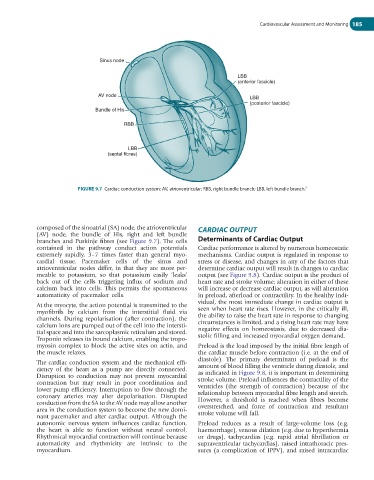
                           FIGURE 9.7  Cardiac conduction system: AV, atrioventricular; RBB, right bundle branch; LBB, left bundle branch.   5


             composed of the sinoatrial (SA) node, the atrioventricular   CARDIAC OUTPUT
             (AV)  node,  the  bundle  of  His,  right  and  left  bundle
             branches and Purkinje fibres (see Figure 9.7). The cells   Determinants of Cardiac Output
             contained  in  the  pathway  conduct  action  potentials   Cardiac performance is altered by numerous homeostatic
             extremely  rapidly,  3–7  times  faster  than  general  myo-  mechanisms. Cardiac output is regulated in response to
             cardial  tissue.  Pacemaker  cells  of  the  sinus  and     stress or disease, and changes in any of the factors that
             atrioventricular nodes differ, in that they are more per-  determine cardiac output will result in changes to cardiac
             meable  to  potassium,  so  that  potassium  easily  ‘leaks’   output (see Figure 9.8). Cardiac output is the product of
             back  out  of  the  cells  triggering  influx  of  sodium  and   heart rate and stroke volume; alteration in either of these
             calcium  back  into  cells.  This  permits  the  spontaneous   will increase or decrease cardiac output, as will alteration
             automaticity  of  pacemaker  cells.                  in preload, afterload or contractility. In the healthy indi-
                                                                  vidual, the most immediate change in cardiac output is
             At the myocyte, the action potential is transmitted to the
             myofibrils  by  calcium  from  the  interstitial  fluid  via    seen when heart rate rises. However, in the critically ill,
             channels.  During  repolarisation  (after  contraction),  the   the ability to raise the heart rate in response to changing
             calcium ions are pumped out of the cell into the intersti-  circumstances is limited, and a rising heart rate may have
             tial space and into the sarcoplasmic reticulum and stored.   negative  effects  on  homeostasis,  due  to  decreased  dia-
             Troponin releases its bound calcium, enabling the tropo-  stolic filling and increased myocardial oxygen demand.
             myosin complex to block the active sites on actin, and   Preload is the load imposed by the initial fibre length of
             the muscle relaxes.                                  the cardiac muscle before contraction (i.e. at the end of
                                                                  diastole).  The  primary  determinant  of  preload  is  the
             The cardiac conduction system and the mechanical effi-  amount of blood filling the ventricle during diastole, and
             ciency  of  the  heart  as  a  pump  are  directly  connected.   as indicated in Figure 9.8, it is important in determining
             Disruption  to  conduction  may  not  prevent  myocardial   stroke volume. Preload influences the contractility of the
             contraction  but  may  result  in  poor  coordination  and   ventricles  (the  strength  of  contraction)  because  of  the
             lower pump efficiency. Interruption to flow through the   relationship between myocardial fibre length and stretch.
             coronary  arteries  may  alter  depolarisation.  Disrupted   However,  a  threshold  is  reached  when  fibres  become
             conduction from the SA to the AV node may allow another   overstretched,  and  force  of  contraction  and  resultant
             area in the conduction system to become the new domi-  stroke volume will fall.
             nant pacemaker and alter cardiac output. Although the
             autonomic  nervous  system  influences  cardiac  function,   Preload  reduces  as  a  result  of  large-volume  loss  (e.g.
             the  heart  is  able  to  function  without  neural  control.   haemorrhage), venous dilation (e.g. due to hyperthermia
             Rhythmical myocardial contraction will continue because   or  drugs),  tachycardias  (e.g.  rapid  atrial  fibrillation  or
             automaticity  and  rhythmicity  are  intrinsic  to  the   supraventricular tachycardias), raised intrathoracic pres-
             myocardium.                                          sures  (a  complication  of  IPPV),  and  raised  intracardiac

