


Page 240 - ACCCN's Critical Care Nursing
P. 240
Cardiovascular Alterations and Management 217

             wall is affected, with a small infarction often resulting in
             a  dyskinetic  wall  (altered  movement),  whereas  a  large   TABLE 10.1  The PQRST criteria for assessing
             infarction may result in akinesis (no movement).       chest pain 110
             The location and impact of the infarction will depend on
             which coronary artery has been obstructed:             P   Precipitating  Exercise and activity
                                                                                     Stress and anxiety
             ●  Left anterior descending (LAD) affects the function of               Cold weather
                the left ventricle and interventricular septum, includ-  Palliating  Stop activity
                ing ventricular conduction tissue. Patients with antero-             Rest
                septal MI are at high risk of heart failure, cardiogenic             Nitroglycerin
                shock and mortality due to pump deficits.           Q  Quality       Heavy, tight, choking, vice-like,
             ●  Circumflex  (CX)  affects  the  left  ventricle  lateral  and          constricting
                                                              5
                posterior walls and the SA node in 50% of people.    R  Region, Radiation  Left side of chest, shoulder, arm and jaw
                The impact on pump efficiency of lateral and posterior               Retrosternal and radiating to the neck
                wall necrosis is not as severe as anteroseptal infarcts,   S  Severity  Rate pain on scale of 1 (no pain) to 10
                although patients are at more risk of arrhythmias.                     (worst pain possible)
             ●  Right coronary artery (RCA) affects the inferior wall of
                the left ventricle and the right ventricle, as well as the   T  Time  Pain lasts longer than 10 minutes
                                                                                       despite nitroglycerin
                AV node in most patients and the SA node in 50% of                   Pain comes and goes but lasts longer
                people. There is potentially severe impact on ventricu-                than 20 minutes
                lar  function  if  both  the  inferior  wall  and  the  right   Hudak CM, Gallo BM, Morton PG. Critical care nursing, A holistic approach.
                ventricle are affected, as well as a high risk of arrhyth-  (7  Ed) Philadelphia: Lippincott 1998.
                                                                     th
                mias due to SA and AV node involvement.
             Clinical Features
             Patients  with  AMI  most  often  present  with  chest  pain.   delayed diagnosis and treatment and a higher mortality
                                                                                                       7
             This  pain  is  described  as  central  crushing  retrosternal   (50%) than with typical symptoms (18%).  Differentiat-
             pain,  which  lasts  longer  than  20  minutes  and  is  not   ing this pain from any previous pain is also useful. The
             relieved by nitrate therapy. The pain may radiate to the   brief  history  should  include  a  short  cardiovascular  risk
             neck, jaw, back and shoulders and is often accompanied   profile: (a) previous cardiac history such as angina, MI,
             by  ‘feelings  of  impending  doom’,  sweating  and  pallor.   revascularisation; and (b) family history, smoking, hyper-
             Nausea  is  often  associated  with  the  pain,  due  to  vagal   tension, diabetes.
             nerve stimulation. Depending on the size and location of
             the AMI, patients may also present as sudden death and   Practice tip
             with varying degrees of syncope and heart failure. Women
             may present with different symptoms.                   Because of changes in neuroreceptors, older patients and dia-
                                                                    betic  patients  may  not  describe  the  typical  anginal  pain.
             Patient Assessment and Diagnostic Features             Women  also  may  not  describe  classic  angina  symptoms  and
                                                                                                4
             A key feature of assessment of the patient with chest pain   may use different descriptors from men.  Be alert for prodromal
             is the use of protocols and guidelines to promote rapid   symptoms,  such  as  increased  shortness  of  breath,  weakness
             assessment so that revascularisation procedures such as   and fainting.
             thrombolysis  and  percutaneous  coronary  intervention
             (PCI)  can  be  implemented  as  soon  as  possible.  This
             means that assessment may begin as early as in the ambu-
             lance, with ECG transmission to hospital ED where rapid,   A more complete history, which includes detailed infor-
                                                  9
             early  triage  models  of  care  are  in  place.   Additionally   mation  about  risk  factors,  can  be  acquired  when  the
             assessment also needs to determine whether there are any   patient is stabilised. This information will be essential to
             contraindications for thrombolysis.                  guide patient education, rehabilitation and to plan dis-
             The assessment method used depends on the condition   charge. Recurrent chest discomfort requires urgent reas-
             of  the  patient  but  should  occur  within  10  minutes  of   sessment, including immediate ECG.
                   7
             arrival.   This  initial  history  will  focus  on  the  nature  of
             symptoms such as pain. Pain assessment is complex, and   Physical examination
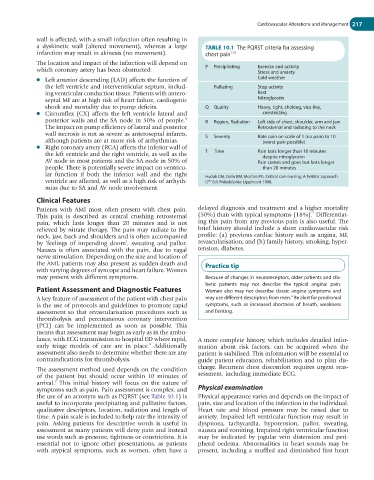
             the use of an acronym such as PQRST (see Table 10.1) is   Physical appearance varies and depends on the impact of
             useful to incorporate precipitating and palliative factors,   pain, size and location of the infarction in the individual.
             qualitative descriptors, location, radiation and length of   Heart  rate  and  blood  pressure  may  be  raised  due  to
             time. A pain scale is included to help rate the intensity of   anxiety. Impaired left ventricular function may result in
             pain.  Asking  patients  for  descriptive  words  is  useful  in   dyspnoea,  tachycardia,  hypotension,  pallor,  sweating,
             assessment as many patients will deny pain and instead   nausea and vomiting. Impaired right ventricular function
             use words such as pressure, tightness or constriction. It is   may  be  indicated  by  jugular  vein  distension  and  peri-
             essential  not  to  ignore  other  presentations,  as  patients   pheral  oedema.  Abnormalities  in  heart  sounds  may  be
             with  atypical  symptoms,  such  as  women,  often  have  a   present, including a muffled and diminished first heart

